


Page 1658 - Williams Hematology ( PDFDrive )
P. 1658
1632  Part XI:  Malignant Lymphoid Diseases  Chapter 98:  Diffuse Large B-Cell Lymphoma and Related Diseases         1633


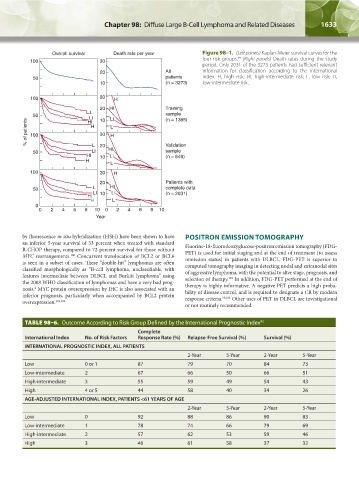
                            Overall survival    Death rate per year           Figure 98–1.  (Left panels) Kaplan-Meier survival curves for the
                                                                                          94
                    100                     30                                four risk groups.  (Right panels) Death rates during the study
                                                                              period. Only 2031 of the 3273 patients had sufficient relevant
                                            20                    All         information for classification according to the international
                     50                                           patients    index. H, high risk; HI, high-intermediate risk; L, low risk; LI,
                                            10                    (n = 3273)  low-intermediate risk.

                    100                     30   H
                                            20 HI                 Training
                                        L
                     50                 HI  10  LI                sample
                                        LI
                                                                  (n = 1385)
                   % of patients  100    H  30  L H

                                         L
                                                                  sample
                     50                  LI  20  HI               Validation
                                       HI   10  LI                (n = 646)
                                       H
                                               L
                    100                     30   H
                                            20                    Patients with
                     50                  L     HI                 complete data
                                                LI
                                         LI
                                        HI  10                    (n = 2031)
                                         H      L
                      0
                       0 0  2  4   6   8  10  0  2   4   6   8  10
                                          Year

                  by fluorescence in situ hybridization (FISH) have been shown to have   POSITRON EMISSION TOMOGRAPHY
                  an inferior 5-year survival of 33 percent when treated with standard
                  R-CHOP therapy, compared to 72 percent survival for those without   Fluorine-18-fluorodeoxyglucose-positron emission tomography (FDG-
                  MYC  rearrangements.   Concurrent  translocation  of  BCL2  or  BCL6   PET) is used for initial staging and at the end of treatment (to assess
                                  100
                  is seen in a subset of cases. These “double-hit” lymphomas are often   remission status) in patients with DLBCL. FDG-PET is superior to
                  classified morphologically as “B-cell lymphoma, unclassifiable, with   computed tomography imaging in detecting nodal and extranodal sites
                  features intermediate between DLBCL and Burkitt lymphoma” using   of aggressive lymphoma, with the potential to alter stage, prognosis, and
                                                                                       103
                  the 2008 WHO classification of lymphomas and have a very bad prog-  selection of therapy.  In addition, FDG-PET performed at the end of
                  nosis.  MYC protein overexpression by IHC is also associated with an   therapy is highly informative. A negative PET predicts a high proba-
                      2
                  inferior prognosis, particularly when accompanied by BCL2 protein   bility of disease control, and is required to designate a CR by modern
                                                                                     33,104
                  overexpression. 101,102                               response criteria.   Other uses of PET in DLBCL are investigational
                                                                        or not routinely recommended.
                   TABLE 98–6.  Outcome According to Risk Group Defined by the International Prognostic Index 93
                                                         Complete
                   International Index  No. of Risk Factors  Response Rate (%)  Relapse-Free Survival (%)  Survival (%)
                   INTERNATIONAL PROGNOSTIC INDEX, ALL PATIENTS
                                                                         2-Year       5-Year       2-Year       5-Year
                   Low                 0 or 1            87              79           70           84           73
                   Low-intermediate    2                 67              66           50           66           51
                   High-intermediate   3                 55              59           49           54           43
                   High                4 or 5            44              58           40           34           26
                   AGE-ADJUSTED INTERNATIONAL INDEX, PATIENTS <61 YEARS OF AGE
                                                                         2-Year       5-Year       2-Year       5-Year
                   Low                 0                 92              88           86           90           83
                   Low-intermediate    1                78               74           66           79           69
                   High-intermediate   2                57               62           53           59           46
                   High                3                46               61           58           37           32


          Kaushansky_chapter 98_p1625-1640.indd   1633                                                                  9/18/15   11:42 PM

