


Page 1673 - Williams Hematology ( PDFDrive )
P. 1673
1648           Part XI:  Malignant Lymphoid Diseases                                                                                                                                  Chapter 99:  Follicular Lymphoma           1649


               with relatively intensive initial chemotherapy (p = 0.00005), (2) at a dose   121 adult patients conducted by St. Bartholomew’s Hospital and the
               of 5 million units or greater (p = 0.000002), (3) at a cumulative dose   Dana-Farber Cancer Institute, where an apparent plateau in the remis-
               of 36 million units or greater per month (p = 0.000008), and (4) when   sion duration curve was observed in 48 percent of patients with a median
               given with induction chemotherapy rather than as maintenance therapy   followup of 13.5 years.  Survival was longer in patients transplanted
                                                                                       70
                        66
               (p = 0.004).  With regard to remission duration, there was also a sig-  in second remission compared to those transplanted later in their dis-
               nificant difference in favor of IFN-α , irrespective of the intensity of che-  ease course. The value of autologous stem cell transplantation was also
                                         2
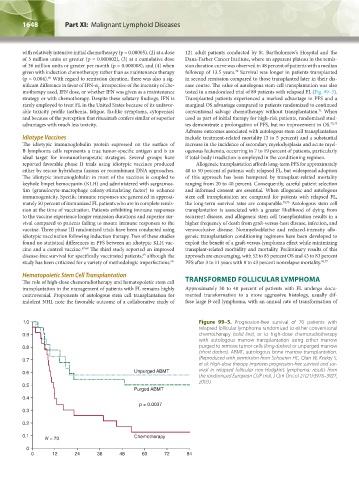
               motherapy used, IFN dose, or whether IFN was given as a maintenance   tested in a randomized trial of 89 patients with relapsed FL (Fig. 99–5).
               strategy or with chemotherapy. Despite these salutary findings, IFN is   Transplanted patients experienced a marked advantage in PFS and a
               rarely employed to treat FL in the United States because of its unfavor-  marginal OS advantage compared to patients randomized to continued
                                                                                                                   71
               able toxicity profile (asthenia, fatigue, flu-like symptoms, cytopenias)   conventional salvage chemotherapy without transplantation.  When
               and because of the perception that rituximab confers similar or superior   used as part of initial therapy for high-risk patients, randomized stud-
               advantages with much less toxicity.                    ies demonstrate a prolongation of PFS, but no improvement in OS. 72,73
                                                                      Adverse outcomes associated with autologous stem cell transplantation
               Idiotype Vaccines                                      include treatment-related mortality (3 to 5 percent) and a substantial
               The idiotypic immunoglobulin protein expressed on the surface of     increase in the incidence of secondary myelodysplasia and acute myel-
               B lymphoma cells represents a true tumor-specific antigen and is an   ogenous leukemia, occurring in 7 to 19 percent of patients, particularly
               ideal target for immunotherapeutic strategies. Several groups have   if total-body irradiation is employed in the conditioning regimen.
               reported favorable phase II trials using idiotypic vaccines produced   Allogeneic transplantation affords long-term PFS for approximately
               either by rescue hybridoma fusions or recombinant DNA approaches.   40 to 50 percent of patients with relapsed FL, but widespread adoption
               The idiotypic immunoglobulin in most of the vaccines is coupled to   of this approach has been hampered by transplant-related mortality
               keyhole limpet hemocyanin (KLH) and administered with sargramos-  ranging from 20 to 40 percent. Consequently, careful patient selection
               tim (granulocyte-macrophage colony-stimulating factor) to enhance   and informed consent are essential. When allogeneic and autologous
               immunogenicity. Specific immune responses are generated in approxi-  stem cell transplantation are compared for patients with relapsed FL,
               mately 50 percent of immunized FL patients who are in complete remis-  the long-term survival rates are comparable. 74,75  Autologous stem cell
               sion at the time of vaccination. Patients exhibiting immune responses   transplantation is associated with a greater likelihood of dying from
               to the vaccine experience longer remission durations and superior sur-  recurrent disease, and allogeneic stem cell transplantation results in a
               vival compared to patients failing to mount immune responses to the   higher frequency of death from graft-versus-host disease, infection, and
               vaccine. Three phase III randomized trials have been conducted using   venoocclusive  disease. Nonmyeloablative  and reduced-intensity allo-
               idiotypic vaccination following induction therapy. Two of these studies   geneic transplantation conditioning regimens have been developed to
               found no statistical differences in PFS between an idiotypic KLH vac-  exploit the benefit of a graft-versus-lymphoma effect while minimizing
               cine and a control vaccine. 67,68  The third study reported an improved   transplant-related morbidity and mortality. Preliminary results of this
                                                        69
               disease-free survival for specifically vaccinated patients,  although the   approach are encouraging, with 52 to 85 percent OS and 43 to 83 percent
               study has been criticized for a variety of methodologic imperfections. 68  PFS after 3 to 11 years with 8 to 43 percent nonrelapse mortality. 76,77
               Hematopoietic Stem Cell Transplantation
               The role of high-dose chemoradiotherapy and hematopoietic stem cell   TRANSFORMED FOLLICULAR LYMPHOMA
               transplantation in the management of patients with FL remains highly   Approximately 30 to 40 percent of patients with FL undergo docu-
               controversial. Proponents of autologous stem cell transplantation for   mented transformation to a more aggressive histology, usually dif-
               indolent NHL note the favorable outcome of a collaborative study of     fuse large B-cell lymphoma, with an annual rate of transformation of


                1.0                                                        Figure 99–5.  Progression-free survival of 70 patients with
                                                                           relapsed follicular lymphoma randomized to either conventional
               0.9                                                         chemotherapy  (solid line), or to high-dose chemoradiotherapy
                                                                           with autologous marrow transplantation using either marrow
               0.8                                                         purged to remove tumor cells (long dashes) or unpurged marrow
                                                                           (short dashes). ABMT, autologous bone marrow transplantation.
               0.7                                                         (Reproduced with permission from Schouten HC, Qian W, Kvaloy S,
                                                                           et al: High-dose therapy improves progression-free survival and sur-
               0.6                                   Unpurged ABMT         vival in relapsed follicular non-Hodgkin’s lymphoma: results from
                                                                           the randomized European CUP trial. J Clin Oncol 21(21):3918–3927,
                                                                           2003.)
               0.5
                                                     Purged ABMT
               0.4
                                                       p = 0.0037
               0.3
               0.2

               0.1                                   Chemotherapy
                       N = 70
                 0
                  0      12      24     36      48     60      72      84


          Kaushansky_chapter 99_p1641-1652.indd   1648                                                                  9/18/15   3:57 PM

