


Page 1674 - Williams Hematology ( PDFDrive )
P. 1674
1648  Part XI:  Malignant Lymphoid Diseases                               Chapter 99:  Follicular Lymphoma           1649


                     1.00
                                                                           1.00   Survival after transformation


                     0.75
                    Proportion transforming  0.50  Cumulative incidence of transformation  Proportion surviving  0.75


                                                                           0.50


                     0.25                                      N = 325     0.25

                                                                                                                    N = 88

                       0    2  4  6  810121416182022242628303234             0    2  4   6  8  101214161820222426
                                           Time (years)                                         Time (years)
                   A                                                    B
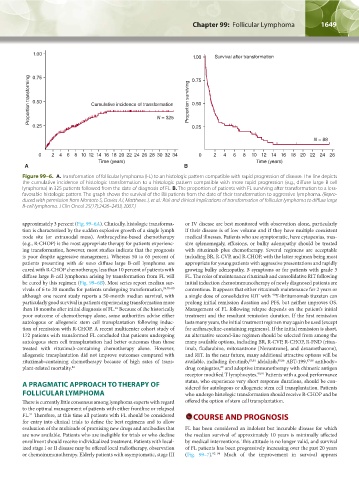
                  Figure 99–6.  A. Transformation of follicular lymphoma (FL) to an histologic pattern compatible with rapid progression of disease. The line depicts
                  the cumulative incidence of histologic transformation to a histologic pattern compatible with more rapid progression (e.g., diffuse large B-cell
                  lymphoma) in 325 patients followed from the date of diagnosis of FL. B. The proportion of patients with FL surviving after transformation to a less-
                  favorable histologic pattern. The graph shows the survival of the 88 patients from the date of their transformation to aggressive lymphoma. (Repro-
                  duced with permission from Montoto S, Davies AJ, Matthews J, et al.: Risk and clinical implications of transformation of follicular lymphoma to diffuse large
                  B-cell lymphoma. J Clin Oncol 25(17):2426–2433, 2007.)

                  approximately 3 percent (Fig. 99–6A). Clinically, histologic transforma-  or IV disease are best monitored with observation alone, particularly
                  tion is characterized by the sudden explosive growth of a single lymph   if their disease is of low volume and if they have multiple coexistent
                  node  site  (or  extranodal  mass).  Anthracycline-based  chemotherapy   medical illnesses. Patients who are symptomatic, have cytopenias, mas-
                  (e.g., R-CHOP) is the most appropriate therapy for patients experienc-  sive  splenomegaly,  effusions,  or  bulky  adenopathy  should  be  treated
                  ing transformation, however, most studies indicate that the prognosis   with rituximab plus chemotherapy. Several regimens are acceptable
                  is poor despite aggressive management. Whereas 50 to 65 percent of   including BR, R-CVP, and R-CHOP, with the latter regimen being most
                  patients presenting with  de novo diffuse large B-cell lymphoma are   appropriate for young patients with aggressive presentations and rapidly
                  cured with R-CHOP chemotherapy, less than 10 percent of patients with   growing bulky adenopathy, B symptoms or for patients with grade 3
                  diffuse large B-cell lymphoma arising by transformation from FL will   FL. The roles of maintenance rituximab and consolidative RIT following
                  be cured by this regimen (Fig. 99–6B). Most series report median sur-  initial induction chemoimmunotherapy of newly diagnosed patients are
                  vivals of 6 to 20 months for patients undergoing transformation, 29,78–80    contentious. It appears that either rituximab maintenance for 2 years or
                  although one recent study reports a 50-month median survival, with   a single dose of consolidative RIT with  Y-ibritumomab tiuxetan can
                                                                                                      90
                  particularly good survival in patients experiencing transformation more   prolong initial remission duration and PFS, but neither improves OS.
                  than 18 months after initial diagnosis of FL.  Because of the historically   Management of FL following relapse depends on the patient’s initial
                                                 81
                  poor outcome of chemotherapy alone, some authorities advise either   treatment and the resultant remission duration. If the first remission
                  autologous or allogeneic stem cell transplantation following induc-  lasts many years, the initial treatment regimen may again be used (except
                  tion of remission with R-CHOP. A recent multicenter cohort study of     for anthracycline-containing regimens). If the initial remission is short,
                  172 patients with transformed FL concluded that patients undergoing   an alternative second-line regimen should be selected from among the
                  autologous stem cell transplantation had better outcomes than those   many available options, including BR, R-CVP, R-CHOP, R-FND (ritux-
                  treated with  rituximab-containing  chemotherapy alone.  However,   imab, fludarabine, mitoxantrone [Novantrone], and dexamethasone),
                  allogeneic transplantation did not improve outcomes compared with   and RIT. In the near future, many additional attractive options will be
                  rituximab-containing  chemotherapy because  of high rates of  trans-  available, including ibrutinib, 83,84  idelalisib, 85,86  ABT-199, 87,88  antibody–
                  plant-related mortality. 82                           drug conjugates,  and adoptive immunotherapy with chimeric antigen
                                                                                    89
                                                                        receptor modified T lymphocytes. 90,91  Patients with a good performance
                  A PRAGMATIC APPROACH TO THERAPY OF                    status, who experience very short response durations, should be con-
                                                                        sidered for autologous or allogeneic stem cell transplantation. Patients
                  FOLLICULAR LYMPHOMA                                   who undergo histologic transformation should receive R-CHOP and be
                  There is currently little consensus among lymphoma experts with regard   offered the option of stem cell transplantation.
                  to the optimal management of patients with either frontline or relapsed
                  FL.  Therefore, at this time all patients with FL should be considered   COURSE AND PROGNOSIS
                    51
                  for entry into clinical trials to define the best regimens and to allow
                  evaluation of the multitude of promising new drugs and antibodies that   FL has been considered an indolent but incurable disease for which
                  are now available. Patients who are ineligible for trials or who decline   the  median survival  of  approximately  10  years  is  minimally  affected
                  enrollment should receive individualized treatment. Patients with local-  by medical interventions. This attitude is no longer valid, and survival
                  ized stage I or II disease may be offered local radiotherapy, observation   of FL patients has been progressively increasing over the past 20 years
                  or chemoimmunotherapy. Elderly patients with asymptomatic, stage III   (Fig. 99–7). 92–94  Much of the improvement in survival appears


          Kaushansky_chapter 99_p1641-1652.indd   1649                                                                  9/18/15   3:57 PM

