


Page 1691 - Williams Hematology ( PDFDrive )
P. 1691
1666           Part XI:  Malignant Lymphoid Diseases                                                                                                                     Chapter 101:  Marginal Zone B-cell Lymphomas            1667


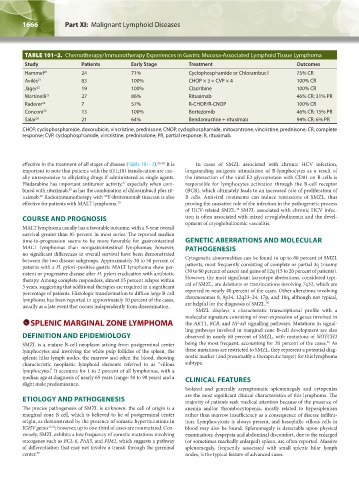
                TABLE 101–2.  Chemotherapy/Immunotherapy Experiences in Gastric Mucosa-Associated Lymphoid Tissue Lymphoma
                Study              Patients         Early Stage        Treatment                           Outcomes
                Hammel 20          24               71%                Cyclophosphamide or Chlorambucil    75% CR
                Avilés 21          83               100%               CHOP × 3 + CVP × 4                  100% CR
                Jäger 22           19               100%               Cladribine                          100% CR
                Martinelli 23      27               86%                Rituximab                           46% CR; 31% PR
                Raderer 24         7                57%                R-CHOP/R-CNOP                       100% CR
                Conconi 25         13               100%               Bortezomib                          46% CR; 15% PR
                Salar 26           21               64%                Bendamustine + rituximab            94% CR; 6% PR

               CHOP, cyclophosphamide, doxorubicin, vincristine, prednisone; CNOP, cyclophosphamide, mitoxantrone, vincristine, prednisone; CR, complete
               response; CVP, cyclophosphamide, vincristine, prednisolone; PR, partial response; R, rituximab.


               effective in the treatment of all stages of disease (Table 101–2). 20–26  It is   In cases of SMZL associated with chronic HCV infection,
               important to note that patients with the t(11;18) translocation are usu-  longstanding antigenic stimulation of B-lymphocytes as a result of
               ally unresponsive to alkylating drugs if administered as single agents.   the interaction of the viral E2 glycoprotein with CD81 on B cells is
               Fludarabine has important antitumor activity,  especially when com-  responsible for lymphocytes activation through the B-cell receptor
                                                 27
               bined with rituximab,  as has the combination of chlorambucil plus rit-  (BCR), which ultimately leads to an increased rate of proliferation of
                               28
               uximab.  Radioimmunotherapy with  Y-ibritumomab tiuxetan is also   B cells. Antiviral treatments can induce remissions of SMZL, thus
                                           90
                     29
               effective for patients with MALT lymphoma. 30          proving the causative role of the infection in the pathogenetic process
                                                                      of HCV-related SMZL.  SMZL associated with chronic HCV infec-
                                                                                       34
               COURSE AND PROGNOSIS                                   tion is often associated with mixed cryoglobulinemia and the devel-
                                                                      opment of cryoglobulinemic vasculitis.
               MALT lymphoma usually has a favorable outcome, with a 5-year overall
               survival greater than 85 percent in most series. The reported median
               time-to-progression seems to be more favorable for gastrointestinal   GENETIC ABERRATIONS AND MOLECULAR
               MALT lymphomas than nongastrointestinal lymphomas; however,   PATHOGENESIS
               no significant differences in overall survival have been demonstrated
               between the two disease subgroups. Approximately 30 to 50 percent of   Cytogenetic abnormalities can be found in up to 80 percent of SMZL
               patients with a H. pylori–positive gastric MALT lymphoma show per-  patients, most frequently consisting of complete or partial 3q trisomy
               sistent or progressive disease after H. pylori eradication with antibiotic   (30 to 80 percent of cases) and gains of 12q (15 to 20 percent of patients).
               therapy. Among complete responders, almost 15 percent relapse within   However, the most significant karyotype aberrations, considered typi-
               3 years, suggesting that additional therapies are required in a significant   cal of SMZL, are deletions or translocations involving 7q32, which are
               percentage of patients. Histologic transformation to diffuse large B-cell   reported in nearly 40 percent of the cases. Other alterations involving
               lymphoma has been reported in approximately 10 percent of the cases,   chromosomes 8, 9p34, 12q23–24, 17p, and 18q, although not typical,
                                                                                                 35
               usually as a late event that occurs independently from dissemination.  are helpful for the diagnosis of SMZL.
                                                                          SMZL displays a characteristic transcriptional profile with a
                                                                      molecular signature consisting of over-expression of genes involved in
                  SPLENIC MARGINAL ZONE LYMPHOMA                      the AKT1, BCR, and NF-κB signalling pathways. Mutations in signal-
                                                                      ling pathways involved in marginal zone B-cell development are also
               DEFINITION AND EPIDEMIOLOGY                            observed in nearly 60 percent of SMZL, with mutations of NOTCH2
                                                                                                                     36
               SMZL is a mature B-cell neoplasm arising from postgerminal center   being the most frequent, accounting for 20 percent of the cases.  As
               lymphocytes and involving the white pulp follicles of the spleen, the   these mutations are restricted to SMZL, they represent a potential diag-
               splenic hilar lymph nodes, the marrow and often the blood, showing   nostic marker (and presumably a therapeutic target) for this lymphoma
               characteristic  neoplastic  lymphoid  elements  referred to  as  “villous   subtype.
               lymphocytes.” It accounts for 1 to 2 percent of all lymphomas, with a
               median age at diagnosis of nearly 65 years (range: 30 to 90 years) and a   CLINICAL FEATURES
               slight male predominance.
                                                                      Isolated and generally asymptomatic splenomegaly and cytopenias
               ETIOLOGY AND PATHOGENESIS                              are the most significant clinical characteristics of this lymphoma. The
                                                                      majority of patients seek medical attention because of the presence of
               The precise pathogenesis of SMZL is unknown: the cell of origin is a   anemia  and/or  thrombocytopenia,  mostly  related  to  hypersplenism
               marginal zone B cell, which is believed to be of postgerminal center   rather than marrow insufficiency as a consequence of disease infiltra-
               origin, as demonstrated by the presence of somatic hypermutations in   tion. Lymphocytosis is always present, and basophilic villous cells in
               IGHV genes 31,32 ; however, up to one-third of cases are nonmutated. Con-  blood may also be found. Splenomegaly is detectable upon physical
               versely, SMZL exhibits a low frequency of somatic mutations involving   examination; dyspepsia and abdominal discomfort, due to the enlarged
               oncogenes such as BCL-6, PAX5, and PIM1, which suggests a pathway   (or sometimes markedly enlarged) spleen, are often reported. Massive
               of differentiation that may not involve a transit through the germinal   splenomegaly, frequently associated with small splenic hilar lymph
               center. 33                                             nodes, is the typical feature of advanced cases.


          Kaushansky_chapter 101_p1663-1670.indd   1666                                                                 9/18/15   9:37 AM

