


Page 1689 - Williams Hematology ( PDFDrive )
P. 1689
1664           Part XI:  Malignant Lymphoid Diseases                                                                                                                     Chapter 101:  Marginal Zone B-cell Lymphomas            1665


               survival- and proliferation-related genes in B cells during immune   GENETIC ABERRATIONS
               responses. The constitutive activation of this signalling pathway results   Recurrent genomic lesions, including chromosomal translocations and
               in uncontrolled B-cell proliferation and subsequent neoplastic transfor-  unbalanced aberrations, can be detected in MALT lymphomas in up
               mation of the involved tissue.                         to 40 percent of the cases, depending on the specific aberration. The
                   The  longstanding  antigenic  stimulation  explains  how  lymphoid   t(11;18)(q21;q21) translocation is the most common structural chro-
               infiltrates—or  an  acquired  MALT—may appear  in  extranodal  sites   mosomal  abnormality  in  MALT  lymphoma,  being  demonstrated  in
               normally lacking MALT. The MALT that organizes in proximity to   15 to 40 percent of the cases, especially in gastric and lung MALT lym-
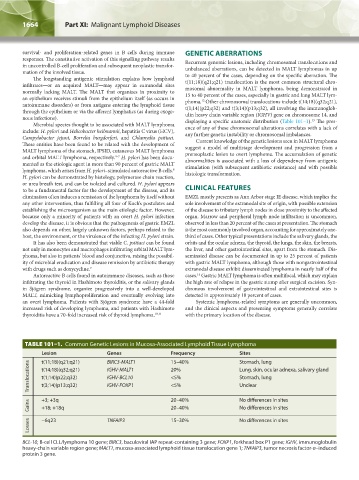
               an epithelium receives stimuli from the epithelium itself (as occurs in   phoma.  Other chromosomal translocations include t(14;18)(q32;q21),
                                                                           12
               autoimmune disorders) or from antigens entering the lymphoid tissue   t(1;14)(p22;q32) and t(3;14)(p13;q32), all involving the immunoglob-
               through the epithelium or via the afferent lymphatics (as during exoge-  ulin heavy chain variable region (IGHV) gene on chromosome 14, and
               nous infections).                                      displaying a specific anatomic distribution (Table 101–1).  The pres-
                                                                                                                13
                   Microbial species thought to be associated with MALT lymphoma   ence of any of these chromosomal alterations correlates with a lack of
               include: H. pylori and Helicobacter heilmannii, hepatitis C virus (HCV),   any further genetic instability or chromosomal imbalances.
               Campylobacter jejuni,  Borrelia burgdorferi, and  Chlamydia psittaci.   Current knowledge of the genetic lesions seen in MALT lymphoma
               These entities have been found to be related with the development of   suggest a model of multistage development and progression from a
               MALT lymphoma of the stomach, IPSID, cutaneous MALT lymphoma   preneoplastic lesion to overt lymphoma. The accumulation of genetic
               and orbital MALT lymphoma, respectively.  H. pylori has been docu-  abnormalities is associated with a loss of dependency from antigenic
                                              4–7
               mented as the etiologic agent in more than 90 percent of gastric MALT   stimulation (with subsequent antibiotic resistance) and with possible
               lymphoma, which arises from H. pylori–stimulated autoreactive B cells.    histologic transformation.
                                                                  8
               H. pylori can be demonstrated by histology, polymerase chain reaction,
               or urea breath test, and can be isolated and cultured. H. pylori appears
               to be a fundamental factor for the development of the disease, and its   CLINICAL FEATURES
               elimination often induces a remission of the lymphoma by itself without   EMZL mostly presents as Ann Arbor stage IE disease, which implies the
               any other intervention, thus fulfilling all four of Koch’s postulates and   sole involvement of the extranodal site of origin, with possible extension
               establishing the microorganism as the main etiologic factor. However,   of the disease to tributary lymph nodes in close proximity to the affected
               because only a minority of patients with an overt H. pylori infection   organ. Marrow and peripheral lymph node infiltration is uncommon,
               develop the disease, it is obvious that the pathogenesis of gastric EMZL   observed in less than 20 percent of the cases at presentation. The stomach
               also depends on other, largely unknown factors, perhaps related to the   is the most commonly involved organ, accounting for approximately one-
               host, the environment, or the virulence of the infecting H. pylori strain.  third of cases. Other typical presentations include the salivary glands, the
                   It has also been demonstrated that viable C. psittaci can be found   orbits and the ocular adnexa, the thyroid, the lungs, the skin, the breasts,
               not only in monocytes and macrophages infiltrating orbital MALT lym-  the liver, and other gastrointestinal sites, apart from the stomach. Dis-
               phoma, but also in patients’ blood and conjunctiva, raising the possibil-  seminated disease can be documented in up to 25 percent of patients
               ity of microbial eradication and disease remission by antibiotic therapy   with gastric MALT lymphoma, although those with nongastrointestinal
               with drugs such as doxycycline. 9                      extranodal disease exhibit disseminated lymphoma in nearly half of the
                   Autoreactive B cells found in autoimmune diseases, such as those   cases.  Gastric MALT lymphoma is often multifocal, which may explain
                                                                          14
               infiltrating the thyroid in Hashimoto thyroiditis, or the salivary glands   the high rate of relapse in the gastric stump after surgical excision. Syn-
               in Sjögren syndrome, organize progressively into a well-developed   chronous involvement of gastrointestinal and extraintestinal sites is
               MALT, mimicking lymphoproliferation and eventually evolving into   detected in approximately 10 percent of cases.
               an overt lymphoma. Patients with Sjögren syndrome have a 44-fold   Systemic lymphoma-related symptoms are generally uncommon,
               increased risk of developing lymphoma, and patients with Hashimoto   and the clinical aspects and presenting symptoms generally correlate
               thyroiditis have a 70-fold increased risk of thyroid lymphoma. 10,11  with the primary location of the disease.


                TABLE 101–1.  Common Genetic Lesions in Mucosa-Associated Lymphoid Tissue Lymphoma
                      Lesion                Genes                Frequency              Sites
                                                                                        Stomach, lung
                                                                 15–40%
                      t(11;18)(q21;q21)
                                            BIRC3-MALT1
                  Translocations  t(14;18)(q32;q21)  IGHV-MALT1  20%                    Lung, skin, ocular adnexa, salivary gland
                                                                                        Stomach, lung
                                                                 <5%
                                            IGHV-BCL10
                      t(1;14)(p22;q32)
                                                                 <5%
                                                                                        Unclear
                                            IGHV-FOXP1
                      t(3;14)(p13;q32)
                  Gains  +3; +3q                                 20–40%                 No differences in sites
                                                                                        No differences in sites
                      +18; +18q
                                                                 20–40%
                  Losses  −6q23             TNFAIP3              15–30%                 No differences in sites
               BCL-10, B-cell CLL/lymphoma 10 gene; BIRC3, baculoviral IAP repeat-containing 3 gene; FOXP1, forkhead box P1 gene; IGHV, immunoglobulin
               heavy-chain variable region gene; MALT1, mucosa-associated lymphoid tissue translocation gene 1; TNFAIP3, tumor necrosis factor-α–induced
               protein 3 gene.


          Kaushansky_chapter 101_p1663-1670.indd   1664                                                                 9/18/15   9:37 AM

