


Page 1713 - Williams Hematology ( PDFDrive )
P. 1713
1688           Part XI:  Malignant Lymphoid Diseases                                                                              Chapter 103:  Cutaneous T-Cell Lymphoma (Mycosis Fungoides and Sézary Syndrome)                1689


                                                                                       14
               infections, leading to death in the majority of patients who develop this   with a worse prognosis.  In some cases, distinction between LyP and
                         144
               complication.  Combination therapy produces objective responses in   PCALCL cannot be made because of discrepancies between clinical fea-
               greater than 80 percent of patients and complete responses in approx-  tures and histologic appearance. These cases are referred to as borderline
               imately one fourth of cases. 99,145  The duration of remission varies, with   lesions, and their classification should take into consideration their clin-
               a median of approximately 1 year. No long-term disease-free survival   ical behavior and appearance (Fig. 103–7A).
               has been reported.                                         Other CD30+ cutaneous lymphoproliferative disorders include
                   Combined  Modality Therapy  Several multidrug regimens   large cell transformation of MF, systemic anaplastic large cell lymphoma
               reportedly  improve  clinical  response  in  patients  with  MF,  including   (ALCL),  cutaneous  NK/T-cell  lymphoma,  and  Hodgkin  lymphoma.
               combination of extracorporeal photophoresis with low-dose interferon-α   Making the distinctions between these diagnoses is critical because
               and oral bexarotene; prednisone and fludarabine; and PUVA and oral   management and prognosis are significantly different (see “Treatment”
               bexarotene. 3,146                                      below). The descriptive term anaplastic could be omitted from the name
                   Because in general MF is an indolent malignancy of T cells with   of this lymphoma because these lymphomas may have an anaplastic,
               excellent prognosis in early stages, the treatment should be conser-  immunoblastic, or pleomorphic cell morphology. Regardless of patho-
               vative, with skin-directed therapies (nitrogen mustard, topical gluco-  logic type, these CD30+ large cell lymphomas have a similar clinical
               corticoids, topical bexarotene) combined with light therapy, low-dose   course, treatment, and prognosis. 81,147–149
               interferon, low-dose methotrexate, or other single-agent chemotherapy.   CD30+ PCALCL can occur at any age, with the peak incidence in
               The survival of patients treated with aggressive chemotherapy is not dif-  patients in their 60s, with a slight male predominance. 79,150  PCALCL can
               ferent from the survival of patients treated conservatively, but aggressive   occur anywhere on the body. The lesions are brownish to violaceous
               chemotherapy results in greater toxicity. Because no curative therapy   nodules or tumors, ranging in number from solitary (most commonly)
               exists, the goal of therapy is to prevent progression to more advanced   to numerous with generalized involvement. They may regress sponta-
               stages and to preserve the patient’s quality of life for as long as possible.  neously. Histopathologically, at least 75 percent of the large cells should
                                                                      express CD30. Most cases are CD4+, with loss of pan–T-cell markers
                  PROGNOSIS                                           CD2, CD3, and CD5. In rare cases, the cells are CD8+CD30+. In con-
                                                                      trast to systemic ALCL, primary cutaneous large cell lymphoma is neg-
                                                                                                         151
               Prognosis largely depends on the stage at presentation. Fifty percent of   ative for CD15 and epithelial membrane antigen.  In addition, primary
               deaths among patients with MF result from infections. Septicemia and   cutaneous large cell lymphoma usually does not express anaplastic lym-
               bacterial pneumonia are common; they usually are caused by Staphylo-  phoma kinase-1 (ALK-1) or the t(2;5) chromosomal translocation. 152,153
               coccus or Pseudomonas and develop from cutaneous lesions.  Herpes   Presence of ALK-1 in cutaneous lesions without systemic involvement
                                                            54
               virus infections occur in up to 10 percent of patients with advanced MF.   does not carry a worse prognosis.
               Progressive MF with widespread visceral involvement late in the course
               of the disease is the next most common cause of death.
                                                                         LYMPHOMATOID PAPULOSIS
                  PRIMARY CUTANEOUS ANAPLASTIC                        LyP is the benign counterpart of primary cutaneous ALCL. It is charac-
               LARGE CELL LYMPHOMA                                    terized by crops of erythematous, dome-shaped papules or nodules that
                                                                      may ulcerate spontaneously. It regresses over a few months with minor
               CLINICAL FINDINGS                                      sequelae such as scarring or atrophy (see Fig. 103–7B). The three main
                                                                      histologic types of LyP are A, B, and C. The infiltrate usually is wedge
               CD30+ cutaneous lymphoproliferative disorders are the second most   shaped with ulcer formation. The large atypical cells of type A resemble
               common CTCLs after MF and represent approximately 25 percent of   immunoblasts of Reed-Sternberg cells. These cells are surrounded by
               CTCL cases.  PCALCL represents a spectrum of CD30+ lymphoprolif-  neutrophils and eosinophils. Type B cells resemble MF, with lichenoid
                        81
               erative disorders, including LyP and PCALCL as its malignant counter-  lymphocytic infiltration of cells with cerebriform nuclei and some epi-
               part. It is defined by the presence of skin involvement without evidence   dermotropism. Type C cells resemble ALCL, with sheets of large CD30+
               of extracutaneous disease for at least 6 months after presentation.  Sec-  cells in the infiltrate. The histologic distinction between LyP and the
                                                              13
               ondary involvement of lymph nodes may not necessarily be associated   corresponding condition may be difficult, and clinical correlation is


                         A                                           B
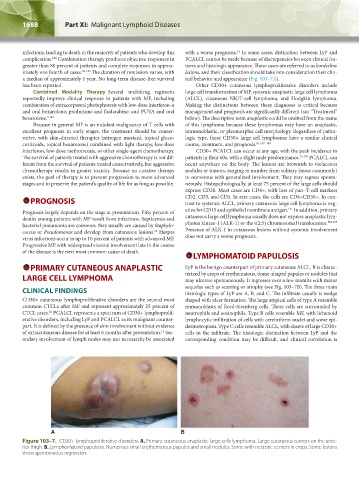
               Figure 103–7.  CD30+ lymphoproliferative disorders. A. Primary cutaneous anaplastic large cells lymphoma. Large cutaneous tumors on the ante-
               rior thigh. B. Lymphomatoid papulosis. Numerous small erythematous papules and small nodules. Some with necrotic centers in crops. Some lesions
               show spontaneous regression.


          Kaushansky_chapter 103_p1679-1692.indd   1688                                                                 9/21/15   12:51 PM

