


Page 1710 - Williams Hematology ( PDFDrive )
P. 1710
1684  Part XI:  Malignant Lymphoid Diseases  Chapter 103:  Cutaneous T-Cell Lymphoma (Mycosis Fungoides and Sézary Syndrome)  1685


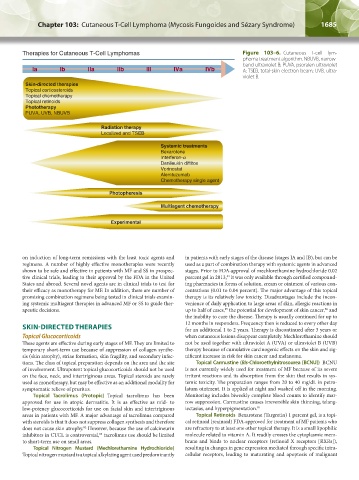
                  Therapies for Cutaneous T-Cell Lymphomas                                  Figure 103–6.  Cutaneous T-cell  lym-
                                                                                            phoma treatment algorithm. NBUVB, narrow-
                                                                                            band ultraviolet B; PUVA, psoralen ultraviolet
                     la       Ib        lla       llb      III       IVa       IVb          A; TSEB, total-skin electron beam; UVB, ultra-
                                                                                            violet B.
                   Skin-directed therapies
                   Topical corticosteroids
                   Topical chemotherapy
                   Topical retinoids
                   Phototherapy
                   PUVA, UVB, NBUVB

                                            Radiation therapy
                                            Localized and TSEB
                                                                Systemic treatments
                                                                Bexarotene
                                                                Interferon
                                                                Denileukin diftitox
                                                                Vorinostat
                                                                Alemtuzumab
                                                                Chemotherapy single agent

                                               Photopheresis

                                                                Multiagent chemotherapy

                                               Experimental


                  on induction of long-term remissions with the least toxic agents and   in patients with early stages of the disease (stages IA and IB), but can be
                  regimens. A number of highly effective monotherapies were recently   used as a part of combination therapy with systemic agents in advanced
                  shown to be safe and effective in patients with MF and SS in prospec-  stages. Prior to FDA-approval of mechlorethamine hydrochloride 0.02
                  tive clinical trials, leading to their approval by the FDA in the United   percent gel in 2013,  it was only available through certified compound-
                                                                                      84
                  States and abroad. Several novel agents are in clinical trials to test for   ing pharmacies in forms of solution, cream or ointment of various con-
                  their efficacy as monotherapy for MF. In addition, there are number of   centrations (0.01 to 0.04 percent). The major advantage of this topical
                  promising combination regimens being tested in clinical trials examin-  therapy is its relatively low toxicity. Disadvantages include the incon-
                  ing systemic multiagent therapies in advanced MF or SS to guide ther-  venience of daily application to large areas of skin, allergic reactions in
                  apeutic decisions.                                    up to half of cases,  the potential for development of skin cancer,  and
                                                                                      85
                                                                                                                       86
                                                                        the inability to cure the disease. Therapy is usually continued for up to
                                                                        12 months in responders. Frequency then is reduced to every other day
                  SKIN-DIRECTED THERAPIES                               for an additional 1 to 2 years. Therapy is discontinued after 3 years or
                  Topical Glucocorticoids                               when cutaneous lesions disappear completely. Mechlorethamine should
                  These agents are effective during early stages of MF. They are limited to   not be used together with ultraviolet A (UVA) or ultraviolet B (UVB)
                  temporary short-term use because of suppression of collagen synthe-  therapy because of cumulative carcinogenic effects on the skin and sig-
                  sis (skin atrophy), striae formation, skin fragility, and secondary infec-  nificant increase in risk for skin cancer and melanoma.
                  tions. The class of topical preparation depends on the area and the site   Topical Carmustine (Bis-Chloroethylnitrosourea [BCNU])  BCNU
                  of involvement. Ultrapotent topical glucocorticoids should not be used   is not currently widely used for treatment of MF because of its severe
                  on the face, neck, and intertriginous areas. Topical steroids are rarely   irritant reactions and its absorption from the skin that results in sys-
                  used as monotherapy, but may be effective as an additional modality for   temic toxicity. The preparation ranges from 20 to 40 mg/dL in petro-
                  symptomatic relieve of pruritus.                      latum ointment. It is applied at night and washed off in the morning.
                     Topical Tacrolimus  (Protopic)  Topical tacrolimus has been   Monitoring includes biweekly complete blood counts to identify mar-
                  approved for  use  in  atopic  dermatitis.  It is  as effective as  mid-  to   row suppression. Carmustine causes irreversible skin thinning, telang-
                  low-potency glucocorticoids for use on facial skin and intertriginous   iectasias, and hyperpigmentation. 87
                  areas in patients with MF. A major advantage of tacrolimus compared   Topical Retinoids  Bexarotene (Targretin) 1 percent gel, is a topi-
                  with steroids is that it does not suppress collagen synthesis and therefore   cal retinoid (rexinoid) FDA-approved for treatment of MF patients who
                  does not cause skin atrophy.  However, because the use of calcineurin   are refractory to at least one other topical therapy. It is a small lipophilic
                                      82
                  inhibitors in CTCL is controversial,  tacrolimus use should be limited   molecule related to vitamin A. It readily crosses the cytoplasmic mem-
                                            83
                  to short-term use on small areas.                     brane and binds to nuclear receptors (retinoid X receptors [RXRs]),
                     Topical Nitrogen Mustard (Mechlorethamine Hydrochloride)    resulting in changes in gene expression mediated through specific intra-
                  Topical nitrogen mustard is a topical alkylating agent used predominantly   cellular receptors, leading to maturating and apoptosis of malignant


          Kaushansky_chapter 103_p1679-1692.indd   1685                                                                 9/21/15   12:51 PM

