


Page 182 - Williams Hematology ( PDFDrive )
P. 182
156  Part IV:  Molecular and Cellular Hematology                                     Chapter 11:  Genomics            157


                     Unlike Sanger sequencing, Illumina’s sequencing-by-synthesis   SEQUENCING BY PH CHANGE SENSING: THE
                  method generates relatively short read lengths, typically 100 to 300 bp.   ION TORRENT PLATFORM
                  The limitations on read length are primarily a signal-to-noise issue,
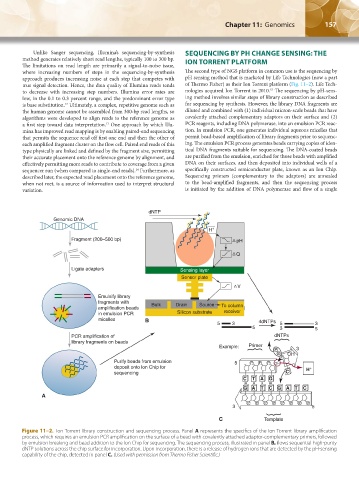
                  where increasing numbers of steps in the sequencing-by-synthesis   The second type of NGS platform in common use is the sequencing by
                  approach produces increasing noise at each step that competes with   pH sensing method that is marketed by Life Technologies (now a part
                  true signal detection. Hence, the data quality of Illumina reads tends   of Thermo Fisher) as their Ion Torrent platform (Fig. 11–2). Life Tech-
                                                                                                     15
                  to decrease with increasing step numbers. Illumina error rates are   nologies acquired Ion Torrent in 2010.  The sequencing by pH-sens-
                  low, in the 0.1 to 0.3 percent range, and the predominant error type   ing method involves similar steps of library construction as described
                                12
                  is base substitution.  Ultimately, a complex, repetitive genome such as   for sequencing by synthesis. However, the library DNA fragments are
                  the human genome cannot be assembled from 300-bp read lengths, so   diluted and combined with (1) individual micron-scale beads that have
                  algorithms were developed to align reads to the reference genome as   covalently attached complementary adaptors on their surface and (2)
                  a first step toward data interpretation.  One approach by which Illu-  PCR reagents, including DNA polymerase, into an emulsion PCR reac-
                                              13
                  mina has improved read mapping is by enabling paired-end sequencing   tion. In emulsion PCR, one generates individual aqueous micelles that
                  that permits the sequence read off first one end and then the other of   permit bead-based amplification of library fragments prior to sequenc-
                  each amplified fragment cluster on the flow cell. Paired end reads of this   ing. The emulsion PCR process generates beads carrying copies of iden-
                  type physically are linked and defined by the fragment size, permitting   tical DNA fragments suitable for sequencing. The DNA-coated beads
                  their accurate placement onto the reference genome by alignment, and   are purified from the emulsion, enriched for those beads with amplified
                  effectively permitting more reads to contribute to coverage from a given   DNA on their surfaces, and then deposited into individual wells of a
                                                        14
                  sequencer run (when compared to single-end reads).  Furthermore, as   specifically constructed semiconductor plate, known as an Ion Chip.
                  described later, the expected read placement onto the reference genome,   Sequencing  primers  (complementary  to the  adaptors)  are  annealed
                  when not met, is a source of information used to interpret structural   to the bead-amplified fragments, and then the sequencing process
                  variation.                                            is initiated by the addition of DNA polymerase and flow of a single


                                                            dNTP
                            Genomic DNA
                                                                                H +
                                  Fragment (200–500 bp)                                   pH

                                                                                          Q

                                  Ligate adapters                      Sensing layer
                                                                       Sensor plate
                                                                                          V
                                           Emulsify library
                                           fragments with    Bulk    Drain   Source
                                           amplification beads                       To column
                                           in emulsion PCR            Silicon substrate  receiver
                                           micelles        B
                                                                                   5    3        4dNTPs  5          3
                                                                                               5        3           5
                                  PCR amplification of                                                dNTPs
                                  library fragments on beads
                                                                                    Example:  Primer
                                                                                                      P       3
                                                                                                       P   OH
                                                                                                        P
                                                 Purify beads from emulsion              5    P  P  P  OH
                                                 deposit onto lon Chip for                                       H +
                                                 sequencing                                               C
                                                                                            C  T  A  G
                                                                                            G  A  T  C  G  A  T  C
                        A
                                                                                             P  P  P  P  P  P  P  P
                                                                                        3                          5
                                                                                    C              Template

                  Figure 11–2.  Ion Torrent library construction and sequencing process. Panel A represents the specifics of the Ion Torrent library amplification
                  process, which requires an emulsion PCR amplification on the surface of a bead with covalently attached adaptor-complementary primers, followed
                  by emulsion breaking and bead addition to the Ion Chip for sequencing. The sequencing process, illustrated in panel B, flows sequential high-purity
                  dNTP solutions across the chip surface for incorporation. Upon incorporation, there is a release of hydrogen ions that are detected by the pH-sensing
                  capability of the chip, detected in panel C. (Used with permission from Thermo Fisher Scientific.)


          Kaushansky_chapter 11_p0155-0164.indd   157                                                                   9/18/15   11:48 PM

