


Page 183 - Williams Hematology ( PDFDrive )
P. 183
158            Part IV:  Molecular and Cellular Hematology                                                                                                                                       Chapter 11:  Genomics             159


               dNTP-containing buffer solution across the Ion Chip surface. The flow   Biosciences approach is in the read length obtained, which ranges
               of the four nucleotides occurs in a stepwise fashion, with a detection   according to the template type but can exceed 50,000 bases with the
               step and an intervening wash. When a specific dNTP is incorporated   input of very long molecules to the library construction.
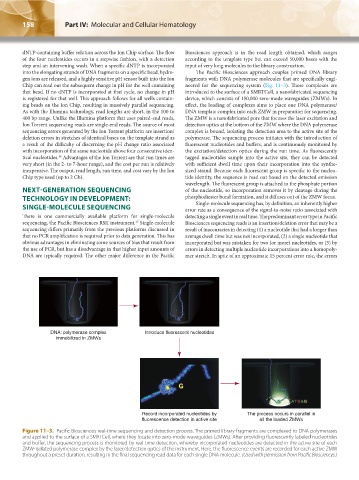
               into the elongating strands of DNA fragments on a specific bead, hydro-  The Pacific Biosciences approach couples primed DNA library
               gen ions are released, and a highly sensitive pH sensor built into the Ion   fragments with DNA polymerase molecules that are specifically engi-
               Chip can read out the subsequent change in pH for the well containing   neered for  the  sequencing system (Fig.  11–3).  These  complexes  are
               that bead. If no dNTP is incorporated at that cycle, no change in pH   introduced to the surface of a SMRTCell, a nanofabricated sequencing
               is registered for that well. This approach follows for all wells contain-  device, which consists of 150,000 zero-mode waveguides (ZMWs). In
               ing beads on the Ion Chip, resulting in massively parallel sequencing.   effect, the loading of complexes aims to place one DNA polymerase/
               As with the Illumina technology, read lengths are short, in the 100 to   DNA template complex into each ZMW in preparation for sequencing.
               400 bp range. Unlike the Illumina platform that uses paired-end reads,   The ZMW is a nanofabricated pore that focuses the laser excitation and
               Ion Torrent sequencing reads are single-end reads. The source of most   detection optics at the bottom of the ZMW where the DNA polymerase
               sequencing errors generated by the Ion Torrent platform are insertion/  complex is bound, isolating the detection area to the active site of the
               deletion errors in stretches of identical bases on the template strand as   polymerase. The sequencing process initiates with the introduction of
               a result of the difficulty of discerning the pH change ratio associated   fluorescent nucleotides and buffers, and is continuously monitored by
               with incorporation of the same nucleotide above four consecutive iden-  the excitation/detection optics during the run time. As fluorescently
               tical nucleotides.  Advantages of the Ion Torrent are that run times are   tagged  nucleotides  sample into the active site, they can be detected
                            16
               very short (in the 2- to 7-hour range), and the cost per run is relatively   with sufficient dwell time upon their incorporation into the synthe-
               inexpensive. The output, read length, run time, and cost vary by the Ion   sized strand. Because each fluorescent group is specific to the nucleo-
               Chip type used (up to 2 Gb).                           tide identity, the sequence is read out based on the detected emission
                                                                      wavelength. The fluorescent group is attached to the phosphate portion
               NEXT-GENERATION SEQUENCING                             of the nucleotide, so incorporation removes it by cleavage during the
               TECHNOLOGY IN DEVELOPMENT:                             phosphodiester bond formation, and it diffuses out of the ZMW focus.
                                                                          Single-molecule sequencing has, by definition, an inherently higher
               SINGLE-MOLECULE SEQUENCING                             error rate as a consequence of the signal-to-noise ratio associated with
               There is one commercially available platform for single-molecule   detecting a single event in real time. The predominant error type in Pacific
               sequencing, the Pacific Biosciences RSII instrument.  Single-molecule   Biosciences sequencing reads is an insertion/deletion error that may be a
                                                     17
               sequencing differs primarily from the previous platforms discussed in   result of inaccuracies in detecting (1) a nucleotide that had a longer than
               that no PCR amplification is required prior to data generation. This has   average dwell time but was not incorporated, (2) a single nucleotide that
               obvious advantages in eliminating some sources of bias that result from   incorporated but was mistaken for two (or more) nucleotides, or (3) by
               the use of PCR, but has a disadvantage in that higher input amounts of   errors in detecting multiple nucleotide incorporations into a homopoly-
               DNA are typically required. The other major difference in the Pacific   mer stretch. In spite of an approximate 15 percent error rate, the errors


                         DNA: polymerase complex        Introduce fluorescent nucleotides
                           immobilized in ZMWs


                                                        Record incorporated nucleotides by  The process occurs in parallel in
                                                        fluorescence detection in active site  all the loaded ZMWs
               Figure 11–3.  Pacific Biosciences real-time sequencing and detection process. The primed library fragments are complexed to DNA polymerases
               and applied to the surface of a SMRTCell, where they locate into zero-mode waveguides (ZMWs). After providing fluorescently labeled nucleotides
               and buffer, the sequencing process is monitored by real time detection, whereby incorporated nucleotides are detected in the active site of each
               ZMW-isolated polymerase complex by the laser/detection optics of the instrument. Here, the fluorescence events are recorded for each active ZMW
               throughout a preset duration, resulting in the final sequencing read data for each single DNA molecule. (Used with permission from Pacific Biosciences.)


          Kaushansky_chapter 11_p0155-0164.indd   158                                                                   9/18/15   11:48 PM

