


Page 184 - Williams Hematology ( PDFDrive )
P. 184
158  Part IV:  Molecular and Cellular Hematology                                     Chapter 11:  Genomics            159


                  are essentially random, which means that oversampling (or “coverage”)   outside of the known genes, inspired the development of methods to
                  of the sequence of interest can correct most errors, resulting in a cumu-  focus sequencing onto these loci. In particular, hybrid capture tech-
                  lative error rate of around 0.1 percent following read assembly.  The very   niques were developed that provided either a subset of known genes
                                                             18
                  long read lengths possible on this platform enable read assembly, rather   (all kinases, for example), or all the known genes (the “exome”) by a
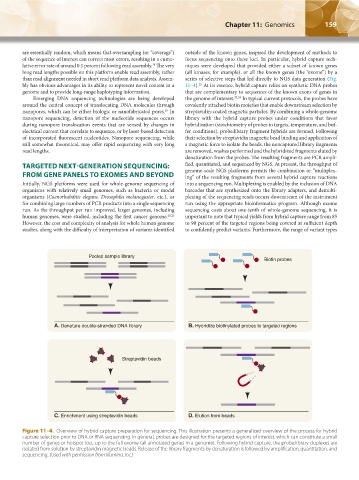
                  than read alignment needed in short read platform data analysis. Assem-  series of selective steps that led directly to NGS data generation (Fig.
                  bly has obvious advantages in its ability to represent novel content in a   11–4).  At its essence, hybrid capture relies on synthetic DNA probes
                                                                             22
                  genome and to provide long-range haplotyping information.  that are complementary to sequences of the known exons of genes in
                     Emerging DNA sequencing technologies are being developed   the genome of interest. 23,24  In typical current protocols, the probes have
                  around the central concept of translocating DNA molecules through   covalently attached biotin moieties that enable downstream selection by
                  nanopores, which can be either biologic or nanofabricated pores.  In   streptavidin-coated magnetic particles. By combining a whole-genome
                                                                  19
                  nanopore sequencing, detection of the nucleotide sequences occurs   library with the hybrid capture probes under conditions that favor
                  during nanopore translocation events that are sensed by changes in   hybridization (stoichiometry of probes to targets, temperature, and buf-
                  electrical current that correlate to sequence, or by laser-based detection   fer conditions), probe:library fragment hybrids are formed. Following
                  of incorporated fluorescent nucleotides. Nanopore sequencing, while   their selection by streptavidin magnetic bead binding and application of
                  still somewhat theoretical, may offer rapid sequencing with very long   a magnetic force to isolate the beads, the noncaptured library fragments
                  read lengths.                                         are removed, washes performed and the hybridized fragments eluted by
                                                                        denaturation from the probes. The resulting fragments are PCR ampli-
                  TARGETED NEXT-GENERATION SEQUENCING:                  fied, quantitated, and sequenced by NGS. At present, the throughput of
                  FROM GENE PANELS TO EXOMES AND BEYOND                 genome-scale NGS platforms permits the combination or “multiplex-
                                                                        ing” of the resulting fragments from several hybrid capture reactions
                  Initially, NGS platforms were used for whole-genome sequencing of   into a sequencing run. Multiplexing is enabled by the inclusion of DNA
                  organisms with relatively small genomes, such as bacteria or model   barcodes that are synthesized onto the library adapters, and demulti-
                  organisms (Caenorhabditis elegans, Drosophila melanogaster, etc.), or   plexing of the sequencing reads occurs downstream of the instrument
                  for combining large numbers of PCR products into a single sequencing   run using the appropriate bioinformatics program. Although exome
                  run. As the throughput per run improved, larger genomes, including   sequencing  costs  about  one-tenth  of  whole-genome  sequencing,  it  is
                  human genomes, were studied, including the first cancer genome. 20,21    important to note that typical yields from hybrid capture range from 85
                  However, the cost and complexity of analysis for whole human genome   to 90 percent of the targeted regions being covered at sufficient depth
                  studies, along with the difficulty of interpretation of variants identified   to confidently predict variants. Furthermore, the range of variant types


                                        Pooled sample library
                                                                                                   Biotin probes


                            A. Denature double-stranded DNA library      B. Hybridize biotinylated probes to targeted regions


                                                   Streptavidin beads


                            C. Enrichment using streptavidin beads       D. Elution from beads

                  Figure 11–4.  Overview of hybrid capture preparation for sequencing. This illustration presents a generalized overview of the process for hybrid
                  capture selection prior to DNA or RNA sequencing. In general, probes are designed for the targeted regions of interest, which can constitute a small
                  number of genes or hotspot loci, up to the full exome (all annotated genes in a genome). Following hybrid capture, the probe:library duplexes are
                  isolated from solution by streptavidin magnetic beads. Release of the library fragments by denaturation is followed by amplification, quantitation, and
                  sequencing. (Used with permission from Illumina, Inc.)


          Kaushansky_chapter 11_p0155-0164.indd   159                                                                   9/18/15   11:48 PM

