


Page 181 - Williams Hematology ( PDFDrive )
P. 181
156            Part IV:  Molecular and Cellular Hematology                                                                                                                                       Chapter 11:  Genomics             157


                                                                                                  O
                                 Genomic DNA
                                                                                               HN     Cleavage
                                                                                                        site  Fluor
                                                                         3’  5’                O  N
                                       Fragment (200–500 bp)
                                                                                           PPP   O
                                                                                              3
                                                                                                 Block
                                        Ligate adapters
                        A1 SP1                                   A             Emission
                                                                            T
                                                                           G                     Incorporate
                                                 SP2 A2       C  G         C T                     Detect
                                        Generate clusters   T               A                      Deblock
                                                                           C
                                        SP2 A2                     C       G A                   Cleave fluor
                                                            A   T           T  Excitation
                                                                            A
                                              Flowcell     G               C
                                        SP1  A1                            C
                                                                 A          C                       O
                                                                           G                                X
                                                              T             A                    HN
                                                                            T              5
                        SP1             Sequence first end       G         C               DNA   O  N
                                                                           G
                                                 A2                         A
                                                              C                               O   O
                                                                        5’
                                                                                                3
                                        Regerate clusters and
                        SP2             sequence paired end                                      OH free 3 end
                                                 A1
                        A                                  B
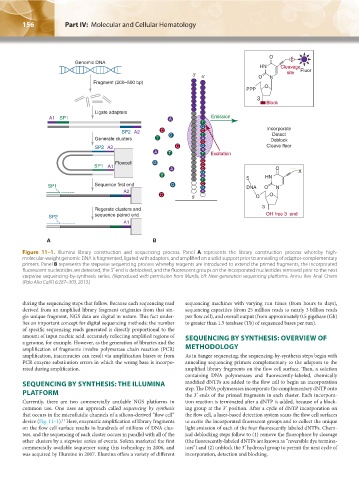
               Figure 11–1.  Illumina library construction and sequencing process. Panel  A represents the library construction process whereby high-
               molecular-weight genomic DNA is fragmented, ligated with adaptors, and amplified on a solid support prior to annealing of adaptor-complementary
               primers. Panel B represents the stepwise sequencing process whereby reagents are introduced to extend the primed fragments, the incorporated
               fluorescent nucleotides are detected, the 3′ end is deblocked, and the fluorescent groups on the incorporated nucleotides removed prior to the next
               stepwise sequencing-by-synthesis series. (Reproduced with permission from Mardis, ER: Next-generation sequencing platforms. Annu Rev Anal Chem
               (Palo Alto Calif) 6:287–303, 2013.)


               during the sequencing steps that follow. Because each sequencing read   sequencing machines with varying run times (from hours to days),
               derived from an amplified library fragment originates from that sin-  sequencing capacities (from 25 million reads to nearly 3 billion reads
               gle unique fragment, NGS data are digital in nature. This fact under-  per flow cell), and overall output (from approximately 0.5 gigabase (Gb)
               lies an important concept for digital sequencing methods: the number   to greater than 1.5 terabase (Tb) of sequenced bases per run).
               of specific sequencing reads generated is directly proportional to the
               amount of input nucleic acid, accurately reflecting amplified regions of   SEQUENCING BY SYNTHESIS: OVERVIEW OF
               a genome, for example. However, as the generation of libraries and the
               amplification of  fragments  involve  polymerase  chain  reaction  (PCR)   METHODOLOGY
               amplification, inaccuracies can result via amplification biases or from   As in Sanger sequencing, the sequencing-by-synthesis steps begin with
               PCR enzyme substitution errors in which the wrong base is incorpo-  annealing sequencing primers complementary to the adaptors to the
               rated during amplification.                            amplified library fragments on the flow cell surface. Then, a solution
                                                                      containing DNA polymerases and fluorescently-labeled, chemically
               SEQUENCING BY SYNTHESIS: THE ILLUMINA                  modified dNTPs are added to the flow cell to begin an incorporation
                                                                      step. The DNA polymerases incorporate the complementary dNTP onto
               PLATFORM                                               the 3′ ends of the primed fragments in each cluster. Each incorpora-
               Currently, there are two commercially available NGS platforms in   tion reaction is terminated after a dNTP is added, because of a block-
               common use. One uses an approach called  sequencing by synthesis   ing group at the 3′ position. After a cycle of dNTP incorporation on
               that occurs in the microfluidic channels of a silicon-derived “flow cell”   the flow cell, a laser-based detection system scans the flow cell surfaces
               device (Fig. 11–1).  Here, enzymatic amplification of library fragments   to excite the incorporated fluorescent groups and to collect the unique
                             11
               on the flow cell surface results in hundreds of millions of DNA clus-  light emission of each of the four fluorescently labeled dNTPs. Chem-
               ters, and the sequencing of each cluster occurs in parallel with all of the   ical deblocking steps follow to (1) remove the fluorophore by cleavage
               other clusters by a stepwise series of events. Solexa marketed the first   (the fluorescently-labeled dNTPs are known as “reversible dye termina-
               commercially available sequencer using this technology in 2006, and   tors”) and (2) unblock the 3′ hydroxyl group to permit the next cycle of
               was acquired by Illumina in 2007. Illumina offers a variety of different   incorporation, detection and blocking.


          Kaushansky_chapter 11_p0155-0164.indd   156                                                                   9/18/15   11:48 PM

