


Page 2012 - Williams Hematology ( PDFDrive )
P. 2012
1986  Part XII:  Hemostasis and Thrombosis  Chapter 116:  Classification, Clinical Manifestations, and Evaluation of Disorders of Hemostasis  1987


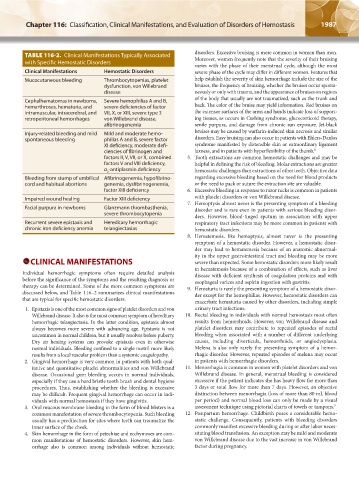
                   TABLE 116-2.  Clinical Manifestations Typically Associated   disorders. Excessive bruising is more common in women than men.
                                                                            Moreover, women frequently note that the severity of their bruising
                   with Specific Hemostatic Disorders
                                                                            varies  with  the  phase  of  their  menstrual  cycle,  although  the  most
                   Clinical Manifestations   Hemostatic Disorders           severe phase of the cycle may differ in different women. Features that
                   Mucocutaneous bleeding    Thrombocytopenias, platelet    help establish the severity of skin hemorrhage include the size of the
                                             dysfunction, von Willebrand    bruises, the frequency of bruising, whether the bruises occur sponta-
                                             disease                        neously or only with trauma, and the appearance of bruises on regions
                   Cephalhematomas in newborns,   Severe hemophilias A and B,   of the body that usually are not traumatized, such as the trunk and
                   hemarthroses, hematuria, and   severe deficiencies of factor   back. The color of the bruise may yield information. Red bruises on
                   intramuscular, intracerebral, and   VII, X, or XIII, severe type 3   the extensor surfaces of the arms and hands indicate loss of support-
                   retroperitoneal hemorrhages  von Willebrand disease,     ing tissues, as occurs in Cushing syndrome, glucocorticoid therapy,
                                             afibrinogenemia                senile purpura, and damage from chronic sun exposure. Jet-black
                   Injury-related bleeding and mild   Mild and moderate hemo-  bruises may be caused by warfarin-induced skin necrosis and similar
                   spontaneous bleeding      philias A and B, severe factor   disorders. Easy bruising can also occur in patients with Ehlers-Danlos
                                             XI deficiency, moderate defi-  syndrome manifested by distensible skin or extraordinary ligament
                                             ciencies of fibrinogen and     laxness, and in patients with hyperflexibility of the thumb. 8
                                             factors II, V, VII, or X, combined   5.  Tooth extractions are common hemostatic challenges and may be
                                             factors V and VIII deficiency,   helpful in defining the risk of bleeding. Molar extractions are greater
                                             α -antiplasmin deficiency      hemostatic challenges than extractions of other teeth. Objective data
                                              2
                   Bleeding from stump of umbilical  Afibrinogenemia, hypofibrino-  regarding excessive bleeding based on the need for blood products
                   cord and habitual abortions  genemia, dysfibrinogenemia,   or the need to pack or suture the extraction site are valuable.
                                             factor XIII deficiency      6.  Excessive bleeding in response to razor nicks is common in patients
                   Impaired wound healing    Factor XIII deficiency         with platelet disorders or von Willebrand disease.
                                                                         7.  Hemoptysis almost never is the presenting symptom of a bleeding
                   Facial purpura in newborns  Glanzmann thrombasthenia,    disorder and is rare even in patients with serious bleeding disor-
                                             severe thrombocytopenia
                                                                            ders.  However, blood-tinged  sputum in  association with upper
                   Recurrent severe epistaxis and   Hereditary hemorrhagic   respiratory tract infections may be more common in patients with
                   chronic iron deficiency anemia  telangiectasias          hemostatic disorders.
                                                                         8.  Hematemesis, like hemoptysis, almost never is the presenting
                                                                            symptom of a hemostatic disorder. However, a hemostatic disor-
                                                                            der may lead to hematemesis because of an anatomic abnormal-
                                                                            ity in the upper gastrointestinal tract and bleeding may be more
                     CLINICAL MANIFESTATIONS                                severe than expected. Some hemostatic disorders more likely result
                                                                            in hematemesis because of a combination of effects, such as liver
                  Individual hemorrhagic symptoms often require detailed analysis   disease with deficient synthesis of coagulation proteins and with
                  before the significance of the symptoms and the resulting diagnosis or   esophageal varices and aspirin ingestion with gastritis.
                  therapy can be determined. Some of the more common symptoms are   9.  Hematuria is rarely the presenting symptom of a hemostatic disor-
                  discussed below, and Table  116–2 summarizes clinical manifestations   der except for the hemophilias. However, hemostatic disorders can
                  that are typical for specific hemostatic disorders.
                                                                            exacerbate hematuria caused by other disorders, including simple
                   1.  Epistaxis is one of the most common signs of platelet disorders and von   urinary tract infections.
                     Willebrand disease. It also is the most common symptom of hereditary   10.  Rectal bleeding in individuals with normal hemostasis most often
                     hemorrhagic telangiectasia. In the latter condition, epistaxis almost   results from hemorrhoids. However, von Willebrand disease and
                     always  becomes  more severe  with  advancing age.  Epistaxis is  not   platelet disorders may contribute to repeated episodes of rectal
                     uncommon in normal children, but it usually resolves before puberty.   bleeding when associated with a number of different underlying
                     Dry air heating systems can provoke epistaxis even in otherwise   causes, including diverticula, hemorrhoids, or angiodysplasia.
                     normal individuals. Bleeding confined to a single nostril more likely   Melena is also only rarely the presenting symptom of a hemor-
                     results from a local vascular problem than a systemic coagulopathy.  rhagic disorder. However, repeated episodes of melena may occur
                   2.  Gingival hemorrhage is very common in patients with both qual-  in patients with hemorrhagic disorders.
                     itative and quantitative platelet abnormalities and von Willebrand   11.  Menorrhagia is common in women with platelet disorders and von
                     disease. Occasional gum bleeding occurs in normal individuals,   Willebrand disease. In general, menstrual bleeding is considered
                     especially if they use a hard bristle tooth brush and dental hygiene   excessive if the patient indicates she has heavy flow for more than
                     procedures. Thus, establishing whether the bleeding is excessive   3 days or total flow for more than 7 days. However, an objective
                     may be difficult. Frequent gingival hemorrhage can occur in indi-  distinction between menorrhagia (loss of more than 80 mL blood
                     viduals with normal hemostasis if they have gingivitis.  per period) and normal blood loss can only be made by a visual
                   3.  Oral mucous membrane bleeding in the form of blood blisters is a   assessment technique using pictorial charts of towels or tampons. 7
                     common manifestation of severe thrombocytopenia. Such bleeding   12.  Postpartum hemorrhage. Childbirth poses a considerable hemo-
                     usually has a predilection for sites where teeth can traumatize the   static challenge. Consequently, patients with bleeding disorders
                     inner surface of the cheek.                            commonly manifest excessive bleeding during or after labor neces-
                   4.  Skin hemorrhage in the form of petechiae and ecchymoses are com-  sitating blood transfusion. An exception may be mild and moderate
                     mon manifestations of hemostatic disorders. However, skin hem-  von Willebrand disease due to the vast increase in von Willebrand
                     orrhage also is common among individuals without hemostatic   factor during pregnancy.


          Kaushansky_chapter 116_p1985-1992.indd   1987                                                                 9/18/15   10:12 AM

