


Page 2011 - Williams Hematology ( PDFDrive )
P. 2011
1986           Part XII:  Hemostasis and Thrombosis                                                                           Chapter 116:  Classification, Clinical Manifestations, and Evaluation of Disorders of Hemostasis   1987


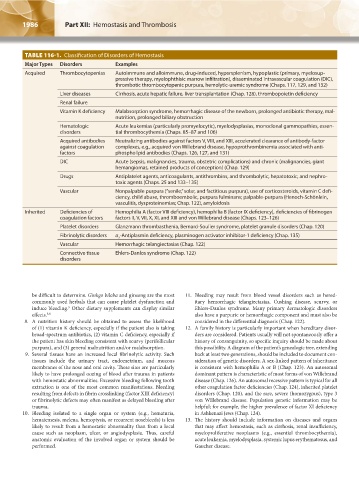
                TABLE 116-1.  Classification of Disorders of Hemostasis
                Major Types  Disorders         Examples
                Acquired    Thrombocytopenias  Autoimmune and alloimmune, drug-induced, hypersplenism, hypoplastic (primary, myelosup-
                                               pressive therapy, myelophthisic marrow infiltration), disseminated intravascular coagulation (DIC),
                                               thrombotic thrombocytopenic purpura, hemolytic-uremic syndrome (Chaps. 117, 129, and 132)
                            Liver diseases     Cirrhosis, acute hepatic failure, liver transplantation (Chap. 128), thrombopoietin deficiency
                            Renal failure
                            Vitamin K deficiency  Malabsorption syndrome, hemorrhagic disease of the newborn, prolonged antibiotic therapy, mal-
                                               nutrition, prolonged biliary obstruction
                            Hematologic        Acute leukemias (particularly promyelocytic), myelodysplasias, monoclonal gammopathies, essen-
                            disorders          tial thrombocythemia (Chaps. 85–87 and 106)
                            Acquired antibodies   Neutralizing antibodies against factors V, VIII, and XIII, accelerated clearance of antibody-factor
                            against coagulation   complexes, e.g., acquired von Willebrand disease, hypoprothrombinemia associated with anti-
                            factors            phospholipid antibodies (Chaps. 126, 127, and 131)
                            DIC                Acute (sepsis, malignancies, trauma, obstetric complications) and chronic (malignancies, giant
                                               hemangiomas, retained products of conception) (Chap. 129)
                            Drugs              Antiplatelet agents, anticoagulants, antithrombins, and thrombolytic, hepatotoxic, and nephro-
                                               toxic agents (Chaps. 25 and 133–135)
                            Vascular           Nonpalpable purpura (“senile,” solar, and factitious purpura), use of corticosteroids, vitamin C defi-
                                               ciency, child abuse, thromboembolic, purpura fulminans; palpable-purpura (Henoch-Schönlein,
                                               vasculitis, dysproteinemias; Chap. 122), amyloidosis
                Inherited   Deficiencies of    Hemophilia A (factor VIII deficiency), hemophilia B (factor IX deficiency), deficiencies of fibrinogen
                              coagulation factors  factors II, V, VII, X, XI, and XIII and von Willebrand disease (Chaps. 123–126)
                            Platelet disorders  Glanzmann thrombasthenia, Bernard-Soulier syndrome, platelet granule disorders (Chap. 120)
                            Fibrinolytic disorders  α -Antiplasmin deficiency, plasminogen activator inhibitor-1 deficiency (Chap. 135)
                                                2
                            Vascular           Hemorrhagic telangiectasias (Chap. 122)
                            Connective tissue   Ehlers-Danlos syndrome (Chap. 122)
                            disorders


                   be difficult to determine. Ginkgo biloba and ginseng are the most   11.  Bleeding may  result  from  blood  vessel  disorders  such  as  hered-
                   commonly used herbals that can cause platelet dysfunction and   itary hemorrhagic telangiectasias, Cushing disease, scurvy, or
                   induce bleeding.  Other dietary supplements can display similar   Ehlers-Danlos syndrome. Many primary dermatologic disorders
                               5
                   effects. 5,6                                          also have a purpuric or hemorrhagic component and must also be
                8.  A nutrition history should be obtained to assess the likelihood   considered in the differential diagnosis (Chap. 122).
                   of (1) vitamin K deficiency, especially if the patient also is taking   12.  A family history is particularly important when hereditary disor-
                   broad-spectrum antibiotics, (2) vitamin C deficiency, especially if   ders are considered. Patients usually will not spontaneously offer a
                   the patient has skin bleeding consistent with scurvy (perifollicular   history of consanguinity, so specific inquiry should be made about
                   purpura), and (3) general malnutrition and/or malabsorption.  this possibility. A diagram of the patient’s genealogic tree, extending
                9.  Several tissues have an increased local fibrinolytic activity. Such   back at least two generations, should be included to document con-
                   tissues include the urinary tract, endometrium, and mucous   sideration of genetic disorders. A sex-linked pattern of inheritance
                     membranes of the nose and oral cavity. These sites are particularly   is consistent with hemophilia A or B (Chap. 123). An autosomal
                   likely to have prolonged oozing of blood after trauma in patients   dominant pattern is characteristic of most forms of von Willebrand
                   with hemostatic abnormalities. Excessive bleeding following tooth   disease (Chap. 126). An autosomal recessive pattern is typical for all
                   extraction is one of the most common manifestations. Bleeding   other coagulation factor deficiencies (Chap. 124), inherited platelet
                   resulting from defects in fibrin crosslinking (factor XIII deficiency)   disorders (Chap. 120), and the rare, severe (homozygous), type 3
                   or fibrinolytic defects may often manifest as delayed bleeding after   von Willebrand disease. Population genetic information may be
                   trauma.                                               helpful; for example, the higher prevalence of factor XI deficiency
               10.  Bleeding isolated to a single organ or system (e.g., hematuria,   in Ashkenazi Jews (Chap. 124).
                   hematemesis, melena, hemoptysis, or recurrent nosebleeds) is less   13.  The history should include information on diseases and organs
                   likely to result from a hemostatic abnormality than from a local   that may affect hemostasis, such as cirrhosis, renal insufficiency,
                   cause such as neoplasm, ulcer, or angiodysplasia. Thus, careful   myeloproliferative neoplasms (e.g., essential thrombocythemia),
                   anatomic evaluation of the involved organ or system should be   acute leukemia, myelodysplasia, systemic lupus erythematosus, and
                   performed.                                            Gaucher disease.


          Kaushansky_chapter 116_p1985-1992.indd   1986                                                                 9/18/15   10:12 AM

