


Page 2015 - Williams Hematology ( PDFDrive )
P. 2015
1990           Part XII:  Hemostasis and Thrombosis                                                                           Chapter 116:  Classification, Clinical Manifestations, and Evaluation of Disorders of Hemostasis   1991


                    PREOPERATIVE ASSESSMENT OF                             SPECIFIC ASSAYS FOR ESTABLISHING

                  HEMOSTASIS                                             THE DIAGNOSIS
               Because surgical procedures are a great challenge to the hemostatic   A tentative diagnosis can be made by following the stepwise process of
               system, careful assessment of the risk of bleeding in every patient is   evaluation outlined in Figs. 116–1 and 116–2. However, further testing
               important. The risk assessment is based on the bleeding history, physi-  usually is required to establish a definitive diagnosis.
               cal examination, the underlying disorder if any, the type and site of sur-
               gery that is planned, and the results of basic hemostatic tests (PT, aPTT,   THROMBOCYTOPENIAS
               platelet count). Several studies indicate that unselected coagulation tests
               have no significant predictive value of perioperative bleeding, and that   When the laboratory reports an abnormally low platelet count, look-
               patients with a negative bleeding history do not require routine coag-  ing at the blood film to exclude pseudothrombocytopenia as a result
               ulation screening.  However, this conclusion does not consider that   of anticoagulant-induced platelet clumping (e.g., induced by ethylene-
                             13
                                                                                                      14
               patients with mild to moderate bleeding disorders who can bleed exces-  diaminetetraacetic acid [EDTA]) is essential.  Examination of the blood
               sively following surgery may have a negative bleeding history because   film also can reveal the presence of giant platelets, as in some inherited
               they  have not been challenged;  obtaining a  good  bleeding  history is   thrombocytopenias; giant platelets and Döhle bodies in leukocytes,
               an expertise that is not shared by all physicians; and if bleeding occurs   as in May-Hegglin and other MYH9 platelet syndromes; moderately
               during or after surgery for whatever reason, the basic tests performed   enlarged platelets,  as in immune  thrombocytopenia or other  condi-
               preoperatively are an essential reference for determining the cause of   tions associated with shortened platelet survival; small platelets, as in
               bleeding.                                              Wiskott-Aldrich syndrome; schistocytes and burr cells, as in the hemo-
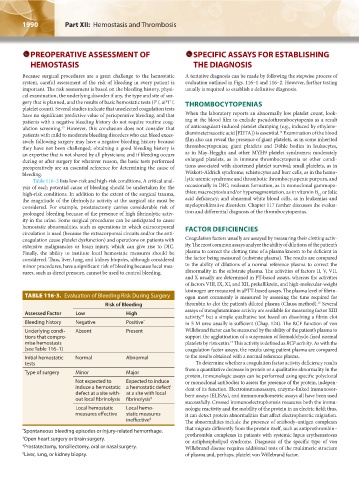
                   Table 116–3 lists low-risk and high-risk conditions. A critical anal-  lytic uremic syndrome and thrombotic thrombocytopenic purpura, and
               ysis of each potential cause of bleeding should be undertaken for the   occasionally in DIC; rouleaux formation, as in monoclonal gammopa-
               high-risk conditions. In addition to the extent of the surgical trauma,   thies; macrocytosis and/or hypersegmentation, as in vitamin B  or folic
                                                                                                                   12
               the magnitude of the fibrinolytic activity at the surgical site must be   acid deficiency; and abnormal white blood cells, as in leukemias and
               considered. For  example,  prostatectomy  carries  considerable  risk  of   myeloproliferative disorders. Chapter 117 further discusses the evalua-
               prolonged bleeding because of the presence of high fibrinolytic activ-  tion and differential diagnosis of the thrombocytopenias.
               ity in the urine. Some surgical procedures can be anticipated to cause
               hemostatic abnormalities, such as operations in which extracorporeal   FACTOR DEFICIENCIES
               circulation is used (because the extracorporeal circuits and/or the anti-
               coagulation cause platelet dysfunction) and operations on patients with   Coagulation factors usually are assayed by measuring their clotting activ-
               extensive malignancies or brain injury, which can give rise to DIC.   ity. The most common assays analyze the ability of dilutions of the patient’s
               Finally, the ability to institute local hemostatic measures should be   plasma to correct the clotting time of a plasma known to be deficient in
               considered. Thus, liver, lung, and kidney biopsies, although considered   the factor being measured (substrate plasma). The results are compared
               minor procedures, have a significant risk of bleeding because local mea-  to the ability of dilutions of a normal reference plasma to correct the
               sures, such as direct pressure, cannot be used to control bleeding.  abnormality in the substrate plasma. The activities of factors II, V, VII,
                                                                      and X usually are determined in PT-based assays, whereas the activities
                                                                      of factors VIII, IX, XI, and XII, prekallikrein, and high-molecular-weight
                                                                        kininogen are measured in aPTT-based assays. The plasma level of fibrin-
                TABLE 116-3.  Evaluation of Bleeding Risk During Surgery  ogen most commonly is measured by assessing the time required for
                                                                                                                  15
                                           Risk of Bleeding           thrombin to clot the patient’s diluted plasma (Clauss method).  Several
                                                                      assays of transglutaminase activity are available for measuring factor XIII
                Assessed Factor  Low              High
                                                                      activity,  but a simple qualitative test based on dissolving a fibrin clot
                                                                           16
                Bleeding history  Negative        Positive *          in 5 M urea usually is sufficient (Chap. 124). The RCF function of von
                Underlying condi-  Absent         Present             Willebrand factor can be measured by the ability of the patient’s plasma to
                tions that compro-                                    support the agglutination of a suspension of formaldehyde-fixed normal
                mise hemostasis                                       platelets by ristocetin.  This activity is defined as RCF activity. As with the
                                                                                     17
                (see Table 116–1)                                     coagulation factor assays, the results using patient plasma are compared
                Initial hemostatic   Normal       Abnormal            to the results obtained with a normal reference plasma.
                tests                                                     To determine whether a coagulation factor activity deficiency results
                                                                      from a quantitative decrease in protein or a qualitative abnormality in the
                Type of surgery  Minor            Major
                                                                      protein, immunologic assays can be performed using specific polyclonal
                                 Not expected to   Expected to induce   or monoclonal antibodies to assess the presence of the protein, indepen-
                                 induce a hemostatic  a hemostatic defect   †  dent of its function. Electroimmunoassays, enzyme-linked immunosor-
                                 defect at a site with-  at a site with local   bent assays (ELISAs), and immunoradiometric assays all have been used
                                 out local fibrinolysis  fibrinolysis ‡
                                                                      successfully. Crossed immunoelectrophoresis measures both the immu-
                                 Local hemostatic   Local hemo-       nologic reactivity and the mobility of the protein in an electric field; thus,
                                 measures effective  static measures   it can detect protein abnormalities that affect electrophoretic migration.
                                                  ineffective §       The abnormalities include the presence of antibody–antigen complexes
                                                                      that migrate differently from the protein itself, such as antiprothrombin–
               * Spontaneous bleeding episodes or injury-related hemorrhage.
               † Open heart surgery or brain surgery.                 prothrombin complexes in patients with systemic lupus erythematosus
                                                                      or antiphospholipid syndrome. Diagnosis of the specific type of von
               ‡ Prostatectomy, tonsillectomy, oral or nasal surgery.  Willebrand disease requires additional tests of the multimeric structure
               § Liver, lung, or kidney biopsy.                       of plasma and, perhaps, platelet von Willebrand factor.


          Kaushansky_chapter 116_p1985-1992.indd   1990                                                                 9/18/15   10:13 AM

