


Page 2014 - Williams Hematology ( PDFDrive )
P. 2014
1988  Part XII:  Hemostasis and Thrombosis  Chapter 116:  Classification, Clinical Manifestations, and Evaluation of Disorders of Hemostasis  1989


                                             PT      – N                                  PT
                                             aPTT                                         aPTT – N
                                             PLT    – N                                   PLT    –  N


                               Bleeding                   No bleeding       Bleeding                   No bleeding
                                                          • Deficiency of factor XII,  • Severe factor VII  • Mild factor VII deficiency
                  Mainly injury related     Unprovoked      HMWK, or PK       deficiency               • Controlled oral anticoagulant
                  • Severe factor Xl deficiency           • Lupus anticoagulant                          therapy
                                                          • Presence of heparin
                  • Mild to moderate                                        B
                    hemophilia A or B  Minor         Major
                                      • VWd          • Severe hemophilia A and
                                                       hemophilia B
                                                     • Severe (type 3) VWd
                                                     • Acquired inhibitor to factor VIII
                                                     • Acquired VWd
                  A


                                 PT                                   PT
                                 aPTT                                 aPTT
                                 PLT  – N                             PLT


                  Bleeding                     No bleeding
                  • Afibrinogenemia            • Hypofibrinogenemia  Bleeding or no bleeding
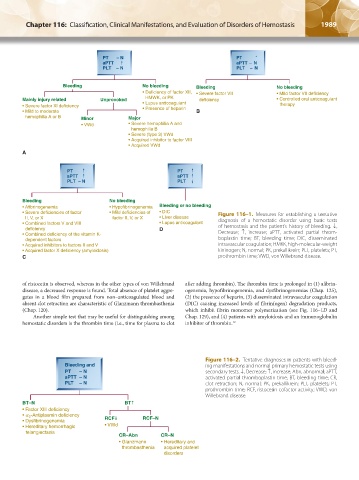
                  • Severe deficiencies of factor  • Mild deficiencies of  • DIC   Figure 116–1.  Measures for establishing a tentative
                    II, V, or X                 factor II, V, or X  • Liver disease  diagnosis of a hemostatic disorder using basic tests
                  • Combined factors V and VIII                 • Lupus anticoagulant  of hemostasis and the patient’s history of bleeding. ↓,
                    deficiency                                  D                  Decrease;  ↑, increase; aPTT, activated partial throm-
                  • Combined deficiency of the vitamin K-
                    dependent factors                                              boplastin time; BT, bleeding time; DIC, disseminated
                  • Acquired inhibitors to factors II and V                        intravascular coagulation; HMKK, high-molecular-weight
                  • Acquired factor X deficiency (amyloidosis)                     kininogen; N, normal; PK, prekallikrein; PLT, platelets; PT,
                  C                                                                prothrombin time; VWD, von Willebrand disease.


                  of ristocetin is observed, whereas in the other types of von Willebrand   after adding thrombin). The thrombin time is prolonged in (1) afibrin-
                  disease, a decreased response is found. Total absence of platelet aggre-  ogenemia, hypofibrinogenemia, and dysfibrinogenemias (Chap. 125),
                  gates in a blood film prepared from non–anticoagulated blood and   (2) the presence of heparin, (3) disseminated intravascular coagulation
                  absent clot retraction are characteristic of Glanzmann thrombasthenia    (DIC) causing increased levels of fibrin(ogen) degradation products,
                  (Chap. 120).                                          which inhibit fibrin monomer polymerization (see Fig. 116–1D and
                     Another simple test that may be useful for distinguishing among   Chap. 129), and (4) patients with amyloidosis and an immunoglobulin
                  hemostatic disorders is the thrombin time (i.e., time for plasma to clot   inhibitor of thrombin. 12


                                                                               Figure 116–2.  Tentative diagnoses in patients with bleed-
                                Bleeding and                                   ing manifestations and normal primary hemostatic tests using
                                PT    – N                                      secondary tests. ↓, Decrease; ↑, increase; Abn, abnormal; aPTT,
                                aPTT  – N                                      activated partial thromboplastin time; BT, bleeding time; CR,
                                PLT   – N                                      clot retraction; N, normal; PK, prekallikrein; PLT, platelets; PT,
                                                                               prothrombin time; RCF, ristocetin cofactor activity; VWD, von
                                                                               Willebrand disease.
                  BT–N                              BT
                  • Factor XIII deficiency
                   α  -Antiplasmin deficiency
                  •     2                    RCF          RCF–N
                  • Dysfibrinogenemia
                  • Hereditary hemorrhagic   • VWd
                   telangiectasia
                                                  CR–Abn        CR–N
                                                  • Glanzmann   • Hereditary and
                                                    thrombasthenia    acquired platelet
                                                                  disorders


          Kaushansky_chapter 116_p1985-1992.indd   1989                                                                 9/18/15   10:13 AM

