


Page 2153 - Williams Hematology ( PDFDrive )
P. 2153
2128           Part XII:  Hemostasis and Thrombosis                                                                                                                       Chapter 123:  Hemophilia A and Hemophilia B            2129


               into surrounding tissues is possible. Hematuria, bleeding from mucous   TABLE 123–7.  Currently Available Factor IX Products*
               membranes, and other bleeding manifestations are as described in the
               section on hemophilia A. The physical, psychological, vocational, and      Origin         Viral Inactivation
               social aspects of the disease are similar to those encountered with hemo-  Intermediate purity (prothrombin complex concentrates)
               philia A. Classification of hemophilia B is based on clinical severity and     Profilnine SD  Plasma  Solvent-detergent
               roughly correlates with the level of factor IX coagulant activity. Severe
               disease usually is associated with factor IX levels of less than 1percent     Bebulin VH  Plasma  Vapor heating
               of normal; moderate disease is associated with factor IX levels of 1 to   High purity
               5 percent; and mild disease is associated with factor IX levels ranging     Mononine  Plasma  Ultrafiltration;
               from 5 to 40 percent.                                                                     chemical
                   The occurrence of factor IX inhibitor antibodies is much less com-
               mon in hemophilia B patients than in hemophilia A patients, and is     AlphaNine  Plasma  Solvent-detergent;
                                                                                                         virus filtered
               very rare in nonsevere disease. Only approximately 3 percent of severely
               affected patients develop inhibitors.                   Recombinant
                                                                         BeneFIX        CHO cells        Solvent-detergent
               LABORATORY FEATURES                                                                       Nanofiltration

               The screening tests used in the diagnosis of hemophilia A also are used     Rixubis  CHO cells  Solvent-detergent
               in the diagnosis of hemophilia B. In most cases of hemophilia B, PT                       Nanofiltration
               is normal and aPTT is prolonged. However, specific assay of factor IX     Alprolix †  HEK cells  Nanofiltration
               coagulant activity is required for definitive diagnosis. The most com-                    Chromatography
               monly used test is a one-stage clotting assay based on aPTT. Determi-
               nation of factor IX antigen levels is valuable in further classifying the   CHO, Chinese hamster ovary; HEK, human embryo kidney.
               disorder.                                              *Additional factor IX concentrates are available in Europe.
                                                                      † Extended half-life factor IX product.
               DIFFERENTIAL DIAGNOSIS
               Hemophilia B must be distinguished from hemophilia A. Both forms
               are inherited as X-linked recessive disorders, and both have almost   factors contaminating these preparations may not be cleared efficiently
               identical hemorrhagic and clinical manifestations. The only method for   by a diseased liver, and thrombosis might be induced.
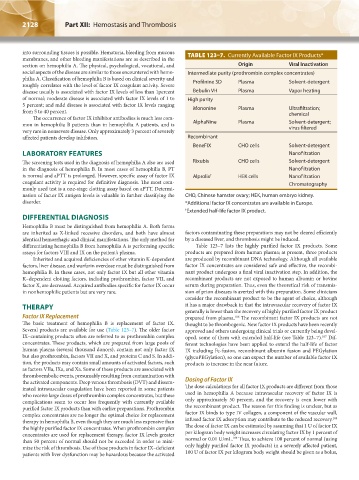
               differentiating hemophilia B from hemophilia A is performing specific   Table   123–7 lists the highly purified factor IX products. Some
               assays for factors VIII and IX on the patient’s plasma.  products are prepared from human plasma; at present, three products
                   Inherited and acquired deficiencies of other vitamin K-dependent   are produced by recombinant DNA technology. Although all available
               factors, liver disease, and warfarin overdose must be distinguished from   factor IX concentrates are considered safe and effective, the recombi-
               hemophilia B. In these cases, not only factor IX but all other vitamin   nant product undergoes a final viral inactivation step. In addition, the
               K–dependent clotting factors, including prothrombin, factor VII, and   recombinant products are not exposed to human albumin or bovine
               factor X, are decreased. Acquired antibodies specific for factor IX occur   serum during preparation. Thus, even the theoretical risk of transmis-
               in nonhemophilic patients but are very rare.           sion of prion diseases is averted with this preparation. Some clinicians
                                                                      consider the recombinant product to be the agent of choice, although
               THERAPY                                                it has a major drawback in that the intravascular recovery of factor IX
                                                                      generally is lower than the recovery of highly purified factor IX product
               Factor IX Replacement                                  prepared from plasma.  The recombinant factor IX products are not
                                                                                       106
               The basic treatment of hemophilia B is replacement of factor IX.     thought to be thrombogenic. New factor IX products have been recently
               Several products are available for use (Table 123–7). The older factor   approved and others undergoing clinical trials or currently being devel-
               IX– containing products often are referred to as prothrombin complex   oped, some of them with extended half-life (see Table  123–7).  Dif-
                                                                                                                    107
               concentrates. These products, which are prepared from large pools of   ferent technologies have been applied to extend the half-life of factor
               human plasma (several thousand donors), contain not only factor IX   IX including Fc-fusion, recombinant albumin fusion and PEGylation
               but also prothrombin, factors VII and X, and proteins C and S. In addi-  (glycoPEGylation), so one can expect the number of available factor IX
               tion, the products may contain small amounts of activated factors, such   products to increase in the near future.
               as factors VIIa, IXa, and Xa. Some of these products are associated with
               thromboembolic events, presumably resulting from contamination with
               the activated components. Deep venous thrombosis (DVT) and dissem-  Dosing of Factor IX
               inated intravascular coagulation have been reported in some patients   The dose calculations for all factor IX products are different from those
               who receive large doses of prothrombin complex concentrates, but these   used in hemophilia A because intravascular recovery of factor IX is
               complications seem to occur less frequently with currently available   only approximately 50 percent, and the recovery is even lower with
               purified factor IX products than with earlier preparations. Prothrombin   the recombinant product. The reason for this finding is unclear, but as
               complex concentrates are no longer the optimal choice for replacement   factor IX binds to type IV collagen, a component of the vascular wall,
                                                                                                                       108
               therapy in hemophilia B, even though they are much less expensive than   infused factor IX adsorption may contribute to the reduced recovery.
               the highly purified factor IX concentrates. When prothrombin complex   The dose of factor IX can be estimated by assuming that 1 U of factor IX
               concentrates are used for replacement therapy, factor IX levels greater   per kilogram body weight increases circulating factor IX by 1 percent of
                                                                                      109
               than 50 percent of normal should not be exceeded in order to mini-  normal or 0.01 U/mL.  Thus, to achieve 100 percent of normal (using
               mize the risk of thrombosis. Use of these products in factor IX–deficient   only highly purified factor IX products) in a severely affected patient,
               patients with liver dysfunction may be hazardous because the activated   100 U of factor IX per kilogram body weight should be given as a bolus,


          Kaushansky_chapter 123_p2113-2132.indd   2128                                                                 9/21/15   4:36 PM

