


Page 2150 - Williams Hematology ( PDFDrive )
P. 2150
2124  Part XII:  Hemostasis and Thrombosis                    Chapter 123:  Hemophilia A and Hemophilia B            2125


                  laboratory diagnosis is required for confirmation. Factor VIII inhibitors   doses of 90 to 120 mcg per kilogram of body weight or higher every 2 to
                  are time and temperature dependent in vitro. The prolonged aPTT of   3 hours is safe and effective in most hemorrhagic episodes.  The dosing
                                                                                                                  79
                  the plasma of a patient without an inhibitor is corrected when mixed   frequency is based on a factor VIIa plasma half-life of approximately
                  1:1 with normal plasma even after incubation at 37°C for 1 to 2 hours.   2 to 3 hours. The mechanisms of action of factor VIIa have been inves-
                  In contrast, the aPTT of a 1:1 mixture of plasma from a patient with an   tigated using in vitro techniques. After coagulation is initiated by the
                  inhibitor and normal plasma is significantly prolonged after incubation   tissue factor–factor VIIa pathway, factor VIIa at recommended doses
                  at 37°C for 1 to 2 hours. Specific diagnosis rests upon demonstrating that   is hypothesized to activate factor X on the surface of activated plate-
                                                                                                                   80
                  an appropriate dilution of the patient’s plasma, when added to normal   lets, even in the absence of additional tissue factor activity.  Factor Xa
                  plasma, specifically neutralizes factor VIII and not other blood clotting   then can associate with factor Va and convert prothrombin to thrombin.
                  factors that influence the aPTT (i.e., factors IX, XI, XII, prekallikrein,   Because activated platelets are localized to the site of vessel injury,
                  high-molecular-weight kininogen). The demonstration that the inhib-  thrombin generation by factor VIIa is localized to the site  of bleed-
                                                                                                                          80
                  itor is specific for factor VIII distinguishes it from inhibitors of other   ing. This process may account for the reported safety of factor VIIa.
                  clotting factors, for example, the lupus anticoagulant, and nonspecific   Factor VIII inhibitor bypassing activity (FEIBA), a plasma-derived
                  inhibitors. A common assay used for inhibitor detection and quantifica-  agent,  has  also been  used successfully  to treat bleeding episodes in
                                     77
                                                                                                            81
                  tion is the Bethesda assay.  In the Bethesda assay, the patient’s plasma   inhibitor patients and is both safe and effective  given at a recom-
                  is diluted such that, when the plasma is mixed with an equal volume of   mended  dose  of  50  to  100  U  per  kilogram  body  weight  every  8  to
                  normal pooled human plasma and incubated for 2 hours at 37°C, the   12 hours (not to exceed 200 U per kilogram per day).
                  factor VIII activity in the mixture is decreased by 50 percent. A modi-  High-responder patients whose initial inhibitor titer is greater
                  fication of the Bethesda assay is the Nijmegen assay, in which buffer is   than 5 BU usually do not respond to even very high doses of human
                                                                                                                         81
                  used instead of factor VIII–deficient plasma. This method has shown   factor VIII. Thus, recombinant factor VIIa or FEIBA should be used.  If
                  to be more dependable at detecting low concentration of inhibitors. 78  these agents are not available, nonactivated prothrombin complex con-
                     Several approaches to treatment  of  factor VIII  inhibitors  are   centrates or plasma exchange with high dose replacement factor VIII
                  available (Table 123–5). Use of these treatments requires knowledge of   can be considered.
                  whether the patient with an inhibitor is a “high” or “low” responder and   Low-Responder Patients  Low-responder patients are arbitrarily
                  whether the bleeding episode requiring treatment is minor or major. 67  defined as patients whose inhibitor titer is less than 5 BU even after
                     High-Responder Patients  Approximately 60 percent of patients   a challenge with factor VIII. For major bleeding episodes, high doses
                  who have inhibitors are high responders. High responders are defined   of human factor VIII can be used as recommended above. For minor
                  as patients whose inhibitor titer is higher than 5 Bethesda units (BU)   bleeds, recombinant factor VIIa or FEIBA are recommended because
                  at baseline or whose initial inhibitor titer is less than 5 BU but rises   some “low” responders may convert to high responders when they are
                  to greater than 5 BU after administration of factor VIII. Thus, high   challenged repeatedly with factor VIII.
                  responders who are not treated with factor VIII for long periods may   Nonactivated or activated prothrombin complex concentrates both
                  have a sustained high level of inhibitor, or they may have a very low to   contain variable amounts of activated factors, including factors VIIa,
                  undetectable level of inhibitor until they are challenged with factor VIII.  IXa, and Xa. The activated products have higher concentrations of acti-
                     Major bleeding episodes in a high-responder patient whose   vated factors than do nonactivated products. FEIBA contains a complex
                  initial inhibitor titer is less than 5 BU can be treated with human    of prothrombin and factor Xa that can bind to membrane surfaces and
                  factor VIII concentrate (see Table  123–5). When the initial titer is low,     enhance thrombin generation in the absence of factors VIII or IX. 80,81
                  sufficient factor VIII can be administered in high doses to neutralize the    Surgery in Inhibitor Patients  The question of whether major sur-
                  inhibitor and attain adequate factor VIII levels for hemostasis. Although   gery can be performed in patients with hemophilia A or B with inhib-
                  factor  VIII inhibitor bypassing agents can be used (see below), they   itors arises now that joint replacement is possible.  Knee, ankle, hip,
                                                                                                             82
                  are  not  as reliable  as  factor  VIII  in  achieving  hemostasis,  and  their   and elbow replacements have been carried out successfully in patients
                  effect cannot be adequately monitored with specific laboratory tests. If     with inhibitor antibodies using bypassing agents. Basically, the patient is
                  factor VIII is used, a loading dose of 10,000 to 15,000 U may be required,   given a loading dose of factor VIIa followed by bolus doses of factor VIIa
                  followed by up to 1000 U of factor VIII per hour, depending upon the   and use of fibrin sealant and antifibrinolytic therapy until healing is
                  factor VIII level. One can expect an anamnestic response approximately   complete. FEIBA has also been successfully used in surgery in hemo-
                  5 days after administration of factor VIII.           philic patients with inhibitors. 83
                     In high-responder patients whose initial inhibitor titer is less than   Immune Tolerance  Removal of the antibody is the definitive goal
                  5 BU and who experience a minor bleeding episode, the agent of choice   of inhibitor management. Plasmapheresis, adsorption of the antibody
                  is a factor VIII inhibitor bypassing agent. Recombinant factor VIIa in   on an affinity column during plasma exchange, and administration of


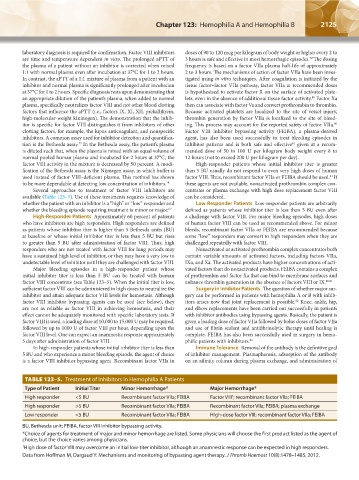
                   TABLE 123–5.  Treatment of Inhibitors in Hemophilia A Patients
                   Type of Patient  Initial Titer  Minor Hemorrhage*             Major Hemorrhage*
                   High responder   <5 BU          Recombinant factor VIIa; FEIBA  Factor VIII ; recombinant factor VIIa; FEIBA
                                                                                        †
                   High responder   >5 BU          Recombinant factor VIIa; FEIBA  Recombinant factor VIIa; FEIBA; plasma exchange
                   Low responder    <5 BU          Recombinant factor VIIa; FEIBA  High-dose factor VIII; recombinant factor VIIa; FEIBA

                  BU, Bethesda unit; FEIBA, factor VIII inhibitor bypassing activity.
                  *Choice of agents for treatment of major and minor hemorrhage are listed. Some physicians will choose the first product listed as the agent of
                  choice, but the choice varies among physicians.
                  † High dose of factor VIII may overcome an initial low-titer inhibitor, although an anamnestic response can be expected in high responders.
                  Data from Hoffman M, Dargaud Y: Mechanisms and monitoring of bypassing agent therapy. J Thromb Haemost 10(8):1478–1485, 2012.


          Kaushansky_chapter 123_p2113-2132.indd   2125                                                                 9/21/15   4:36 PM

