


Page 2149 - Williams Hematology ( PDFDrive )
P. 2149
2124           Part XII:  Hemostasis and Thrombosis                                                                                                                       Chapter 123:  Hemophilia A and Hemophilia B            2125


               pain associated with loss of function, and several weeks of replacement   antibodies against factor VIII has been, and continues to be, one of the
               therapy may be needed postoperatively. 57              more serious complications of replacement therapy.

               Home Therapy                                           Factor VIII Inhibitors
               Home therapy using available factor VIII concentrates was introduced   Other  than  the  transmission  of  viral  diseases  by  factor  VIII  infu-
               in the United States in 1977 and was a major advance in the treatment   sions, the main complication of hemophilia A replacement therapy is
               of all forms of hemophilia. 58,59  Current practice for home therapy is to   the development of specific inhibitor antibodies that neutralize factor
               treat patients at home using a regular prophylactic regimen. Patients,   VIII.  The reported prevalence of anti–factor VIII inhibitors in severe
                                                                          67
               age 6 years and older, can be taught to treat themselves with factor VIII.   hemophilia A patients is variable, ranging from 3.6 percent to 27 per-
               The training of patients and their families for home therapy is best   cent. In the white population the estimated prevalence is approximately
               accomplished in a regional comprehensive hemophilia diagnostic and   13 percent, compared to 27 percent and 25 percent in the black and
               treatment center or an affiliate of one of these centers. Patients are given   Hispanic population, respectively.  The risk of inhibitor development
                                                                                               68
               an adequate quantity of factor concentrates and the supplies required   is higher in patients with large deletions and nonsense mutations when
               for intravenous administration. Prompt treatment of hemarthroses and   compared to small deletions/insertions and missense mutations. Fre-
               hematomas made possible by home therapy has markedly improved the   quent testing for inhibitors in previously untreated patients receiving
               morbidity and mortality associated with hemophilia. In addition, the   newer highly purified factor VIII products from plasma or by recombi-
               quality of life of hemophilia A patients has improved dramatically. 59,60  nant technology revealed the frequent occurrence of transient inhibitors
                                                                      to factor VIII, many of which were of low titer and did not necessitate
               Prophylactic Therapy                                   cessation of treatment with the same product. Although still controver-
               The advent of stable and safe factor VIII concentrates has made pro-  sial, some believe that the risk of inhibitors does not appear to be higher
               phylactic therapy for hemophilia A in severely affected patients feasi-  with the use of highly purified products than the risk reported in ear-
               ble. Such therapy is now the treatment of choice for all severely affected   lier studies using products of intermediate purity that contain VWF. 69–74
               hemophilia patients (unfortunately, such treatment is not available or   Some studies have reported that VWF is immunomodulatory, so that
               affordable for all patients). Administration of 25 to 40 U of factor VIII   products containing VWF may be less likely to induce inhibitors com-
               per kilogram of body weight three times per week or every other day   pared to highly purified products. One outbreak of inhibitors in Europe
               markedly decreases the frequency of hemophilic arthropathy and other   appeared to be related to the neoantigenicity of an intermediate-purity
               long-term effects of hemorrhagic episodes. 60–62  Primary prophylaxis is   plasma-derived factor VIII concentrate. Fortunately, inhibitors disap-
               usually initiated before the age of 2 years or after the first joint bleed,   peared from affected patients when use of the product was stopped. 75
               which is usually when the child begins to walk. Central venous cathe-  Table 123–4 lists the risk factors that have been associated with
               ters may be required sometimes for very young children; however, they   the development of inhibitors. They arise most frequently in severely
               are associated with a risk of infections and thrombosis.  Secondary   affected patients, following treatment at an early age. Many have gross
                                                         63
               prophylaxis is started after the onset of hemarthrosis and can be used   gene rearrangements or the intron 22 inversion abnormality of the fac-
               for short periods of time or to manage target joints. The consumption   tor VIII gene.
               of factor concentrate is higher when patients are on prophylaxis when   Factor VIII inhibitors are antibodies, most often of the immuno-
               compared to on-demand but analysis of the economic impact of pro-  globulin (Ig) G class and frequently restricted to the IgG  subclass.
                                                                                                                        67
                                                                                                                 4
               phylactic therapy, weighing the benefits against the high costs of factor VIII   Antibodies against the A  and C domains of factor VIII are most com-
                                                                                        2
               concentrates, suggests the clinical benefit of prophylaxis is warranted,   mon. These antibodies interfere with the interactions of factor VIII with
               as evidenced by significant improvement in the clinical condition of   other hemostatic components. 67,76
               patients and improvement in the quality of life. 62,64     Early diagnosis of factor VIII inhibitors is essential. Although
                                                                      the presence of an inhibitor can be suspected on clinical grounds, as
               COURSE AND PROGNOSIS                                   when a patient does not respond to conventional doses of factor VIII,
               After the advent of factor VIII concentrates in the 1960s, the morbidity
               and mortality from bleeding in hemophilia were significantly reduced,
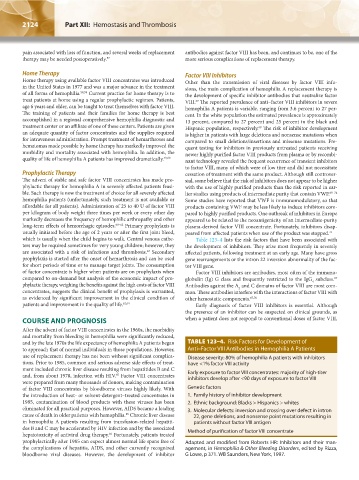
               and by the late 1970s the life expectancy of hemophilia A patients began   TABLE 123–4.  Risk Factors for Development of
               to approach that of normal individuals in those populations. However,   Anti–Factor VIII Antibodies in Hemophilia A Patients
               use of replacement therapy has not been without significant complica-  Disease severity: 80% of hemophilia A patients with inhibitors
               tions. Prior to 1985, common and serious adverse side effects of treat-  have <1% factor VIII activity
               ment included chronic liver disease resulting from hepatitides B and C   Early exposure to factor VIII concentrates: majority of high-titer
               and, from about 1978, infection with HIV.  Factor VIII concentrates   inhibitors develop after <90 days of exposure to factor VIII
                                               65
               were prepared from many thousands of donors, making contamination
               of factor VIII concentrates by bloodborne viruses highly likely. With   Genetic factors
               the introduction of heat- or solvent-detergent–treated concentrates in   1.  Family history of inhibitor development
               1985, contamination of blood products with these viruses has been   2.  Ethnic background: Blacks > Hispanics > whites
               eliminated for all practical purposes. However, AIDS became a leading   3.  Molecular defects: inversion and crossing over defect in intron
                                                  65
               cause of death in older patients with hemophilia.  Chronic liver disease   22, gene deletions, and nonsense point mutations resulting in
               in hemophilia A patients resulting from transfusion-related hepatiti-  patients without factor VIII antigen
               des B and C may be accelerated by HIV infection and by the associated   Method of purification of factor VIII concentrate
               hepatotoxicity of antiviral drug therapy.  Fortunately, patients treated
                                            66
               prophylactically after 1985 can expect almost normal life spans free of   Adapted and modified from Roberts HR: Inhibitors and their man-
               the complications of hepatitis, AIDS, and other currently recognized   agement, in Hemophilia & Other Bleeding Disorders, edited by Rizza,
               bloodborne viral diseases. However, the development of inhibitor   G Lowe, p 371. WB Saunders, New York, 1997.


          Kaushansky_chapter 123_p2113-2132.indd   2124                                                                 9/21/15   4:36 PM

