


Page 2152 - Williams Hematology ( PDFDrive )
P. 2152
2126  Part XII:  Hemostasis and Thrombosis                    Chapter 123:  Hemophilia A and Hemophilia B            2127


                                        Exons   1       2 3    4         5   6             7   8
                                  Gene  5'                                                              3' (35 kb)


                                                                   mRNA
                                                         5'                       3'


                              Exons   1      2   3   4    5  ∗      6      ∗   7          8
                                    Sig/PP  GLA    EGF1 EGF2 Activation peptide  Protease domain


                                         1                  145           180                             415
                                         Tyr                                                              Thr
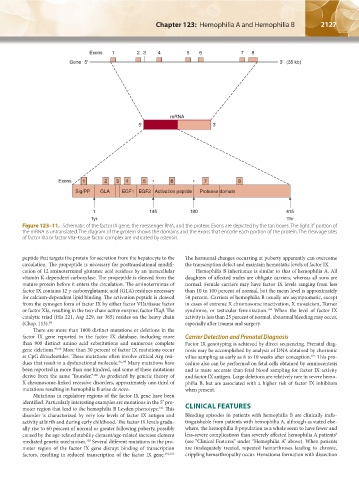
                  Figure 123–11.  Schematic of the factor IX gene, the messenger RNA, and the protein. Exons are depicted by the tan boxes. The light 3′ portion of
                  the mRNA is untranslated. The diagram of the protein shows the domains and the exons that encode each portion of the protein. The cleavage sites
                  of factor XIa or factor VIIa–tissue factor complex are indicated by asterisks.


                  peptide that targets the protein for secretion from the hepatocyte to the   The hormonal changes occurring at puberty apparently can overcome
                  circulation. The propeptide is necessary for posttranslational modifi-  the transcription defect and maintain hemostatic levels of factor IX.
                  cation of 12 aminoterminal glutamic acid residues by an intracellular   Hemophilia B inheritance is similar to that of hemophilia A. All
                  vitamin K-dependent carboxylase. The propeptide is cleaved from the   daughters of affected males are obligate carriers, whereas all sons are
                  mature protein before it enters the circulation. The aminoterminus of   normal. Female carriers may have factor IX levels ranging from less
                  factor IX contains 12 γ-carboxyglutamic acid (GLA) residues necessary   than 10 to 100 percent of normal, but the mean level is approximately
                  for calcium-dependent lipid binding. The activation peptide is cleaved   50 percent. Carriers of hemophilia B usually are asymptomatic, except
                  from the zymogen form of factor IX by either factor VIIa/tissue factor   in cases of extreme X chromosome inactivation, X mosaicism, Turner
                  or factor XIa, resulting in the two-chain active enzyme, factor IXaβ. The   syndrome, or testicular feminization.  When the level of factor IX
                                                                                                    104
                  catalytic triad (His 221, Asp 229, ser 365) resides on the heavy chain   activity is less than 25 percent of normal, abnormal bleeding may occur,
                  (Chap. 113). 94                                       especially after trauma and surgery.
                     There are more than 1000 distinct mutations or deletions in the
                  factor IX gene reported in the factor IX database, including more   Carrier Detection and Prenatal Diagnosis
                  than 900 distinct amino acid substitutions and numerous complete   Factor IX genotyping is achieved by direct sequencing. Prenatal diag-
                  gene deletions. 95,96  More than 30 percent of factor IX mutations occur   nosis may be accomplished by analysis of DNA obtained by chorionic
                  at CpG dinucleotides. These mutations often involve critical Arg resi-  villus sampling as early as 8 to 10 weeks after conception.  This pro-
                                                                                                                   105
                  dues that result in a dysfunctional molecule. 96–99  Many mutations have   cedure also can be performed on fetal cells obtained by amniocentesis
                  been reported in more than one kindred, and some of these mutations   and is more accurate than fetal blood sampling for factor IX activity
                  derive from the same “founder.”  As predicted by genetic theory of    and factor IX antigen. Large deletions are relatively rare in severe hemo-
                                          100
                  X chromosome- linked recessive disorders, approximately one-third of   philia B, but are associated with a higher risk of factor IX inhibitors
                  mutations resulting in hemophilia B arise de novo.    when present.
                     Mutations in regulatory regions of the factor IX gene have been
                  identified. Particularly interesting examples are mutations in the 5′ pro-
                  moter region that lead to the hemophilia B Leyden phenotype.  This   CLINICAL FEATURES
                                                                101
                  disorder is characterized by very low levels of factor IX antigen and   Bleeding episodes in patients with hemophilia B are clinically indis-
                  activity at birth and during early childhood. The factor IX levels gradu-  tinguishable from patients with hemophilia A, although as stated else-
                  ally rise to 60 percent of normal or greater following puberty, possibly   where, the hemophilia B population as a whole seem to have fewer and
                                                                                                                           9
                  caused by the age-related stability element/age-related increase element   less-severe complications than severely affected hemophilia A patients
                  mediated genetic mechanism.  Several different mutations in the pro-  (see “Clinical Features” under “Hemophilia A” above). When patients
                                       102
                  moter  region of  the factor  IX gene disrupt  binding of transcription   are  inadequately  treated, repeated  hemarthroses  leading  to chronic,
                  factors, resulting in reduced transcription of the factor IX gene. 101,103     crippling hemarthropathy occur. Hematoma formation with dissection


          Kaushansky_chapter 123_p2113-2132.indd   2127                                                                 9/21/15   4:36 PM

