


Page 2225 - Williams Hematology ( PDFDrive )
P. 2225
2200           Part XII:  Hemostasis and Thrombosis                                                                                                               Chapter 129:  Disseminated Intravascular Coagulation           2201


                  PATHOGENESIS                                            Endothelial perturbation constitutes a  sine qua non for most
                                                                      patients with DIC. Following injury or infection, the integrity of the
               INFLAMMATION AND ENDOTHELIUM IN                        endothelium is compromised, mononuclear cells are activated by cytok-
               DISSEMINATED INTRAVASCULAR                             ine and hormonal signals, additional cytokines and surface receptors
                                                                      are upregulated, procoagulant proteins and platelets are activated, the
               COAGULATION                                            endothelium changes from an anticoagulant to procoagulant surface,
               Various triggers cause an hemostatic imbalance that gives rise to a pro-  and fibrinolysis is impeded. This sequence of events is typical for the
               coagulant state (Fig. 129–1). The most important mediators responsi-  systemic inflammatory response syndrome and can lead to microvascu-
               ble for this imbalance are cytokines.  There is an extensive crosstalk   lar thrombosis with ensuing multiorgan dysfunction and eventually to
                                          21
               between coagulation and inflammatory systems, whereby inflammation   multiorgan failure.
               leads to activation of coagulation, and coagulation stimulates inflam-
               matory activity.  These interactions are highlighted in sepsis-induced   ROLE OF CYTOKINES AND TISSUE FACTOR
                           22
               systemic activation of coagulation and inflammation that lead to spe-  Tissue factor (TF) plays a central role in the initiation of inflammation-
               cific organ dysfunctions.  The endothelium of the capillary bed is the   induced coagulation in DIC.  Blocking TF activity completely inhibits
                                 23
                                                                                           28
               most important interface in which the interaction between inflamma-  inflammation-induced thrombin generation in experimental models of
               tion and coagulation takes place. Endothelial cells may be a source of   endotoxemia or bacteremia. 29,30  Most cells constitutively expressing TF
               tissue factor and can thereby be involved in the initiation of coagulation   are found in tissues not in direct contact with blood, such as the adven-
               activation. All physiologic anticoagulant systems and various adhesion   titial layer of larger blood vessels. TF becomes exposed to blood upon
               molecules that may modulate both inflammation and coagulation are   disruption of the vascular integrity, or when cells present in the circula-
               connected to the endothelium. In sepsis, endothelial glycosaminogly-  tion, such as monocytes, are triggered to express TF. The in vivo expres-
               cans present in the glycocalyx are downregulated by proinflammatory   sion of TF is dependent on interleukin (IL)-6 generation; inhibition of
               cytokines, thereby impairing the functions of antithrombin (AT), tis-  IL-6, unlike inhibition of other proinflammatory cytokines, completely
               sue factor pathway inhibitor (TFPI), leukocyte adhesion, and leukocyte   abrogates TF-dependent thrombin generation in experimental endotox-
               transmigration. Because the glycocalyx also plays a role in other endo-  emia. 21,31  In severe sepsis, monocytes, stimulated by proinflammatory
               thelial functions, including maintenance of the vascular barrier func-  cytokines, express TF, which leads to systemic activation of coagula-
               tion, nitric oxide–mediated vasodilation, and antioxidant activity, all   tion.  Even in experimental low-dose endotoxemia in healthy subjects,
                                                                         32
               these processes can be impaired in DIC (see “Role of Oxidative Stress   a 125-fold increase in TF mRNA levels in blood monocytes can be
               and Vasoactive Molecules”  below). 24,25  Moreover,  specific  disruption   detected.  A potential alternative source of TF may be endothelial cells,
                                                                            33
               of the glycocalyx results in thrombin generation and platelet adhesion   polymorphonuclear cells, and other cell types. It is hypothesized that
               within a few minutes. 26,27                            TF from these sources is shuttled between cells through microparticles
                                                                      derived from activated mononuclear cells.  However, it is unlikely that
                                                                                                    34
                                                                      cells other than monocytes synthesize TF in substantial quantities. 32,35
                     Endothelial                                      Tumor necrosis factor (TNF)-α and IL-1, also generated during inflam-
                     cells
                                                                      mation, impair the physiologic anticoagulant pathways. 31,36,37
                          Cytokines               Inflammatory cells
                                                                      AMPLIFYING ROLE OF THROMBIN
                                                                      AND PLATELETS
                                                    Tissue factor     The TF–factor VIIa complex catalyzes the conversion of factor X to Xa,
                                                    expression
                                                                      and factor Xa, in turn, forms the prothrombinase complex with fac-
                                                                      tor Va, prothrombin (factor II), and calcium ions, thereby generating
                                       Impairment of
                                        physiologic                   thrombin, and converting fibrinogen into fibrin. The TF–factor VIIa
                                       anticoagulant                  complex can also activate factor IX, and factor IXa forms the tenase
                                       mechanisms                     complex with activated factor VIII and calcium ions, generating addi-
                                                                      tional factor Xa, thereby forming an essential amplification loop of
                               Inhibition of                          thrombin generation. The assembly of the prothrombinase and tenase
                               fibrinolysis                           complexes are markedly facilitated if a suitable phospholipid surface is
                               because of                             available, such as the membrane of activated platelets. In the setting of
                                 high                                 inflammation-induced activation of coagulation, platelets can be acti-
                              levels of PAI-1
                                                                      vated directly by endotoxin or by proinflammatory mediators, such as
                                                                      the membrane of platelet-activating factor. Thrombin itself is one of the
                                    Microvascular thrombosis &        strongest platelet activators (Chap. 115).
                                    modulation of inflammation            Activation  of  platelets  may  also  accelerate  fibrin  formation  by
                                                                      another mechanism. The expression of TF on monocytes is markedly
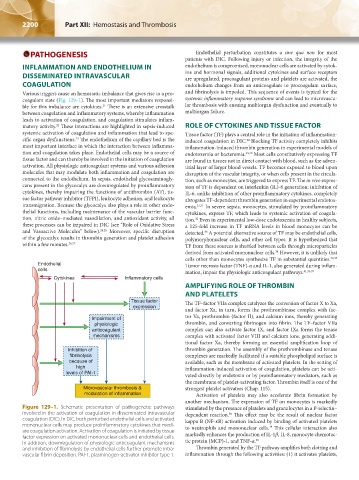
               Figure 129–1.  Schematic presentation of pathogenetic pathways   stimulated by the presence of platelets and granulocytes in a P-selectin–
               involved in the activation of coagulation in disseminated intravascular   dependent reaction.  This effect may be the result of nuclear factor
                                                                                     38
               coagulation (DIC). In DIC, both perturbed endothelial cells and activated   kappa B (NF-κB) activation induced by binding of activated platelets
               mononuclear cells may produce proinflammatory cytokines that medi-  to neutrophils and mononuclear cells.  This cellular interaction also
                                                                                                  39
               ate coagulation activation. Activation of coagulation is initiated by tissue   markedly enhances the production of IL-1β, IL-8, monocyte chemotac-
               factor expression on activated mononuclear cells and endothelial cells.        40
               In addition, downregulation of physiologic anticoagulant mechanisms   tic protein (MCP)-1, and TNF-α.
               and inhibition of fibrinolysis by endothelial cells further promote intra-  Thrombin generated by the TF pathway amplifies both clotting and
               vascular fibrin deposition. PAI-1, plasminogen-activator inhibitor type 1.  inflammation through the following activities: (1) it activates platelets,


          Kaushansky_chapter 129_p2199-2220.indd   2200                                                                 17/09/15   3:45 pm

