


Page 2226 - Williams Hematology ( PDFDrive )
P. 2226
2200  Part XII:  Hemostasis and Thrombosis            Chapter 129:  Disseminated Intravascular Coagulation           2201


                  giving rise to platelet aggregation and augmenting platelet functions   activated by thrombin through cleavage of a specific aminoterminus bond
                  in coagulation; (2) it activates factors VIII, V, and XI, yielding fur-  creating a tethered ligand that activates the receptor. PAR-2 can be cleaved
                  ther thrombin generation; (3) it activates proinflammatory factors via     by factor Xa–TF–factor VIIa complex and by other proteases.  Activated
                                                                                                                   48
                  protease-activated receptors (PARs); (4) it activates factor XIII to factor   PARs then lead through mitogen-activated protein kinase and NF-κB
                  XIIIa, which crosslinks fibrin clots; (5) it activates thrombin-activatable   signaling pathways to cell motility, shape change, proliferation, endoge-
                  fibrinolysis inhibitor (TAFI), making clots resistant to fibrinolysis; and   nous secretagogue release, and apoptosis. The activated protein C (APC)–
                  (6) it increases expression of adhesion molecules, such as L-selectin,   endothelial protein C receptor complex (see “Role of Natural Antico-
                  thereby promoting the inflammatory effects of leukocytes. 41  agulant Pathways” below) appears to be the “off switch” for PAR activa-
                     Paradoxically, at low concentrations, thrombin exhibits both anti-  tion by the proteases. These counterbalances determine the magnitude
                  inflammatory and anticoagulant effects because it binds to thrombo-  of coagulation and inflammatory upregulation by PARs. For exam-
                  modulin and activates protein C to the activated form, which, in turn,   ple, factor VIIa–TF binding to PAR-2 in the lungs is proinflamma-
                  downregulates inflammation and serves as an “off switch” for further   tory and appears to play a role in acute respiratory distress syndrome
                  thrombin generation (Chap. 116).                      (ARDS), raising the possibility that TFPI might be therapeutic in this
                                                                                  49
                                                                        circumstance.  This finding is consistent with data from animal stud-
                                                                        ies demonstrating that TFPI can protect baboons from a LD100 of
                  ROLE OF COAGULATION PROTEASES IN                      Escherichia coli, likely by impeding factor VIIa–TF activation of PAR-2
                  UPREGULATING INFLAMMATION                             and thereby attenuating release of IL-6 and other proinflammatory agents.
                  Coagulation proteases and protease inhibitors not only interact with
                  coagulation proteins, but also with specific cell receptors to induce sig-  ROLE OF FIBRINOGEN AND FIBRIN
                  naling pathways. In particular, protease interactions that affect inflam-  Fibrinogen and fibrin directly influence the production of proinflamma-
                  matory processes may be important in critically ill patients. Coagulation   tory cytokines and chemokines (including TNF-α, IL-1β, and MCP-1)
                  of whole blood in vitro results in a detectable expression of IL-1β mRNA   by mononuclear cells and endothelial cells.  Fibrinogen-deficient mice
                                                                                                       50
                  in blood cells,  and thrombin markedly enhances endotoxin-induced   display inhibition of macrophage adhesion and less thrombin-mediated
                            42
                  IL-1 activity in culture supernatants of guinea pig macrophages.  Simi-  cytokine production in vivo. The effects of fibrinogen on mononuclear
                                                               43
                  larly, clotted blood produces IL-8 in vitro. 44       cells seem to be mediated by toll-like receptor-4, which is also the recep-
                     Factor Xa, thrombin, and fibrin can also activate endothelial cells,   tor of endotoxin.
                  eliciting the synthesis of IL-6 and IL-8. 45,46  Coagulation proteases such
                  as thrombin, factor Xa, and factor VIIa–TF complex induce inflamma-  ROLE OF NATURAL ANTICOAGULANT
                  tory upregulation via leukocyte, endothelial cell, and platelet PAR-1,
                  PAR-2, PAR-3, and PAR-4, which are located on leukocytes, endothelial   PATHWAYS
                               47
                  cells, and platelets.  PARs have an extracellular domain, seven trans-  Procoagulant activity is regulated by three important anticoagulant
                  membrane domains, and an intracellular domain that is coupled to spe-  pathways: AT, the protein C system, and TFPI. In DIC, the function of
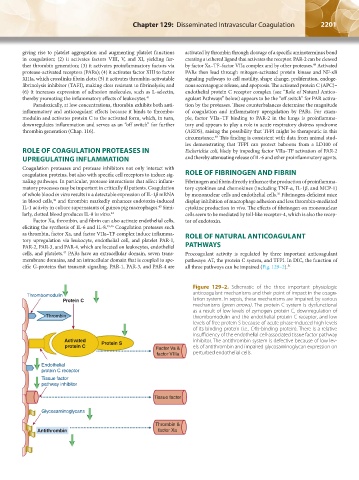
                  cific G-proteins that transmit signaling. PAR-1, PAR-3, and PAR-4 are   all three pathways can be impaired (Fig. 129–2). 51


                                                                           Figure 129–2.  Schematic  of  the  three  important  physiologic
                                                                           anticoagulant mechanisms and their point of impact in the coagu-
                   Thrombomodulin
                               Protein C                                   lation system. In sepsis, these mechanisms are impaired by various
                                                                           mechanisms (green arrows). The protein C system is dysfunctional
                                                                           as a result of low levels of zymogen protein C, downregulation of
                          Thrombin                                         thrombomodulin and the endothelial protein C receptor, and low
                                                                           levels of free protein S because of acute phase-induced high levels
                                                                           of its binding protein (i.e., C4b-binding protein). There is a relative
                                                                           insufficiency of the endothelial cell-associated tissue factor pathway
                                Activated   Protein S                      inhibitor. The antithrombin system is defective because of low lev-
                                protein C                      Factor Va &  els of antithrombin and impaired glycosaminoglycan expression on
                                                               factor VIIIa  perturbed endothelial cells.
                        Endothelial
                        protein C receptor
                        Tissue factor
                        pathway inhibitor

                                                              Tissue factor

                        Glycosaminoglycans

                                                              Thrombin &
                       Antithrombin                            factor Xa


          Kaushansky_chapter 129_p2199-2220.indd   2201                                                                 17/09/15   3:45 pm

