


Page 2230 - Williams Hematology ( PDFDrive )
P. 2230
2204  Part XII:  Hemostasis and Thrombosis            Chapter 129:  Disseminated Intravascular Coagulation           2205


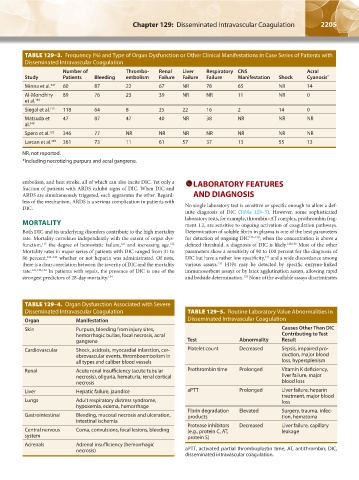
                   TABLE 129–3.  Frequency (%) and Type of Organ Dysfunction or Other Clinical Manifestations in Case Series of Patients with
                   Disseminated Intravascular Coagulation
                               Number of             Thrombo-   Renal   Liver   Respiratory  CNS                 Acral
                   Study       Patients   Bleeding   embolism   Failure  Failure  Failure  Manifestation  Shock  Cyanosis *
                   Minna et al. 347  60   87         22         67      NR      78        65            NR       14
                   Al-Mondhiry   89       76         23         39      NR      NR        11            NR       0
                   et al. 116
                   Siegal et al. 115  118  64        8          25      22      16        2             14       0
                   Matsuda et   47        87         47         40      NR      38        NR            NR       NR
                   al. 348
                   Spero et al. 122  346  77         NR         NR      NR      NR        NR            NR       NR
                   Larcan et al. 349  361  73        11         61      57      37        13            55       13

                  NR, not reported.
                  *Including necrotizing purpura and acral gangrene.


                  embolism, and heat stroke, all of which can also incite DIC. Yet only a     LABORATORY FEATURES
                  fraction of patients with ARDS exhibit signs of DIC. When DIC and
                  ARDS are simultaneously triggered, each aggravates the other. Regard-  AND DIAGNOSIS
                  less of the mechanism, ARDS is a serious complication in patients with
                  DIC.                                                  No single laboratory test is sensitive or specific enough to allow a def-
                                                                        inite diagnosis of DIC (Table 129–5). However, some sophisticated
                                                                        laboratory tests, for example, thrombin–AT complex, prothrombin frag-
                  MORTALITY                                             ment 1.2, are sensitive to ongoing activation of coagulation pathways.
                  Both DIC and its underlying disorders contribute to the high mortality   Determination of soluble fibrin in plasma is one of the best parameters
                  rate. Mortality correlates independently with the extent of organ dys-  for detection of ongoing DIC 125–128 ; when the concentration is above a
                  function,  the degree of hemostatic failure,  and increasing age.    defined threshold, a diagnosis of DIC is likely. 129,130  Most of the other
                                                                   122
                        115
                                                   121
                  Mortality rates in major series of patients with DIC ranged from 31 to   parameters show a sensitivity of 90 to 100 percent for the diagnosis of
                  86 percent, 121–124  whether or not heparin was administrated. Of note,   DIC but have a rather low specificity,  and a wide discordance among
                                                                                                   131
                  there is a clear correlation between the severity of DIC and the mortality   various assays.  FDPs may be detected by specific enzyme-linked
                                                                                   132
                  rate. 121,123,124  In patients with sepsis, the presence of DIC is one of the   immunosorbent assays or by latex agglutination assays, allowing rapid
                  strongest predictors of 28-day mortality. 124         and bedside determination.  None of the available assays discriminates
                                                                                            133
                   TABLE 129–4.  Organ Dysfunction Associated with Severe
                   Disseminated Intravascular Coagulation                TABLE 129–5.  Routine Laboratory Value Abnormalities in
                   Organ            Manifestation                        Disseminated Intravascular Coagulation
                   Skin             Purpura, bleeding from injury sites,                                 Causes Other Than DIC
                                    hemorrhagic bullae, focal necrosis, acral                            Contributing to Test
                                    gangrene                             Test              Abnormality   Result
                   Cardiovascular   Shock, acidosis, myocardial infarction, cer-  Platelet count  Decreased  Sepsis, impaired pro-
                                    ebrovascular events, thromboembolism in                              duction, major blood
                                    all types and caliber blood vessels                                  loss, hypersplenism
                   Renal            Acute renal insufficiency (acute tubular   Prothrombin time  Prolonged  Vitamin K deficiency,
                                    necrosis), oliguria, hematuria, renal cortical                       liver failure, major
                                    necrosis                                                             blood loss
                   Liver            Hepatic failure, jaundice            aPTT              Prolonged     Liver failure, heparin
                                                                                                         treatment, major blood
                   Lungs            Adult respiratory distress syndrome,                                 loss
                                    hypoxemia, edema, hemorrhage
                                                                         Fibrin degradation   Elevated   Surgery, trauma, infec-
                   Gastrointestinal  Bleeding, mucosal necrosis and ulceration,   products               tion, hematoma
                                    intestinal ischemia
                                                                         Protease inhibitors   Decreased  Liver failure, capillary
                   Central nervous   Coma, convulsions, focal lesions, bleeding  (e.g., protein C, AT,   leakage
                   system                                                protein S)
                   Adrenals         Adrenal insufficiency (hemorrhagic
                                    necrosis)                           aPTT, activated partial thromboplastin time, AT, antithrombin; DIC,
                                                                        disseminated intravascular coagulation.


          Kaushansky_chapter 129_p2199-2220.indd   2205                                                                 17/09/15   3:45 pm

