


Page 2231 - Williams Hematology ( PDFDrive )
P. 2231
2206 Part XII: Hemostasis and Thrombosis Chapter 129: Disseminated Intravascular Coagulation 2207
between degradation products of crosslinked fibrin and fibrinogen, a 80
situation that may cause spuriously high results. 134,135 The specificity of Not overt DIC Overt DIC
high levels of FDPs is therefore limited and many other conditions, such 70
as trauma, recent surgery, inflammation or venous thromboembolism,
are associated with elevated FDPs.
Newly developed tests are aimed at the detection of neoantigens 60
on degraded crosslinked fibrin, one of which detects an epitope related
to plasmin-degraded crosslinked γ-chain, associated with D-dimer for- Mortality % 50
mation. These tests better differentiate degradation of crosslinked fibrin
136
from fibrinogen or fibrinogen degradation products. D-dimer level is 40
substantially elevated in patients with DIC, but this poorly distinguishes
patients with DIC from patients with venous thromboembolism, recent 30
surgery, or inflammatory conditions. 133,137
In routine practice, simple laboratory tests in conjunction with 20
clinical considerations are used for establishing the diagnosis of DIC. 0–2 3 4 5 6 7
The simple tests include platelet count, prothrombin time, fibrinogen DIC score
level, and fibrin-related markers, such as FDP or D-dimer. Caution
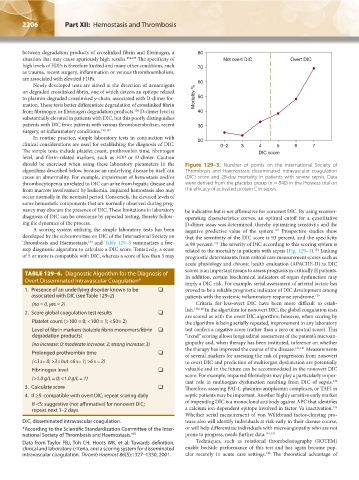
should be exercised when using these laboratory parameters in the Figure 129–3. Number of points on the International Society of
algorithms described below, because an underlying disease by itself can Thrombosis and Haemostasis disseminated intravascular coagulation
cause an abnormality. For example, impairment of hemostasis and/or (DIC) score and 28-day mortality in patients with severe sepsis. Data
thrombocytopenia unrelated to DIC can arise from hepatic disease and were derived from the placebo group (n = 840) in the Prowess trial on
from marrow involvement by leukemia. Impaired hemostasis also may the efficacy of activated protein C in sepsis.
occur normally in the neonatal period. Conversely, the elevated levels of
some hemostatic components that are normally observed during preg-
nancy may obscure the presence of DIC. These limitations in laboratory be indicative but is not affirmative for nonovert DIC. By using receiver-
diagnosis of DIC can be overcome by repeated testing, thereby follow- operating characteristics curves, an optimal cutoff for a quantitative
ing the dynamics of the process. D-dimer assay was determined, thereby optimizing sensitivity and the
A scoring system utilizing the simple laboratory tests has been negative predictive value of the system. Prospective studies show
131
developed by the subcommittee on DIC of the International Society on that the sensitivity of the DIC score is 93 percent, and the specificity
138
Thrombosis and Haemostasis, and Table 129–6 summarizes a five- is 98 percent. The severity of DIC according to this scoring system is
123
step diagnostic algorithm to calculate a DIC score. Tentatively, a score related to the mortality in patients with sepsis (Fig. 129–3). Linking
124
of 5 or more is compatible with DIC, whereas a score of less than 5 may prognostic determinants from critical care measurement scores such as
acute physiology and chronic health evaluation (APACHE-II) to DIC
scores is an important means to assess prognosis in critically ill patients.
TABLE 129–6. Diagnostic Algorithm for the Diagnosis of In addition, certain biochemical indicators of organ dysfunction may
Overt Disseminated Intravascular Coagulation* imply a DIC risk. For example, serial assessment of arterial lactate has
1. Presence of an underlying disorder known to be proved to be a reliable prognostic indicator of DIC development among
associated with DIC (see Table 129–2) patients with the systemic inflammatory response syndrome. 139
(no = 0, yes = 2) Criteria for less-overt DIC have been more difficult to estab-
2. Score global coagulation test results lish. 138,140 In the algorithm for nonovert DIC, the global coagulation tests
are scored as with the overt DIC algorithm; however, when scoring by
Platelet count (>100 = 0; <100 = 1; <50= 2) the algorithm is being serially repeated, improvement in any laboratory
Level of fibrin markers (soluble fibrin monomers/fibrin test confers a negative score (rather than a zero or neutral score). This
degradation products) “trend” scoring allows longitudinal assessment of the patient’s microan-
(no increase: 0; moderate increase: 2; strong increase: 3) giopathy and, when therapy has been instituted, inference on whether
121,141
Prolonged prothrombin time the therapy has improved the course of the disease. Measurements
of several markers for assessing the risk of progression from nonovert
(<3 s= 0; >3 s but <6 s= 1; >6 s = 2) to overt DIC and prediction of multiorgan dysfunction are potentially
Fibrinogen level valuable and in the future can be accommodated in the nonovert DIC
score. For example, impaired fibrinolysis may play a particularly impor-
(>1.0 g/L = 0; <1.0 g/L = 1)
tant role in multiorgan dysfunction resulting from DIC of sepsis.
142
3. Calculate score Therefore, assaying PAI-1, plasmin–antiplasmin complexes, or TAFI in
4. If ≥5: compatible with overt DIC; repeat scoring daily septic patients may be important. Another highly sensitive early marker
of impending DIC is a monoclonal antibody against APC that identifies
If <5: suggestive (not affirmative) for nonovert DIC; 143
repeat next 1–2 days a calcium ion-dependent epitope involved in factor Va inactivation.
Whether serial measurement of von Willebrand factor-cleaving pro-
DIC, disseminated intravascular coagulation. tease also will identify individuals at risk early in their disease course,
*According to the Scientific Standardization Committee of the Inter- or will help differentiate individuals with microangiopathy who are not
national Society of Thrombosis and Haemostasis. 138 prone to progress, needs further data. 144,145
Data from Taylor FBJ, Toh CH, Hoots WK, et al: Towards definition, Techniques, such as rotational thrombelastography (ROTEM)
clinical and laboratory criteria, and a scoring system for disseminated enable bedside performance of this test and has again become pop-
intravascular coagulation. Thromb Haemost 86(5):1327–1330, 2001. ular recently in acute care settings. The theoretical advantage of
146
Kaushansky_chapter 129_p2199-2220.indd 2206 17/09/15 3:46 pm

