


Page 2299 - Williams Hematology ( PDFDrive )
P. 2299
2274           Part XII:  Hemostasis and Thrombosis                                                                                                                                   Chapter 133:  Venous Thrombosis            2275


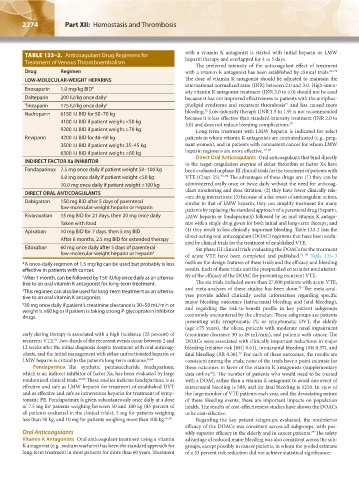
                TABLE 133–2.  Anticoagulant Drug Regimens for         with a vitamin K antagonist is started with initial heparin or LMW
                                                                      heparin therapy and overlapped for 4 to 5 days.
                Treatment of Venous Thromboembolism
                                                                          The  preferred  intensity  of  the  anticoagulant  effect  of  treatment
                Drug        Regimen                                   with a vitamin K antagonist has been established by clinical trials. 69–72
                LOW-MOLECULAR-WEIGHT HEPARINS                         The dose of vitamin K antagonist should be adjusted to maintain the
                                                                      international normalized ratio (INR) between 2.0 and 3.0. High-inten-
                Enoxaparin  1.0 mg/kg BID*                            sity vitamin K antagonist treatment (INR 3.0 to 4.0) should not be used
                Dalteparin  200 IU/kg once daily †                    because it has not improved effectiveness in patients with the antiphos-
                                                                                                        71
                Tinzaparin  175 IU/kg once daily ‡                    pholipid syndrome and recurrent thrombosis  and has caused more
                                                                             72
                Nadroparin  6150 IU BID for 50–70 kg                  bleeding.  Low-intensity therapy (INR 1.5 to 1.9) is not recommended
                            4100 IU BID if patient weighs <50 kg      because it is less effective than standard-intensity treatment (INR 2.0 to
                                                                      3.0) and does not reduce bleeding complications.
                                                                                                         70
                            9200 IU BID if patient weighs >70 kg          Long-term treatment with LMW heparin is indicated for select
                Reviparin   4200 IU BID for 46–60 kg                  patients in whom vitamin K antagonists are contraindicated (e.g., preg-
                            3500 IU BID if patient weighs 35–45 kg    nant women), and in patients with concurrent cancer for whom LMW
                            6300 IU BID if patient weighs >60 kg      heparin regimens are more effective.  67,68
                                                                          Direct Oral Anticoagulants  Oral anticoagulants that bind directly
                INDIRECT FACTOR Xa INHIBITOR                          to the target coagulation enzyme of either thrombin or factor Xa have
                Fondaparinux 7.5 mg once daily if patient weight 50–100 kg  been evaluated in phase III clinical trials for the treatment of patients with
                            5.0 mg once daily if patient weight <50 kg  VTE (Chap. 25). 73–78  The advantages of these drugs are: (1) they can be
                            10.0 mg once daily if patient weight >100 kg  administered orally once or twice daily without the need for anticoag-
                DIRECT ORAL ANTICOAGULANTS                            ulant monitoring and dose titration; (2) they have fewer clinically rele-
                                                                      vant drug interactions; (3) because of a fast onset of anticoagulant action,
                Dabigatran  150 mg BID after 5 days of parenteral     similar to that of LMW heparin, they can simplify treatment for many
                            low-molecular-weight heparin or heparin   patients by replacing the standard approach of a parenteral drug (heparin,
                Rivaroxaban  15 mg BID for 21 days, then 20 mg once daily  LMW heparin or fondaparinux) followed by an oral vitamin K antago-
                            Taken with food                           nist with a single drug given for both initial and long-term therapy; and
                Apixaban    10 mg BID for 7 days, then 5 mg BID       (4) they result in less clinically important bleeding. Table 133-2 lists the
                            After 6 months, 2.5 mg BID for extended therapy  direct-acting oral anticoagulant (DOAC) regimens that have been evalu-
                                                                      ated by clinical trials for the treatment of established VTE.
                Edoxaban    60 mg once daily after 5 days of parenteral   Six phase III clinical trials evaluating the DOACs for the treatment
                            low-molecular-weight heparin or heparin §
                                                                      of acute VTE have been completed and published. 73–78   Table 133–3
               *A once-daily regimen of 1.5 mg/kg can be used but probably is less   outlines the design features of these trials and the efficacy and bleeding
               effective in patients with cancer.                     results. Each of these trials met the prespecified criteria for noninferior-
               † After 1 month, can be followed by 150 IU/kg once daily as an alterna-  ity of the efficacy of the DOAC for preventing recurrent VTE.
               tive to an oral vitamin K antagonist for long-term treatment.  The six trials included more than 27,000 patients with acute VTE,
                                                                                                            79
               ‡ This regimen can also be used for long-term treatment as an alterna-  and meta-analyses of these studies has been done.  The meta-anal-
               tive to an oral vitamin K antagonist.                  yses provide added clinically useful information regarding specific
               § 30 mg once daily if patient’s creatinine clearance is 30–50 mL/min or   major bleeding outcomes  (intracranial  bleeding and fatal  bleeding),
               weight is ≤60 kg or if patient is taking strong P-glycoprotein inhibitor   and regarding the risk-to-benefit profile in key patient subgroups
               drugs.                                                 commonly encountered by the clinician. These subgroups are patients
                                                                      presenting with symptomatic PE or symptomatic DVT, the elderly
                                                                      (age ≥75 years), the obese, patients with moderate renal impairment
               early during therapy is associated with a high incidence (25 percent) of   (creatinine clearance 30 to 49 mL/min), and patients with cancer. The
               recurrent VTE.  Two-thirds of the recurrent events occur between 2 and   DOACs were associated with clinically important reductions in major
                          63
               12 weeks after the initial diagnosis despite treatment with oral anticoag-  bleeding (relative risk [RR] 0.61), intracranial bleeding (RR 0.37), and
               ulants, and the initial management with either unfractionated heparin or   fatal bleeding (RR 0.36).  For each of these outcomes, the results are
                                                                                        79
               LMW heparin is critical to the patient’s long-term outcome. 63,64  consistent among the trials; none of the trials have a point estimate for
                   Fondaparinux  The synthetic pentasaccharide fondaparinux,   these outcomes in favor of the vitamin K antagonists (supplementary
               which is an indirect inhibitor of factor Xa, has been evaluated by large   data online ). The number of patients who would need to be treated
                                                                              79
               randomized clinical trials. 65,66  These studies indicate fondaparinux is as   with a DOAC rather than a vitamin K antagonist to avoid one event of
               effective and safe as LMW heparin for treatment of established DVT   intracranial bleeding is 588, and for fatal bleeding is 1250. In view of
               and as effective and safe as intravenous heparin for treatment of symp-  the large number of VTE patients each year, and the devastating nature
               tomatic PE. Fondaparinux is given subcutaneously once daily at a dose   of these bleeding events, these are important impacts on population
               of 7.5 mg for patients weighing between 50 and 100 kg (85 percent of   health. The results of cost-effectiveness studies have shown the DOACs
               all patients evaluated in the clinical trials), 5 mg for patients weighing   to be cost-effective.
               less than 50 kg, and 10 mg for patients weighing more than 100 kg. 65,66  Regarding the key patient subgroups evaluated, the noninferior
                                                                      efficacy of the DOACs was consistent across all subgroups, with pos-
               Oral Anticoagulants                                    sibly superior efficacy in the elderly and in cancer patients.  The safety
                                                                                                                79
               Vitamin K Antagonists  Oral anticoagulant treatment using a vitamin   advantage of reduced major bleeding was also consistent across the sub-
               K antagonist (e.g., sodium warfarin) has been the standard approach for   groups, except possibly in cancer patients, in whom the pooled estimate
               long-term treatment in most patients for more than 60 years. Treatment   of a 33 percent risk reduction did not achieve statistical significance.


          Kaushansky_chapter 133_p2267-2280.indd   2274                                                                 9/18/15   10:53 AM

