


Page 2300 - Williams Hematology ( PDFDrive )
P. 2300
2274  Part XII:  Hemostasis and Thrombosis                                Chapter 133:  Venous Thrombosis            2275


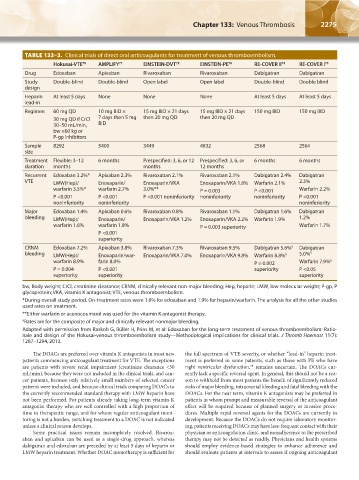
                   TABLE 133–3.  Clinical trials of direct oral anticoagulants for treatment of venous thromboembolism.
                            Hokusai-VTE 78  AMPLIFY 77    EINSTEIN-DVT 75    EINSTEIN-PE 76     RE-COVER II 74  RE-COVER I 73
                   Drug     Edoxaban       Apixaban       Rivaroxaban        Rivaroxaban        Dabigatran     Dabigatran
                   Study    Double-blind   Double-blind   Open label         Open label         Double-blind   Double blind
                   design
                   Heparin   At least 5 days  None        None               None               At least 5 days  At least 5 days
                   lead-in
                   Regimen  60 mg QD       10 mg BID ×    15 mg BID × 21 days   15 mg BID × 21 days   150 mg BID  150 mg BID
                            30 mg QD if CrCl   7 days then 5 mg   then 20 mg QD  then 20 mg QD
                            30–50 mL/min,   BID
                            bw ≤60 kg or
                            P-gp inhibitors
                   Sample   8292           5400           3449               4832               2568           2564
                   size
                   Treatment  Flexible: 3–12   6 months   Prespecified: 3, 6, or 12  Prespecified: 3, 6, or   6 months  6 months
                   duration  months                       months             12 months
                   Recurrent   Edoxaban 3.2%*  Apixaban 2.3%  Rivaroxaban 2.1%  Rivaroxaban 2.1%  Dabigatran 2.4%  Dabigatran
                   VTE      LMW(Hep)/      Enoxaparin/    Enoxaparin/VKA     Enoxaparin/VKA 1.8%  Warfarin 2.1%  2.3%
                            warfarin 3.5%*  warfarin 2.7%  3.0%**            P = 0.003          P <0.001       Warfarin 2.2%
                            P <0.001       P <0.001       P <0.001 noninferiority  noninferiority  noninferiority  P <0.001
                            noninferiority  noninferiority                                                     noninferiority
                   Major    Edoxaban 1.4%  Apixaban 0.6%  Rivaroxaban 0.8%   Rivaroxaban 1.1%   Dabigatran 1.6%  Dabigatran
                   bleeding  LMW(Hep)/     Enoxaparin/    Enoxaparin/VKA 1.2%  Enoxaparin/VKA 2.2%  Warfarin 1.9%  1.2%
                            warfarin 1.6%  warfarin 1.8%                     P = 0.003 superiority             Warfarin 1.7%
                                           P <0.001
                                           superiority
                   CRNM     Edoxaban 7.2%  Apixaban 3.8%  Rivaroxaban 7.3%   Rivaroxaban 9.5%   Dabigatran 5.6% §  Dabigatran
                   bleeding  LMW(Hep)/     Enoxaparin/war-  Enoxaparin/VKA 7.0%  Enoxaparin/VKA 9.8%  Warfarin 8.8% §  5.0% §
                            warfarin 8.9%  farin 8.0%                                           P = 0.002      Warfarin 7.9% §
                            P = 0.004      P <0.001                                             superiority    P <0.05
                            superiority    superiority                                                         superiority

                  bw, Body weight; CrCl, creatinine clearance; CRNM, clinically relevant non-major bleeding; Hep, heparin; LMW, low molecular weight; P-gp, P
                  glycoprotein; VKA, vitamin K antagonist; VTE, venous thromboembolism.
                  *During overall study period. On-treatment rates were 1.6% for edoxaban and 1.9% for heparin/warfarin. The analysis for all the other studies
                  used rates on treatment.
                  **Either warfarin or acenocoumarol was used for the vitamin K antagonist therapy.
                  § Rates are for the composite of major and clinically relevant nonmajor bleeding.
                  Adapted with permission from Raskob G, Büller H, Prins M, et al: Edoxaban for the long-term treatment of venous thromboembolism: Ratio-
                  nale and design of the Hokusai-venous thromboembolism study—Methodological implications for clinical trials. J Thromb Haemost 11(7):
                  1287–1294, 2013.

                     The DOACs are preferred over vitamin K antagonists in most new   the full spectrum of VTE severity, or whether “lead-in” heparin treat-
                  patients commencing anticoagulant treatment for VTE. The exceptions   ment is preferred in some patients, such as those with PE who have
                  are patients with severe renal impairment (creatinine clearance <30   right ventricular dysfunction,  remains uncertain. The  DOACs cur-
                                                                                              78
                  mL/min), because they were not included in the clinical trials, and can-  rently lack a specific reversal agent. In general, this should not be a rea-
                  cer patients, because only relatively small numbers of selected cancer   son to withhold from most patients the benefit of significantly reduced
                  patients were included, and because clinical trials comparing DOACs to   risks of major bleeding, intracranial bleeding and fatal bleeding with the
                  the currently recommended standard therapy with LMW heparin have   DOACs. For the near term, vitamin K antagonists may be preferred in
                  not been performed. For patients already taking long-term vitamin K   patients in whom prompt and measurable reversal of the anticoagulant
                  antagonist therapy who are well controlled with a high proportion of   effect will be required because of planned surgery or invasive proce-
                  time in therapeutic range, and for whom regular anticoagulant moni-  dures. Multiple rapid reversal agents for the DOACs are currently in
                  toring is not a burden, switching treatment to a DOAC is not indicated   development. Because the DOACs do not require laboratory monitor-
                  unless a clinical reason develops.                    ing, patients receiving DOACs may have less-frequent contact with their
                     Some practical issues remain incompletely resolved. Rivarox-  physician or anticoagulation clinic, and nonadherence to the prescribed
                  aban  and  apixaban  can  be  used  as  a  single-drug  approach,  whereas   therapy may not be detected as readily. Physicians and health systems
                  dabigatran and edoxaban are preceded by at least 5 days of heparin or   should employ evidence-based strategies to enhance adherence and
                  LMW heparin treatment. Whether DOAC monotherapy is sufficient for   should evaluate patients at intervals to assess if ongoing anticoagulant


          Kaushansky_chapter 133_p2267-2280.indd   2275                                                                 9/18/15   10:53 AM

