


Page 2317 - Williams Hematology ( PDFDrive )
P. 2317
2290  Part XII:  Hemostasis and Thrombosis  Chapter 134:   Atherothrombosis: Disease Initiation, Progression, and Treatment  2291


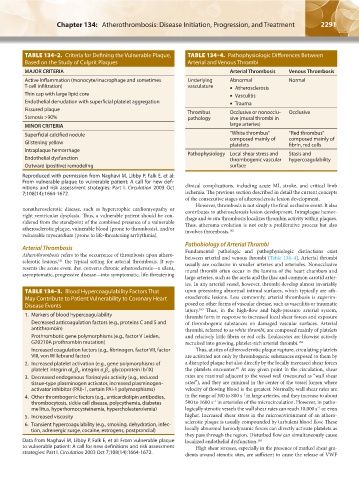
                   TABLE 134–2.  Criteria for Defining the Vulnerable Plaque,   TABLE 134–4.  Pathophysiologic Differences Between
                   Based on the Study of Culprit Plaques                 Arterial and Venous Thrombi
                   MAJOR CRITERIA                                                      Arterial Thrombosis  Venous Thrombosis
                   Active Inflammation (monocyte/macrophage and sometimes   Underlying   Abnormal          Normal
                   T-cell infiltration)                                  vasculature   •  Atherosclerosis
                   Thin cap with large lipid core                                      •  Vasculitis
                   Endothelial denudation with superficial platelet aggregation        •  Trauma
                   Fissured plaque                                       Thrombus      Occlusive or nonocclu-  Occlusive
                   Stenosis >90%                                         pathology     sive (mural thrombi in
                   MINOR CRITERIA                                                      large arteries)
                   Superficial calcified nodule                                        “White thrombus”    “Red thrombus”
                   Glistening yellow                                                   composed mainly of   composed mainly of
                                                                                       platelets
                                                                                                           fibrin, red cells
                   Intraplaque hemorrhage                                Pathophysiology Local shear stress and   Stasis and
                   Endothelial dysfunction                                             thrombogenic vascular   hypercoagulability
                   Outward (positive) remodeling                                       surface
                  Reproduced with permission from Naghavi M, Libby P, Falk E, et al:
                  From vulnerable plaque to vulnerable patient: A call for new defi-
                  nitions and risk assessment strategies: Part I.  Circulation 2003 Oct   clinical complications, including acute MI, stroke, and critical limb
                  7;108(14):1664-1672.                                  ischemia. The previous section described in detail the current concepts
                                                                        of the consecutive stages of atherosclerotic lesion development.
                                                                            However, thrombosis is not simply the final occlusive event. It also
                  nonatherosclerotic disease, such as hypertrophic cardiomyopathy or   contributes to atherosclerosis lesion development. Intraplaque hemor-
                  right ventricular dysplasia. Thus, a vulnerable patient should be con-  rhage and in situ thrombosis localizes thrombin activity within plaques.
                  sidered from the standpoint of the combined presence of a vulnerable   Thus, atheroma evolution is not only a proliferative process but also
                  atherosclerotic plaque, vulnerable blood (prone to thrombosis), and/or   involves thrombosis. 162
                  vulnerable myocardium (prone to life-threatening arrhythmia).
                                                                        Pathobiology of Arterial Thrombi
                  Arterial Thrombosis                                   Fundamental pathologic and pathophysiologic distinctions exist
                  Atherothrombosis refers to the occurrence of thrombosis upon athero-  between arterial and venous thrombi (Table 134–4). Arterial thrombi
                  sclerotic lesions,  the typical setting for arterial thrombosis. It rep-  usually are occlusive in smaller arteries and arterioles. Nonocclusive
                              161
                  resents the acute event that converts chronic atherosclerosis—a silent,   mural thrombi often occur in the lumina of the heart chambers and
                  asymptomatic, progressive disease—into symptomatic, life-threatening
                                                                        large arteries, such as the aorta and the iliac and common carotid arter-
                                                                        ies. In any arterial vessel, however, thrombi develop almost invariably
                   TABLE 134–3.  Blood Hypercoagulability Factors That    upon preexisting abnormal intimal surfaces, which typically are ath-
                   May Contribute to Patient Vulnerability to Coronary Heart   erosclerotic lesions. Less commonly, arterial  thrombosis  is  superim-
                   Disease Events                                       posed on other forms of vascular disease, such as vasculitis or traumatic
                                                                        injury.   Thus,  in the high-flow  and  high-pressure  arterial  system,
                                                                             163
                   1.   Markers of blood hypercoagulability             thrombi form in response to increased local shear forces and exposure
                     Decreased anticoagulation factors (e.g., proteins C and S and   of thrombogenic substances on damaged vascular surfaces. Arterial
                     antithrombin)                                      thrombi, referred to as white thrombi, are composed mainly of platelets
                     Prothrombotic gene polymorphisms (e.g., factor V Leiden,   and relatively little fibrin or red cells. Leukocytes are likewise actively
                     G20210A prothrombin mutation)                      recruited into growing, platelet-rich arterial thrombi. 164
                     Increased coagulation factors (e.g., fibrinogen, factor VII, factor   Thus, at sites of atherosclerotic plaque rupture, circulating platelets
                     VIII, von Willebrand factor)                       are activated not only by thrombogenic substances exposed to them by
                   2.   Increased platelet activation (e.g., gene polymorphisms of   a disrupted plaque but also directly by the locally increased shear forces
                                                                                         85
                     platelet integrin αI β , integrin α β , glycoprotein Ib/IX)  the platelets encounter.  At any given point in the circulation, shear
                                   Ib 3      2 1
                   3.   Decreased endogenous fibrinolysis activity (e.g., reduced    rates are maximal adjacent to the vessel wall (measured as “wall shear
                     tissue-type plasminogen activator, increased plasminogen-   rates”), and they are minimal in the center of the vessel lumen where
                     activator inhibitor (PAI)-1, certain PAI-1 polymorphisms)  velocity of flowing blood is the greatest. Normally, wall shear rates are
                                                                                           –1
                   4.   Other thrombogenic factors (e.g., anticardiolipin antibodies,   in the range of 300 to 800 s  in large arteries, and they increase to about
                                                                                  –1
                     thrombocytosis, sickle cell disease, polycythemia, diabetes   500 to 1600 s  in arterioles of the microcirculation. However, in patho-
                     mellitus, hyperhomocysteinemia, hypercholesterolemia)  logically stenotic vessels the wall shear rates can reach 10,000 s  or even
                                                                                                                     –1
                   5.   Increased viscosity                             higher. Increased shear stress in the microenvironment of an athero-
                   6.   Transient hypercoagulability (e.g., smoking, dehydration, infec-  sclerotic plaque is usually compounded by turbulent blood flow. These
                     tion, adrenergic surge, cocaine, estrogens, postprandial)  locally abnormal hemodynamic forces can directly activate platelets as
                                                                        they pass through the region. Disturbed flow can simultaneously cause
                  Data from Naghavi M, Libby P, Falk E, et al: From vulnerable plaque   localized endothelial dysfunction. 165
                  to vulnerable patient: A call for new definitions and risk assessment   High shear stresses, especially in the presence of marked shear gra-
                  strategies: Part I. Circulation 2003 Oct 7;108(14):1664-1672.  dients around stenotic sites, are sufficient to cause the release of VWF


          Kaushansky_chapter 134_p2281-2302.indd   2291                                                                 17/09/15   3:49 pm

