


Page 2314 - Williams Hematology ( PDFDrive )
P. 2314
2288  Part XII:  Hemostasis and Thrombosis  Chapter 134:   Atherothrombosis: Disease Initiation, Progression, and Treatment  2289


                                    Intima at highly susceptible sites of arteries  Intima at moderately susceptible sites of arteries


                                                          I. Isolated macrophage foam cells
                                Lipid and cells accumulate
                                    faster and advanced
                                     lesions develop first  II. Multiple foam cell layers formed  Regression of
                                    at highly susceptible                                types I–III changes
                                   rather than moderately                                to normal is possible
                                       susceptible sites
                                                        III. Isolated extracellular lipid pools added


                                                       IV. Confluent extracellular lipid core formed

                                                                                           Fibrosis of type VI change
                                                                                           adds to type V thickness
                                                        V. Fibromuscular tissue layers produced                    and stiffness
                                                                                                             and leads to
                                                                                                             loss of lumen
                                                 Successive type VI episodes may quickly lead to occlusion

                                                       VI. Surface defect, hematoma, thrombosis


                                                            VII. Calcification predominates
                                                                                         Regression or change of
                                                                                         lipid in lesion types IV–VI
                                                                                         may result in lesion
                                                        VIII. Fibrous tissue changes predominate  types VII–VIII
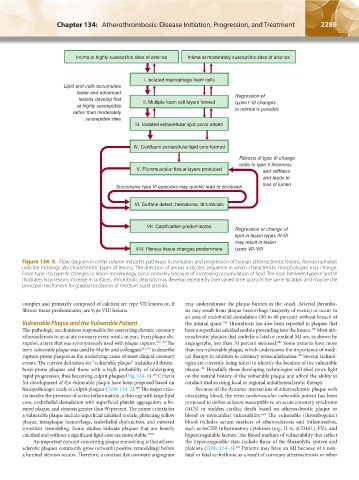
                  Figure 134–5.  Flow diagram in center column indicates pathways in evolution and progression of human atherosclerotic lesions. Roman numerals
                  indicate histologically characteristic types of lesions. The direction of arrows indicates sequence in which characteristic morphologies may change.
                  From type I to type IV, changes in lesion morphology occur primarily because of increasing accumulation of lipid. The loop between types V and VI
                  illustrates how lesions increase in surfaces. Thrombotic deposits may develop repeatedly over varied time spans in the same location and may be the
                  principal mechanism for gradual occlusion of medium-sized arteries.


                  complex and primarily composed of calcium are type VII lesions or, if   may underestimate the plaque burden in the vessel. Arterial thrombo-
                  fibrous tissue predominates, are type VIII lesions.   sis may result from plaque hemorrhage (majority of events) or occur in
                                                                        an area of endothelial denudation (30 to 40 percent) without breach of
                  Vulnerable Plaque and the Vulnerable Patient          the intimal space.  Thrombosis has also been reported in plaques that
                                                                                     156
                  The pathologic mechanisms responsible for converting chronic coronary   have a superficial calcified nodule protruding into the lumen.  Most ath-
                                                                                                                   156
                  atherosclerosis to an acute coronary event result, in part, from plaque dis-  erosclerotic plaques that underlie a fatal or nonfatal MI are, as shown by
                  ruption, a term that was synonymously used with plaque rupture. 151,152  The   angiography, less than 70 percent stenosed.  Some patients have more
                                                                                                       157
                  term vulnerable plaque was used by Muller and colleagues 153,154  to describe   than one vulnerable plaque, which underscores the importance of medi-
                  rupture-prone plaques as the underlying cause of most clinical coronary   cal therapy in addition to coronary revascularization.  Several technol-
                                                                                                              158
                  events. The current definition for “vulnerable plaque” includes all throm-  ogies are currently being tested to identify the location of the vulnerable
                  bosis-prone plaques and those with a high probability of undergoing   plaque.  Hopefully these developing technologies will shed more light
                                                                             159
                  rapid progression, thus becoming culprit plaques (Fig. 134–6).  Criteria   on the natural history of the vulnerable plaque and afford the ability to
                                                             155
                  for development of the vulnerable plaque have been proposed based on   conduct studies using local or regional antiatherosclerotic therapy.
                  histopathologic study of culprit plaques (Table 134–2).  The major crite-  Because of the dynamic interaction of atherosclerotic plaque with
                                                        155
                  ria involve the presence of active inflammation, a thin cap with large lipid   circulating blood, the term cardiovascular vulnerable patient has been
                  core, endothelial denudation with superficial platelet aggregation, a fis-  proposed to define subjects susceptible to an acute coronary syndrome
                  sured plaque, and stenosis greater than 90 percent. The minor criteria for   (ACS) or sudden cardiac death based on atherosclerotic plaque or
                  a vulnerable plaque include superficial calcified nodule, glistening yellow   blood or myocardial vulnerability.  The vulnerable (thrombogenic)
                                                                                                  160
                  plaque, intraplaque hemorrhage, endothelial dysfunction, and outward   blood includes serum markers of atherosclerosis and inflammation,
                  (positive) remodeling. Some studies indicate plaques that are heavily     such as hsCRP, inflammatory cytokines (e.g., IL-6, sCD40L), EVs, and
                  calcified and without a significant lipid core are more stable. 25,48  hypercoagulable factors. The blood markers of vulnerability that reflect
                     An important concept concerning plaque remodeling is that athero-  the hypercoagulable state include those of the fibrinolytic system and
                  sclerotic plaques commonly grow outward (positive remodeling) before   platelets (Table 134–3).  Patients may have an MI because of a non-
                                                                                         161
                  a luminal stenosis occurs. Therefore, a contrast dye coronary angiogram   fatal or fatal arrhythmia as a result of coronary atherosclerosis or other


          Kaushansky_chapter 134_p2281-2302.indd   2289                                                                 17/09/15   3:49 pm

