


Page 233 - Williams Hematology ( PDFDrive )
P. 233
208            Part IV:  Molecular and Cellular Hematology                                                                                 Chapter 15:  Apoptosis Mechanisms: Relevance to the Hematopoietic System                209


               which are several genes that suppress apoptosis. As a result, this NF-κB   most relevant activity of IAPs appears to be their noncanonical E3 ligase
               pathway nullifies the caspase pathway, negating apoptosis,  in addition   activity, as well as a protein scaffold role where they serve as platforms
                                                         62
               to accounting for the untoward inflammatory actions of this cytokine.   for assembling multiprotein complexes. Additional roles for IAP family
               Several antiapoptotic genes are among the direct transcriptional targets   members include cell division, where, for example, the Survivin protein
               of NF-κB (REL)-family proteins, including the genes encoding c-FLIP,   plays a fundamental role in chromosome segregation and cytokinesis.
               c-IAP2, Bcl-X , and Bfl-1.                                 Several of the IAPs are opposed by proteins released from mito-
                         L
                   In this regard, the c-IAP1 and c-IAP2 proteins were first identi-  chondria, SMAC and HtrA2. SMAC and Htra2 bind BIR domains on
               fied because of their association with TNF receptor complexes. These   IAPs, thus displacing caspases and other associated proteins. In many
               IAPs bind the kinase Rip1 via their BIR3 domains, mediating nonca-  cases, SMAC binding to IAPs induces their polyubiquitination and pro-
               nonical ubiquitination of Rip1 via interactions of atypical UBCs with   teasomal degradation. Thus, factors that cause MOMP take the breaks
               their RING domains and possibly also indirectly via interactions of the   off the caspases by eliminating various IAP family proteins.
               E3 ligase TRAF2, which binds their BIR1 domains. The noncanonical
               ubiquitination of Rip1 is required for TNFR1-mediated NF-κB acti-    SIGNAL TRANSDUCTION AND
               vation and suppression of cytokine-induced apoptosis. The c-IAP1
               and c-IAP2 proteins also control the “alternative” pathway for NF-κB   APOPTOSIS REGULATION
               activation via yet another mechanism, which involves classical lysine
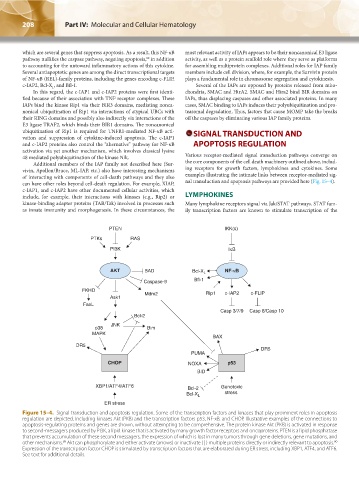
               48 mediated polyubiquitination of the kinase Nik.      Various  receptor-mediated  signal  transduction  pathways  converge  on
                   Additional members of the IAP family not described here (Sur-  the core components of the cell death machinery outlined above, includ-
               vivin, Apollon/Bruce, ML-IAP, etc.) also have interesting mechanisms   ing receptors for growth factors, lymphokines and cytokines. Some
               of interacting with components of cell-death pathways and they also   examples illustrating the intimate links between receptor-mediated sig-
               can have other roles beyond cell-death regulation. For example, XIAP,   nal transduction and apoptosis pathways are provided here (Fig. 15–4).
               c-IAP1, and c-IAP2 have other documented cellular activities, which
               include, for example, their interactions with kinases (e.g., Rip2) or   LYMPHOKINES
               kinase-binding adapter proteins (TAB/Tak) involved in processes such   Many lymphokine receptors signal via Jak/STAT pathways. STAT fam-
               as innate immunity and morphogenesis. In these circumstances, the   ily transcription factors are known to stimulate transcription of the


                                            PTEN                                   IKK(s)
                                      PTKs          RAS
                                             PI3K                                   IκB


                                             AKT        BAD             Bcl-X L    NF-κB

                                                        Caspase-9        Bfl-1
                                   FKHD                 Mdm2                 Rip1  c-IAP2   c-FLIP
                                             Ask1
                                    FasL
                                                                                  Casp 3/7/9  Casp 8/Casp 10
                                                     Bcl-2
                                             JNK
                                        p38              Bim
                                       MAPK
                                                                               BAX
                                 DR5
                                                                                               DR5
                                                                        PUMA
                                            CHOP                       NOXA         p53
                                                                          BID
                                        XBP1/ATF4/ATF6                 Bcl-2      Genotoxic
                                                                                   stress
                                                                      Bcl-X L
                                           ER stress
               Figure 15–4.  Signal transduction and apoptosis regulation. Some of the transcription factors and kinases that play prominent roles in apoptosis
               regulation are depicted, including kinases Akt (PKB) and the transcription factors p53, NF-κB, and CHOP. Illustrative examples of the connections to
               apoptosis-regulating proteins and genes are shown, without attempting to be comprehensive. The protein kinase Akt (PKB) is activated in response
               to second-messagers produced by PI3K, a lipid kinase that is activated by many growth factor receptors and oncoproteins. PTEN is a lipid phosphatase
               that prevents accumulation of these second messagers, the expression of which is lost in many tumors through gene deletions, gene mutations, and
               other mechanisms.  Akt can phosphorylate and either activate (arrows) or inactivate ( | ) multiple proteins directly or indirectly relevant to apoptosis.
                                                                                                                        90
                             89
               Expression of the transcription factor CHOP is stimulated by transcription factors that are elaborated during ER stress, including XBP1, ATF4, and ATF6.
               See text for additional details.


          Kaushansky_chapter 15_p0203-0212.indd   208                                                                   17/09/15   6:38 pm

