


Page 229 - Williams Hematology ( PDFDrive )
P. 229
204            Part IV:  Molecular and Cellular Hematology                                                                                 Chapter 15:  Apoptosis Mechanisms: Relevance to the Hematopoietic System                205


                   From a functional perceptive, it is useful to view the caspases as either   include cytoskeletal and nuclear matrix proteins, chromatin-modifying
               upstream “initiator” caspases or downstream “effector” caspases.  The   (e.g., poly-ADP ribosyl polymerase [PARP]) and DNA repair proteins,
                                                              5
               zymogen forms of upstream initiator caspases possess large N-terminal   inhibitory subunits of endonucleases (CIDE-family proteins), protein
               prodomains, which function as protein interaction modules, allowing   kinases (often separating the autorepressing regulatory domains from
               them to interact with various proteins that trigger caspase activation. In   catalytic domains) and other signal transduction proteins.
               contrast, the proforms of downstream effector caspases contain only short
               N-terminal prodomains, serving no apparent function. Downstream cas-    CASPASE ACTIVATION PATHWAYS
               pases are largely dependent on upstream caspases for their proteolytic
               processing and activation. The substrates of effector caspases are myriad,   Several pathways for activating caspases have been delineated
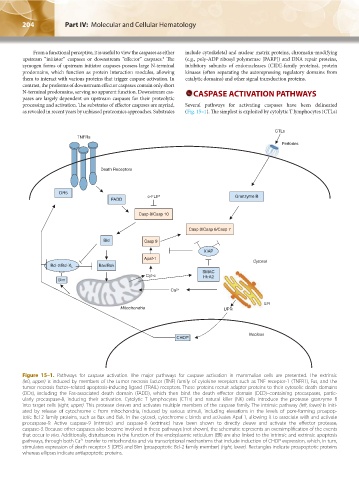
               as revealed in recent years by unbiased proteomics approaches. Substrates   (Fig. 15–1). The simplest is exploited by cytolytic T lymphocytes (CTLs)


                                                                                                    CTLs
                                  TNFRs
                                                                                                      Perforins


                                          Death Receptors


                            DR5
                                                         c-FLIP                        Granzyme B
                                             FADD

                                                      Casp 8/Casp 10

                                                                       Casp 3/Casp 6/Casp 7
                                           Bid          Casp 9
                                                                            XIAP
                                                        Apaf-1
                                                                                             Cytosol
                         Bcl-2/Bcl-X L   Bax/Bak
                                                                            SMAC
                                                         Cyt-c              HtrA2
                           Bim
                                                                 Ca 2+

                                                                                                ER
                                                Mitochondria                       UPR


                                                                                           Nucleus
                                                                   CHOP


               Figure 15–1.  Pathways for caspase activation.  The major pathways for caspase activation in mammalian cells are presented.  The extrinsic
               (left, upper) is induced by members of the tumor necrosis factor (TNF) family of cytokine receptors such as TNF receptor-1 (TNFR1), Fas, and the
               tumor necrosis factor–related apoptosis-inducing ligand (TRAIL) receptors. These proteins recruit adapter proteins to their cytosolic death domains
               (DDs),  including  the  Fas-associated  death  domain  (FADD),  which  then  bind  the  death  effector  domain  (DED)–containing  procaspases,  partic-
               ularly procaspase-8, inducing their activation. Cytolytic  T lymphocytes (CTLs) and natural killer (NK) cells introduce the protease granzyme B
               into target cells (right, upper). This protease cleaves and activates multiple members of the caspase family. The intrinsic pathway (left, lower) is initi-
               ated  by  release  of  cytochrome  c  from  mitochondria,  induced  by  various  stimuli,  including  elevations  in  the  levels  of  pore-forming  proapop-
               totic Bcl-2 family proteins, such as Bax and Bak. In the cytosol, cytochrome c binds and activates Apaf-1, allowing it to associate with and activate
               procaspase-9. Active caspase-9 (intrinsic) and caspase-8 (extrinsic) have been shown to directly cleave and activate the effector protease,
               caspase-3. Because other caspases also become involved in these pathways (not shown), the schematic represents an oversimplification of the events
               that occur in vivo. Additionally, disturbances in the function of the endoplasmic reticulum (ER) are also linked to the intrinsic and extrinsic apoptosis
               pathways, through both Ca  transfer to mitochondria and via transcriptional mechanisms that include induction of CHOP expression, which, in turn,
                                   2+
               stimulates expression of death receptor 5 (DR5) and Bim (proapoptotic Bcl-2 family member) (right, lower). Rectangles indicate proapoptotic proteins
               whereas ellipses indicate antiapoptotic proteins.


          Kaushansky_chapter 15_p0203-0212.indd   204                                                                   17/09/15   6:37 pm

