


Page 2331 - Williams Hematology ( PDFDrive )
P. 2331
2304  Part XII:  Hemostasis and Thrombosis                      Chapter 135:  Fibrinolysis and Thrombolysis          2305


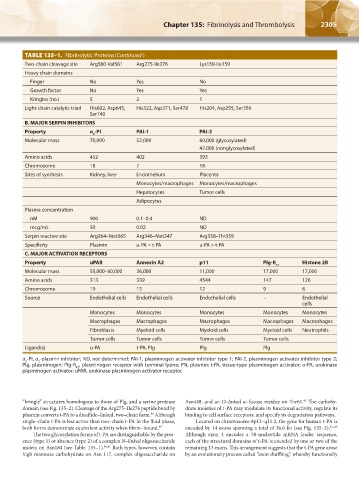
                   TABLE 135–1.  Fibrinolytic Proteins (Continued )
                   Two-chain cleavage site  Arg560-Val561  Arg275-Ile276     Lys158-Ile159
                   Heavy chain domains
                     Finger             No              Yes                  No
                     Growth factor      No              Yes                  Yes
                     Kringles (no.)     5               2                    1
                   Light-chain catalytic triad  His602, Asp645,   His322, Asp371, Ser478  His204, Asp255, Ser356
                                        Ser740
                   B. MAJOR SERPIN INHIBITORS
                   Property             α -PI           PAI-1                PAI-2
                                         2
                   Molecular mass       70,000          52,000               60,000 (glycosylated)
                                                                             47,000 (nonglycosylated)
                   Amino acids          452             402                  393
                   Chromosome           18              7                    18
                   Sites of synthesis   Kidney, liver   Endothelium          Placenta
                                                        Monocytes/macrophages  Monocytes/macrophages
                                                        Hepatocytes          Tumor cells
                                                        Adipocytes
                   Plasma concentration
                     nM                 900             0.1–0.4              ND
                     mcg/mL             50              0.02                 ND
                   Serpin reactive site  Arg364–Met365  Arg346–Met347        Arg358–Thr359
                   Specificity          Plasmin         u-PA = t-PA          u-PA > t-PA
                   C. MAJOR ACTIVATION RECEPTORS
                   Property             uPAR            Annexin A2           p11                   Plg-R        Histone 2B
                                                                                                       KT
                   Molecular mass       55,000–60,000   36,000               11,000                17,000       17,000
                   Amino acids          313             339                  4544                  147          126
                   Chromosome           19              15                   12                    9            6
                   Source               Endothelial cells  Endothelial cells  Endothelial cells    –            Endothelial
                                                                                                                cells
                                        Monocytes       Monocytes            Monocytes             Monocytes    Monocytes
                                        Macrophages     Macrophages          Macrophages           Macrophages  Macrophages
                                        Fibroblasts     Myeloid cells        Myeloid cells         Myeloid cells  Neutrophils
                                        Tumor cells     Tumor cells          Tumor cells           Tumor cells
                   Ligand(s)            u-PA            t-PA, Plg            Plg                   Plg

                  α -PI, α -plasmin inhibitor; ND, not determined; PAI-1, plasminogen activator inhibitor type 1; PAI-2, plasminogen activator inhibitor type 2;
                       2
                   2
                  Plg, plasminogen; Plg-R , plasminogen receptor with terminal lysine; PN, plasmin; t-PA, tissue-type plasminogen activator; u-PA, urokinase
                                    KT
                  plasminogen activator; uPAR, urokinase plasminogen activator receptor.


                  “kringle” structures homologous to those of Plg, and a serine protease   Asn448, and an O–linked α–fucose residue on Thr61.  The carbohy-
                                                                                                                42
                  domain (see Fig. 135–2). Cleavage of the Arg275–Ile276 peptide bond by   drate moieties of t-PA may modulate its functional activity, regulate its
                  plasmin converts t-PA to a disulfide–linked, two–chain form.  Although   binding to cell surface receptors, and specify its degradation pathways.
                                                             38
                  single–chain t-PA is less active than two–chain t-PA in the fluid phase,   Located on chromosome 8p12–q11.2, the gene for human t-PA is
                  both forms demonstrate equivalent activity when fibrin–bound. 39  encoded by 14 exons spanning a total of 36.6 kb (see Fig. 135–2). 43–45
                     The two glycosylation forms of t-PA are distinguishable by the pres-  Although exon  1  encodes  a 58-nucleotide  mRNA  leader  sequence,
                  ence (type 1) or absence (type 2) of a complex N–linked oligosaccharide   each of the structural domains of t-PA is encoded by one or two of the
                  moiety on Asn184 (see Table  135–1). 40,41  Both types, however, contain   remaining 13 exons. This arrangement suggests that the t-PA gene arose
                  high mannose carbohydrate on Asn 117, complex oligosaccharide on   by an evolutionary process called “exon shuffling,” whereby functionally


          Kaushansky_chapter 135_p2303-2326.indd   2305                                                                 9/18/15   5:13 PM

