


Page 2336 - Williams Hematology ( PDFDrive )
P. 2336
2310           Part XII:  Hemostasis and Thrombosis                                                                                                                          Chapter 135:  Fibrinolysis and Thrombolysis         2311


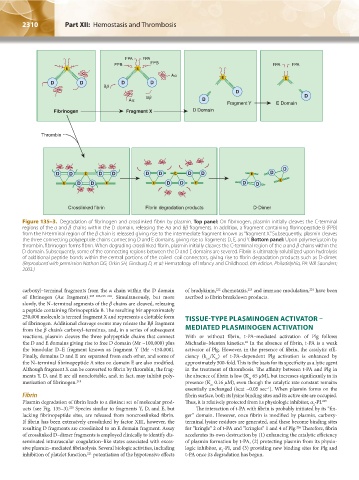
               Figure 135–3.  Degradation of fibrinogen and crosslinked fibrin by plasmin. Top panel: On fibrinogen, plasmin initially cleaves the C-terminal
               regions of the α and β chains within the D domain, releasing the Aα and Bβ fragments. In addition, a fragment containing fibrinopeptide B (FPB)
               from the N-terminal region of the β chain is released giving rise to the intermediate fragment known as “fragment X.” Subsequently, plasmin cleaves
               the three connecting polypeptide chains connecting D and E domains, giving rise to fragments D, E, and Y. Bottom panel: Upon polymerizatoin by
               thrombin, fibrinogen forms fibrin. When degrading crosslinked fibrin, plasmin initially cleaves the C-terminal region of the α and β chains within the
               D domain. Subsequently, some of the connecting regions between the D and E domains are severed. Fibrin is ultimately solubilized upon hydrolysis
               of additional peptide bonds within the central portions of the coiled–coil connectors, giving rise to fibrin degradation products such as D-dimer.
               (Reproduced with permission Nathan DG, Orkin SH, Ginsburg D, et al: Hematology of Infancy and Childhood. 6th edition. Philadelphia, PA: WB Saunders;
               2003.)


                                                                                           223
                                                                                222
                                                                                                                224
               carboxyl–terminal fragments from the α chain within the D domain   of bradykinin,  chemotaxis,  and immune modulation,  have been
               of fibrinogen (Aα fragment). 205–208,215–218 . Simultaneously, but more   ascribed to fibrin breakdown products.
               slowly, the N–terminal segments of the β chains are cleaved, releasing
               a peptide containing fibrinopeptide B. The resulting Mr approximately
               250,000 molecule is termed fragment X and represents a clottable form   TISSUE-TYPE PLASMINOGEN ACTIVATOR –
               of fibrinogen. Additional cleavage events may release the Bβ fragment
               from the β chain’s carboxyl–terminus, and, in a series of subsequent   MEDIATED PLASMINOGEN ACTIVATION
               reactions, plasmin cleaves the three polypeptide chains that connect   With or without fibrin, t-PA–mediated activation of Plg follows
                                                                                          22
               the D and E domains giving rise to free D domain (Mr ~100,000) plus   Michaelis–Menten kinetics.  In the absence of fibrin, t-PA is a weak
               the binodular D–E fragment known as fragment Y (Mr ~150,000).   activator of Plg. However, in the presence of fibrin, the catalytic effi-
               Finally, domains D and E are separated from each other, and some of   ciency (k /K ) of t-PA–dependent Plg activation is enhanced by
                                                                             cat
                                                                                m
               the N–terminal fibrinopeptide A sites on domain E are also modified.   approximately 500-fold. This is the basis for its specificity as a lytic agent
               Although fragment X can be converted to fibrin by thrombin, the frag-  in the treatment of thrombosis. The affinity between t-PA and Plg in
               ments Y, D, and E are all nonclottable, and, in fact, may inhibit poly-  the absence of fibrin is low (K  65 μM), but increases significantly in its
                                                                                           m
               merization of fibrinogen. 219                          presence (K  0.16 μM), even though the catalytic rate constant remains
                                                                              m
                                                                                                 –1
                                                                      essentially unchanged (kcat ~0.05 sec ). When plasmin forms on the
               Fibrin                                                 fibrin surface, both its lysine binding sites and its active site are occupied.
               Plasmin degradation of fibrin leads to a distinct set of molecular prod-  Thus, it is relatively protected from its physiologic inhibitor, α -PI. 225
                                                                                                                 2
               ucts (see Fig. 135–3).  Species similar to fragments Y, D, and E, but   The interaction of t-PA with fibrin is probably initiated by its “fin-
                               220
               lacking  fibrinopeptide  sites,  are  released  from  noncrosslinked fibrin.   ger” domain. However, once fibrin is modified by plasmin, carboxy-
               If fibrin has been extensively crosslinked by factor XIII, however, the   terminal lysine residues are generated, and these become binding sites
                                                                                                           226
               resulting D fragments are crosslinked to an E domain fragment. Assay   for “kringle” 2 of t-PA and “kringles” 1 and 4 of Plg.  Therefore, fibrin
               of crosslinked D–dimer fragments is employed clinically to identify dis-  accelerates its own destruction by (1) enhancing the catalytic efficiency
               seminated intravascular coagulation–like states associated with exces-  of plasmin formation by t-PA, (2) protecting plasmin from its physio-
               sive plasmin–mediated fibrinolysis. Several biologic activities, including   logic inhibitor, α -PI, and (3) providing new binding sites for Plg and
                                                                                  2
                                     221
               inhibition of platelet function,  potentiation of the hypotensive effects   t-PA once its degradation has begun.


          Kaushansky_chapter 135_p2303-2326.indd   2310                                                                 9/18/15   5:13 PM

