


Page 2332 - Williams Hematology ( PDFDrive )
P. 2332
2306           Part XII:  Hemostasis and Thrombosis                                                                                                                          Chapter 135:  Fibrinolysis and Thrombolysis         2307


                          Plasminogen

                           SP  PAP    K1       K2       K3          K4         K5                 P
                                                                                          H     D       S


                          Tissue plasminogen activator


                          SP    F    EGF       K1          K2                    P
                                                                        H     D            S


                           Urokinase


                             SP     EGF         K1                    P
                                                             H     D         S


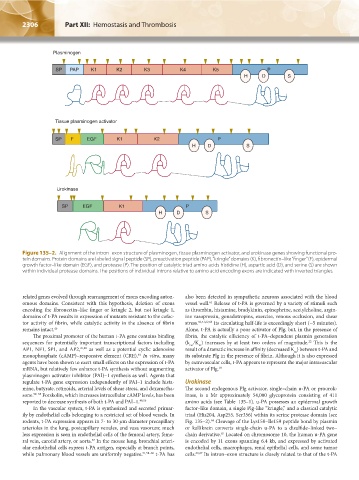
               Figure 135–2.  Alignment of the intron–exon structure of plasminogen, tissue plasminogen activator, and urokinase genes showing functional pro-
               tein domains. Protein domains are labeled signal peptide (SP), preactivation peptide (PAP), “kringle” domains (K), fibronectin–like “finger” (F), epidermal
               growth factor–like domain (EGF), and protease (P). The position of catalytic triad amino acids histidine (H), aspartic acid (D), and serine (S) are shown
               within individual protease domains. The positions of individual introns relative to amino acid encoding exons are indicated with inverted triangles.


               related genes evolved through rearrangement of exons encoding auton-  also been detected in sympathetic neurons associated with the blood
               omous domains. Consistent with this hypothesis, deletion of exons   vessel wall.  Release of t-PA is governed by a variety of stimuli such
                                                                              61
               encoding the fibronectin–like finger or kringle 2, but not kringle 1,   as thrombin, histamine, bradykinin, epinephrine, acetylcholine, argin-
               domains of t-PA results in expression of mutants resistant to the cofac-  ine vasopressin, gonadotropins, exercise, venous occlusion, and shear
               tor activity of fibrin, while catalytic activity in the absence of fibrin   stress. 50,51,62,63  Its circulating half-life is exceedingly short (~5 minutes).
               remains intact. 46                                     Alone, t-PA is actually a poor activator of Plg, but, in the presence of
                   The proximal promoter of the human t-PA gene contains binding   fibrin, the catalytic efficiency of t-PA–dependent plasmin generation
               sequences for potentially important transcriptional factors including   (k /K ) increases by at least two orders of magnitude.  This is the
                                                                                                               22
                                                                           m
                                                                       cat
               AP1, NF1,  SP1, and AP2, 47,48  as well as a potential cyclic adenosine   result of a dramatic increase in affinity (decreased K ) between t-PA and
                                                                                                           m
               monophosphate (cAMP)–responsive element (CRE).  In vitro, many   its substrate Plg in the presence of fibrin. Although it is also expressed
                                                      49
               agents have been shown to exert small effects on the expression of t-PA   by extravascular cells, t-PA appears to represent the major intravascular
               mRNA, but relatively few enhance t-PA synthesis without augmenting   activator of Plg. 18
               plasminogen activator inhibitor (PAI)–1 synthesis as well. Agents that
               regulate t-PA gene expression independently of PAI–1 include hista-  Urokinase
               mine, butyrate, retinoids, arterial levels of shear stress, and dexametha-  The second endogenous Plg activator, single–chain u-PA or prourok-
               sone. 50–55  Forskolin, which increases intracellular cAMP levels, has been   inase, is a Mr approximately 54,000 glycoprotein consisting of 411
               reported to decrease synthesis of both t-PA and PAI–1. 48,56  amino acids (see Table  135–1). u-PA possesses an epidermal growth
                   In the vascular system, t-PA is synthesized and secreted primar-  factor–like domain, a single Plg-like “kringle,” and a classical catalytic
               ily by endothelial cells belonging to a restricted set of blood vessels. In   triad (His204, Asp255, Ser356) within its serine protease domain (see
               rodents, t-PA expression appears in 7- to 30-μm diameter precapillary   Fig. 135–2).  Cleavage of the Lys158–Ile159 peptide bond by plasmin
                                                                               64
               arterioles in the lung, postcapillary venules, and vasa vasorum; much   or kallikrein converts single-chain u-PA to a disulfide–linked two–
               less expression is seen in endothelial cells of the femoral artery, femo-  chain derivative.  Located on chromosome 10, the human u-PA gene
                                                                                  65
               ral vein, carotid artery, or aorta.  In the mouse lung, bronchial arteri-  is encoded by 11 exons spanning 6.4 kb, and expressed by activated
                                       57
               olar endothelial cells express t-PA antigen, especially at branch points,   endothelial cells, macrophages, renal epithelial cells, and some tumor
               while pulmonary blood vessels are uniformly negative. 51,58–60  t-PA has   cells. 66,67  Its intron–exon structure is closely related to that of the t-PA


          Kaushansky_chapter 135_p2303-2326.indd   2306                                                                 9/18/15   5:13 PM

