


Page 2399 - Williams Hematology ( PDFDrive )
P. 2399
2370           Part XIII:  Transfusion Medicine                                                                                                               Chapter 138:  Blood Procurement and Red Cell Transfusion           2371


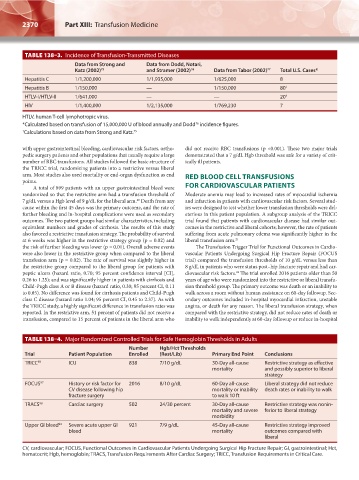
                TABLE 138–3.  Incidence of Transfusion-Transmitted Diseases
                                 Data from Strong and    Data from Dodd, Notari,
                                 Katz (2002) 75          and Stramer (2002) 18  Data from Tabor (2002) 77  Total U.S. Cases*
                Hepatitis C      1/1,200,000             1/1,935,000            1/625,000             8
                Hepatitis B      1/150,000               —                      1/150,000             80 †
                HTLV-I/HTLV-II   1/641,000               —                      —                     20 †
                HIV              1/1,400,000             1/2,135,000            1/769,230             7
               HTLV, human T-cell lymphotropic virus.
               *Calculated based on transfusion of 15,000,000 U of blood annually and Dodd  incidence figures.
                                                                         76
               † Calculations based on data from Strong and Katz. 75

               with upper gastrointestinal bleeding, cardiovascular risk factors, ortho-  did not receive RBC transfusions (p <0.001). These two major trials
               pedic surgery patients and other populations that usually require a large   demonstrated that a 7 g/dL Hgb threshold was safe for a variety of crit-
               number of RBC transfusions. All studies followed the basic structure of   ically ill patients.
               the TRICC trial, randomizing patients into a restrictive versus liberal
               arm. Most studies also used mortality or end-organ dysfunction as end   RED BLOOD CELL TRANSFUSIONS
               points.
                   A total of 899 patients with an upper gastrointestinal bleed were   FOR CARDIOVASCULAR PATIENTS
               randomized so that the restrictive arm had a transfusion threshold of     Moderate anemia may lead to increased rates of myocardial ischemia
                                                      20
               7 g/dL versus a Hgb level of 9 g/dL for the liberal arm.  Death from any   and infarction in patients with cardiovascular risk factors. Several stud-
               cause within the first 45 days was the primary outcome, and the rate of   ies were designed to test whether lower transfusion thresholds were del-
               further bleeding and in-hospital complications were used as secondary   eterious in this patient population. A subgroup analysis of the TRICC
               outcomes. The two patient groups had similar characteristics, including   trial found that patients with cardiovascular disease had similar out-
               equivalent numbers and grades of cirrhosis. The results of this study   comes in the restrictive and liberal cohorts; however, the rate of patients
               also favored a restrictive transfusion strategy. The probability of survival   suffering from acute pulmonary edema was significantly higher in the
               at 6 weeks was higher in the restrictive strategy group (p = 0.02) and   liberal transfusion arm. 21
               the risk of further bleeding was lower (p = 0.01). Overall adverse events   The Transfusion Trigger Trial for Functional Outcomes in Cardio-
               were also lower in the restrictive group when compared to the liberal   vascular Patients Undergoing Surgical Hip Fracture Repair (FOCUS
               transfusion arm (p = 0.02). The rate of survival was slightly higher in   trial) compared the transfusion thresholds of 10 g/dL versus less than
               the restrictive group compared to the liberal group for patients with   8 g/dL in patients who were status post–hip fracture repair and had car-
                                                                                       22
               peptic ulcers (hazard ratio, 0.70; 95 percent confidence interval [CI],   diovascular risk factors.  The trial enrolled 2016 patients older than 50
               0.26 to 1.25); and was significantly higher in patients with cirrhosis and   years of age who were randomized into the restrictive or liberal transfu-
               Child-Pugh class A or B disease (hazard ratio, 0.30; 95 percent CI, 0.11   sion threshold group. The primary outcome was death or an inability to
               to 0.85). No difference was found for cirrhosis patients and Child-Pugh   walk across a room without human assistance on 60-day followup. Sec-
               class C disease (hazard ratio 1.04; 95 percent CI, 0.45 to 2.37). As with   ondary outcomes included in-hospital myocardial infarction, unstable
               the TRICC study, a highly significant difference in transfusion rates was   angina, or death for any reason. The liberal transfusion strategy, when
               reported. In the restrictive arm, 51 percent of patients did not receive a   compared with the restrictive strategy, did not reduce rates of death or
               transfusion, compared to 15 percent of patients in the liberal arm who   inability to walk independently at 60-day followup or reduce in-hospital


                TABLE 138–4.  Major Randomized Controlled Trials for Safe Hemoglobin Thresholds in Adults
                                                   Number    Hgb/Hct Thresholds
                Trial          Patient Population  Enrolled  (Rest/Lib)        Primary End Point  Conclusions
                TRICC 93       ICU                 838       7/10 g/dL         30-Day all-cause   Restrictive strategy as effective
                                                                               mortality         and possibly superior to liberal
                                                                                                 strategy
                FOCUS 97       History or risk factor for   2016  8/10 g/dL    60-Day all-cause   Liberal strategy did not reduce
                               CV disease following hip                        mortality or inability   death rates or inability to walk
                               fracture surgery                                to walk 10 ft
                TRACS 98       Cardiac surgery     502       24/30 percent     30-Day all-cause   Restrictive strategy was nonin-
                                                                               mortality and severe   ferior to liberal strategy
                                                                               morbidity
                Upper GI bleed 94  Severe acute upper GI   921  7/9 g/dL       45-Day all-cause   Restrictive strategy improved
                               bleed                                           mortality         outcomes compared with
                                                                                                 liberal
               CV, cardiovascular; FOCUS, Functional Outcomes in Cardiovascular Patients Undergoing Surgical Hip Fracture Repair; GI, gastrointestinal; Hct,
               hematocrit; Hgb, hemoglobin; TRACS, Transfusion Requirements After Cardiac Surgery; TRICC, Transfusion Requirements in Critical Care.


          Kaushansky_chapter 138_p2365-2380.indd   2370                                                                 9/18/15   11:12 AM

