


Page 2401 - Williams Hematology ( PDFDrive )
P. 2401
2372           Part XIII:  Transfusion Medicine                                                                                                               Chapter 138:  Blood Procurement and Red Cell Transfusion           2373


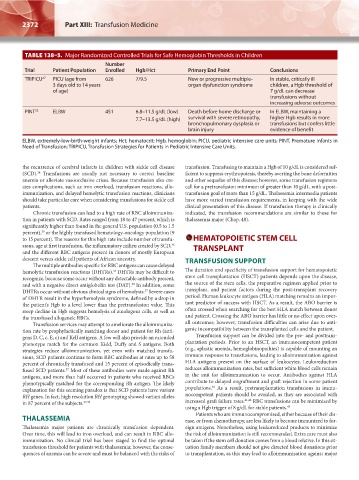
                TABLE 138–5.  Major Randomized Controlled Trials for Safe Hemoglobin Thresholds in Children
                                           Number
                Trial     Patient Population  Enrolled  Hgb/Hct        Primary End Point           Conclusions
                TRIPICU 27  PICU (age from    626    7/9.5             New or progressive multiple-   In stable, critically ill
                          3 days old to 14 years                       organ dysfunction syndrome  children, a Hgb threshold of
                          of age)                                                                  7 g/dL can decrease
                                                                                                     transfusions without
                                                                                                     increasing adverse outcomes
                PINT 32   ELBW             451       6.8–11.5 g/dL (low)  Death before home discharge or   In ELBW, maintaining a
                                                     7.7–13.5 g/dL (high)  survival with severe retinopathy,   higher Hgb results in more
                                                                       bronchopulmonary dysplasia or   transfusions but confers little
                                                                       brain injury                evidence of benefit
               ELBW, extremely-low-birth-weight infants; Hct, hematocrit; Hgb, hemoglobin; PICU, pediatric intensive care units; PINT, Premature Infants in
               Need of Transfusion; TRIPICU, Transfusion Strategies for Patients in Pediatric Intensive Care Units.


               the recurrence of cerebral infarcts in children with sickle cell disease   transfusion. Transfusing to maintain a Hgb of 10 g/dL is considered suf-
               (SCD).  Transfusions are usually not necessary to correct baseline   ficient to suppress erythropoiesis, thereby averting the bone deformities
                    34
               anemia or alleviate vasoocclusive crises. Because transfusion also cre-  and other sequelae of this disease; however, some transfusion regimens
               ates complications, such as iron overload, transfusion reactions, allo-  call for a pretransfusion minimum of greater than 10 g/dL, with a post-
               immunization, and delayed hemolytic transfusion reactions, clinicians   transfusion goal of more than 15 g/dL. Thalassemia intermedia patients
               should take particular care when considering transfusions for sickle cell   have more varied transfusion requirements, in keeping with the wide
               patients.                                              clinical presentation of this disease. If transfusion therapy is clinically
                   Chronic transfusion can lead to a high rate of RBC alloimmuniza-  indicated,  the  transfusion  recommendations  are  similar  to  those  for
               tion in patients with SCD. Rates ranged from 18 to 47 percent, which is   thalassemia major (Chap. 48).
               significantly higher than found in the general U.S. population (0.5 to 1.5
               percent),  or the highly transfused hematology-oncology population (9
                      35
               to 15 percent). The reasons for this high rate include number of transfu-    HEMATOPOIETIC STEM CELL
               sions, age at first transfusion, the inflammatory milieu created by SCD,    TRANSPLANT
                                                                 36
               and the different RBC antigens present in donors of mostly European
               descent versus sickle cell patients of African ancestry.  TRANSFUSION SUPPORT
                   The multiple antibodies specific for RBC antigens can cause delayed
               hemolytic transfusion reactions (DHTRs).  DHTRs may be difficult to   The duration and specificity of transfusion support for hematopoietic
                                              37
               recognize, because some occur without any detectable antibody present,   stem cell transplantation (HSCT) patients depends upon the disease,
                                                    38
               and with a negative direct antiglobulin test (DAT).  In addition, some   the source of the stem cells, the preparative regimen applied prior to
               DHTRs occur without obvious clinical signs of hemolysis.  Severe cases   transplant, and patient factors during the post-transplant recovery
                                                        37
               of DHTR result in the hyperhemolysis syndrome, defined by a drop in   period. Human leukocyte antigen (HLA) matching remains an impor-
               the patient’s Hgb to a level lower than the pretransfusion value. This   tant predictor of success with HSCT. As a result, the ABO barrier is
               steep decline in Hgb suggests hemolysis of autologous cells, as well as   often crossed when searching for the best HLA match between donor
               the transfused allogeneic RBCs.                        and patient. Crossing the ABO barrier has little or no effect upon over-
                   Transfusion services may attempt to ameliorate the alloimmuniza-  all outcomes; however, transfusion difficulties can arise due to anti-
               tion rate by prophylactically matching donor and patient for Rh (anti-  genic incompatibility between the transplanted cells and the patient.
               gens D, C, c, E, e) and Kell antigens. A few will also provide an extended   Transfusion support can be divided into the pre- and posttrans-
               phenotype match for the common Kidd, Duffy and S antigens. Both   plantation periods. Prior to an HSCT, an immunocompetent patient
               strategies reduce alloimmunization, yet even with matched transfu-  (e.g., aplastic anemia, hemoglobinopathies) is capable of mounting an
               sions, SCD patients continue to form RBC antibodies at rates up to 58   immune response to transfusions, leading to alloimmunization against
               percent of chronically transfused and 15 percent of episodically trans-  HLA antigens present on the surface of leukocytes. Leukoreduction
                              37
               fused SCD patients.  Most of these antibodies were made against Rh   reduces alloimmunization rates, but sufficient white blood cells remain
               antigens, and more than half occurred in patients who received RBCs   in the unit for alloimmunization to occur. Antibodies against HLA
               phenotypically matched for the corresponding Rh antigen. The likely   contribute to delayed engraftment and graft rejection in some patient
                                                                               40
               explanation for this seeming paradox is that SCD patients have variant   populations.  As a result, pretransplantation transfusions in immu-
               RH genes. In fact, high resolution RH genotyping showed variant alleles   nocompetent patients should be avoided, as they are associated with
               in 87 percent of the subjects. 37,39                   increased graft failure rates. 41,42  RBC transfusions can be minimized by
                                                                      using a Hgb trigger of 8 g/dL for stable patients. 43
                                                                          Patients who are immunocompromised, either because of their dis-
               THALASSEMIA                                            ease, or from chemotherapy, are less likely to become immunized to for-
               Thalassemia major patients are chronically transfusion dependent.   eign antigens. Nonetheless, using leukoreduced products to minimize
               Over time, this will lead to iron overload, and can result in RBC allo-  the risk of alloimmunization is still recommended. Extra care must also
               immunization. No clinical trial has been staged to find the optimal   be taken if the stem cell donation comes from a blood relative. In this sit-
               transfusion threshold for patients with thalassemia; however, the conse-  uation family members should not give directed blood donations prior
               quences of anemia can be severe and must be balanced with the risks of   to transplantation, as this may lead to alloimmunization against major


          Kaushansky_chapter 138_p2365-2380.indd   2372                                                                 9/18/15   11:13 AM

