


Page 2402 - Williams Hematology ( PDFDrive )
P. 2402
2372  Part XIII:  Transfusion Medicine           Chapter 138:  Blood Procurement and Red Cell Transfusion            2373


                  and/or minor HLA antigens that are present in the transplant organ. In   recipient; these include TA-GVHD and passenger lymphocyte syn-
                  addition, all RBC and platelet transfusions should be irradiated as the   drome (PLS). Another complication, pure red cell aplasia (PRCA),
                  risk for transfusion-associated graft-versus-host disease (TA-GVHD)   occurs when the patient’s residual antibodies  attack the transplanted
                  is high in HSCT patients (see section Transfusion-Associated-Graft-   red cells. Standard transfusion reactions, such as allergic or febrile
                  versus-Host Disease below for more in-depth discussion of TA-GVHD).  nonhemolytic reactions, are frequently seen in this heavily transfused
                     RBC engraftment is difficult to assess, but may be defined by the   patient population; however, these “standard” transfusion reactions are
                  appearance of 1 percent reticulocytes in the peripheral blood, or as the   discussed more fully later in this chapter in the section Adverse Effects
                  day of the last RBC transfusion, with no transfusion given in the follow-  of Red Cell Transfusions.
                  ing 30 days. In general, engraftment time is shortest when hematopoi-
                  etic progenitor cells are obtained by apheresis (HPC-A), and greatest   Major and Minor ABO Mismatches
                  when hematopoietic progenitor cells are obtained from umbilical cords   Complications from ABO incompatibility depend upon whether a
                  (HPC-C) are used; however, considerable patient-to-patient variability   major or minor ABO mismatch is present (see Table  138–6). A major
                  exists. Prolonged engraftment directly translates into higher transfusion   mismatch occurs when the transplant contains RBCs that are incom-
                  rates for RBCs and platelets.                         patible with the recipient’s plasma. Conversely, a minor mismatch is
                     When an ABO incompatible transplant is used, group O red cells   present when the donor plasma contains isohemagglutinins against the
                  are used to avoid incompatibility issues. The ABO type of plasma prod-  recipient’s RBCs. Bidirectional transplants (e.g., group A transplant into
                  ucts may be different from the red cell type (Table 138–6). Once the   group B recipient) carry both major and minor mismatches.
                  patient begins to produce “donor-type” erythrocytes, their blood type   Major ABO Mismatch  When a major ABO mismatched trans-
                  should be reassessed. The decision to switch a patient’s blood type is   plant  is  given,  immediate  hemolysis  may  occur  during  the  infu-
                  highly variable across institutions. In our hospital, when a patient is   sion. This complication is more commonly seen when the HSCT is
                  RBC transfusion independent for 100 days, and no incompatible iso-  derived from marrow, because more red cells are present; however,
                  hemagglutinins against the new RBC phenotype can be detected in two   RBC depletion techniques have effectively eliminated this compli-
                  consecutive blood samples, the patient’s native blood type is switched to   cation. Because HPC-A units contain a minimal volume of RBCs
                  the donor type for future transfusions.               (8 to 15 mL), clinically significant cases of immediate hemolysis
                                                                        have not been identified.  Most HPC-C units are RBC-depleted
                                                                                            44
                  TRANSFUSION-RELATED COMPLICATIONS                     prior to cryopreservation, and the residual erythrocytes lyse during
                  There are transfusion-related complications that are specific to, or more   cryopreservation, therefore immediate hemolysis is not a problem
                  frequently seen, in the HSCT population. Some of these complications   with cord blood transplants.
                  arise when lymphocytes within the transplant are activated against the   Preformed antibodies against non-ABO RBC antigens can remain
                                                                        in a recipient’s peripheral circulation for many weeks after transplanta-
                                                                        tion. These antibodies may cause lysis when engrafted cells begin to pro-
                                                                        duce new RBC. Also chimeric patients may develop antibodies against
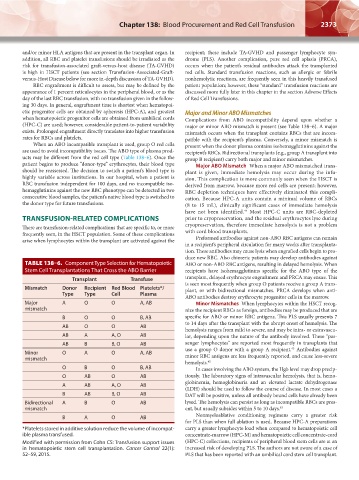
                   TABLE 138–6.  Component Type Selection for Hematopoietic   ABO or non-ABO RBC antigens, resulting in delayed hemolysis. When
                   Stem Cell Transplantations That Cross the ABO Barrier  recipients have isohemagglutinins specific for the ABO type of the
                                   Transplant         Transfuse         transplant, delayed erythrocyte engraftment and PRCA may ensue. This
                                                                        is seen most frequently when group O patients receive a group A trans-
                   Mismatch    Donor   Recipient  Red Blood  Platelets*/  plant, or with bidirectional mismatches. PRCA develops when anti-
                               Type    Type     Cell     Plasma
                                                                        ABO antibodies destroy erythrocyte progenitor cells in the marrow.
                   Major       A       O        O        A, AB              Minor Mismatches  When lymphocytes within the HSCT recog-
                   mismatch                                             nize the recipient RBCs as foreign, antibodies may be produced that are
                               B       O        O        B, AB          specific for ABO or minor RBC antigens. This PLS usually presents 7
                                                                        to 14 days after the transplant with the abrupt onset of hemolysis. The
                               AB      O        O        AB
                                                                        hemolysis ranges from mild to severe, and may be intra- or extravascu-
                               AB      A        A, O     AB             lar, depending upon the nature of the antibody involved. These “pas-
                               AB      B        B, O     AB             senger lymphocytes” are reported most frequently in transplants that
                                                                        use a group O donor with a group A recipient.  Antibodies against
                                                                                                            45
                   Minor       O       A        O        A, AB
                   mismatch                                             minor RBC antigens are less frequently reported, and cause less-severe
                                                                        hemolysis. 45
                               O       B        O        B, AB              In cases involving the ABO system, the Hgb level may drop precip-
                               O       AB       O        AB             itously. The laboratory signs of intravascular hemolysis, that is, hemo-
                                                                        globinemia, hemoglobinuria and an elevated lactate dehydrogenase
                               A       AB       A, O     AB
                                                                        (LDH) should be used to follow the course of disease. In most cases a
                               B       AB       B, O     AB             DAT will be positive, unless all antibody bound cells have already been
                   Bidirectional   A   B        O        AB             lysed. The hemolysis can persist as long as incompatible RBCs are pres-
                   mismatch                                             ent, but usually subsides within 5 to 10 days. 45
                               B       A        O        AB                 Nonmyeloablative conditioning regimens carry a greater risk
                                                                        for PLS than when full ablation is used. Because HPC-A preparations
                  *Platelets stored in additive solution reduce the volume of incompat-  carry a greater lymphocyte load when compared to hematopoietic cell
                  ible plasma transfused.                               concentrate-marrow (HPC-M) and hematopoietic cell concentrate-cord
                  Modified with permission from Cohn CS: Transfusion support issues   (HPC-C) collections, recipients of peripheral blood stem cells are at an
                  in  hematopoietic  stem  cell  transplantation.  Cancer Control  22(1):   increased risk of developing PLS. The authors are not aware of a case of
                  52–59, 2015.                                          PLS that has been reported with an umbilical cord stem cell transplant.


          Kaushansky_chapter 138_p2365-2380.indd   2373                                                                 9/18/15   11:13 AM

