


Page 362 - Williams Hematology ( PDFDrive )
P. 362
336  Part V:  Therapeutic Principles        Chapter 22:  Pharmacology and  Toxicity of  Antineoplastic Drugs          337


                  moderate hepatic impairment. It is contraindicated in patients with   Certain cancers, including subsets of AML, gliomas, intrahe-
                  severe hepatic impairment.  It has a plasma half-life of 2 hours, although   patic cholangiosarcomas, breast and lung cancers, and central chon-
                                     217
                  histones remain hyperacetylated for many hours. Renal elimination does   drosarcomas harbor IDH1/2 mutations that confer a gain of function.
                                                   218
                  not play a major role in the drug’s clearance.  Romidepsin is admin-  These mutated enzymes (commonly mutated at arginine 132 of IDH1
                                                       2
                  istered as a 4-hour intravenous infusion of 14 mg/m  on days 1, 8, and    or arginine 170 of IDH2) convert αKG to the oncometabolite (R)-2-
                                                              2
                  15 of a 28-day treatment cycle. A dose reduction to 10 mg/m  is possi-  hydroxyglutarate (2HG). High concentrations of 2HG inhibit histone
                  ble in patients who experience high-grade toxicities.  Romidepsin is   and DNA demethylation by competing with the dioxygenase function
                                                        219
                  metabolized primarily by CYP3A4 and by glucuronidation, and is rapidly   of the TET family of enzymes and Jumonji-C domain (JMJC) family of
                  cleared with a short half-life of approximately 3.5 hours. Asian patients   histone lysine demethylases. The result of IDH mutations is hypermeth-
                                                                                                                     220
                  with the 2B57 genotype of uridine diphosphate (UDP)-glucuronyl trans-  ylation of both DNA and histones and a block in differentiation.  IDH1
                  ferase may experience delayed clearance and increased toxicity.  or IDH2 mutations are present in 25 percent of AML where they confer
                     Both HDACs are generally well tolerated. The most common adverse   a favorable prognosis. At the same time, IDH mutations in MDS and
                  events for vorinostat are diarrhea, fatigue, nausea, and anorexia, and lab-  other myeloproliferative neoplasms may place patients at an increased
                  oratory abnormalities including, hyperglycemia, thrombocytopenia, and   risk for transformation to AML.  High levels of 2HG are measurable
                                                                                                221
                  proteinuria.  For romidepsin, nausea, vomiting, infection, fatigue, and   in plasma and urine in patients with IDH mutations, and may serve as a
                          213
                                                  212
                  myelosuppression were the primary toxicities.  Significant QTc prolon-  sensitive measure of treatment response and may reflect the presence of
                                                                                           222
                  gation and T-wave flattening but the electrocardiogram (ECG) changes   minimal residual disease.  2HG in IDH mutant solid tumors may also
                  were not associated with clinical cardiotoxicity. Still, it is important to   be imaged by magnetic resonance imaging (MRI) spectroscopy.
                  ensure electrolyte levels are normalized prior to and throughout therapy.  Small molecule inhibitors of IDH mutant enzymes have been
                     Multiple newer HDACs have been extensively tested in clinical     identified. One such inhibitor binds at the dimer interface in an allosteric
                  trials, although none has proven superior to vorinostat or romidepsin.   fashion and exhibits uncompetitive inhibition of mutant IDH2, with
                  One new agent, panobinostat, has demonstrated promising results in   great specificity for mutant IDH2 as compared to the wild-type enzyme.
                  phase II trials against cutaneous T-cell lymphoma, Hodgkin lymphoma,   Mutant AML cells cultured ex vivo in the presence of these inhibitors
                  and Waldenström macroglobulinemia. 208                undergo differentiation. 220
                                                                            An oral formulation of the mutant IDH2 inhibitor has shown
                  FUTURE EPIGENETIC TARGETS                             promising remission-inducing activity in its initial clinical trial. 220A
                  Isocitrate Dehydrogenase 2 Inhibitors
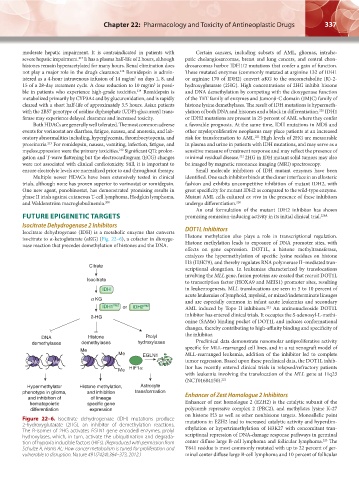
                  Isocitrate dehydrogenase (IDH) is a metabolic enzyme that converts   DOT1L Inhibitors
                  isocitrate to α-ketoglutarate (αKG) (Fig. 22–6), a cofactor in dioxyge-  Histone  methylation  also  plays  a  role  in  transcriptional  regulation.
                  nase reaction that precedes demethylation of histones and the DNA.  Histone methylation leads to exposure of DNA promoter sites, with
                                                                        effects on gene expression. DOT1L, a histone methyltransferase,
                                                                        catalyzes the hypermethylation of specific lysine residues on histone
                                                                        H3 (H3K79), and thereby regulates RNA polymerase II–mediated tran-
                                        Citrate
                                                                        scriptional elongation. In leukemias characterized by translocations
                                                                        involving the MLL gene, fusion proteins are created that recruit DOT1L
                                       Isocitrate
                                                                        to transcription factor (HOXA9 and MEIS1) promoter sites, resulting
                                             IDH                        in leukemogenesis. MLL translocations are seen in 5 to 10 percent of
                                                                        acute leukemias of lymphoid, myeloid, or mixed/indeterminate lineages
                                         a KG                           and are especially common in infant acute leukemias and secondary
                                             IDH1 mut  or  IDH2 mut     AML induced by Topo II inhibitors.  An aminonucleoside DOT1L
                                                                                                    221
                                         2-HG                           inhibitor has entered clinical trials. It occupies the S-adenosyl-L-methi-
                                                                        onine (SAMe) binding pocket of DOT1L and induces conformational
                                                                        changes, thereby contributing to high-affinity binding and specificity of
                        DNA             Histone            Prolyl       the inhibitor.
                     demethylases     demethylases      hydroxylases        Preclinical data demonstrate nanomolar antiproliferative activity
                                     Me                                 specific for MLL-rearranged cell lines, and in a rat xenograft model of
                                                  Me      EGLN1         MLL-rearranged leukemia, addition of the inhibitor led to complete
                     Me     Me                                          tumor regression. Based upon these preclinical data, the DOT1L inhib-
                                                  Me  HIF1a             itor has recently entered clinical trials in relapsed/refractory patients
                                                                        with leukemia involving the translocation of the MLL gene at 11q23
                                                                        (NCT01684150). 221
                   Hypermethylator   Histone methylation,  Astrocyte
                  phenotype in glioma,  and inhibition  transformation  Enhancer of Zest Homologue 2 Inhibitors
                    and inhibition of    of lineage
                    hematopoietic       specific gene                   Enhancer of zest homologue 2 (EZH2) is the catalytic subunit of the
                    differentiation     expression                      polycomb repressive complex 2 (PRC2), and methylates lysine K-27
                                                                        on histone H3 as well as other nonhistone targets. Monoallelic point
                  Figure 22–6.  Isocitrate dehydrogenase (IDH) mutations produce   mutations in EZH2 lead to increased catalytic activity and hyperdim-
                  2-hydroxyglutarate (2HG), an inhibitor of demethylation reactions.   ethylation or hypertrimethylation of H3K27 with concomitant tran-
                  The R-isomer of 2HG activates EGLN1 gene encoded enzymes, prolyl
                  hydroxylases, which, in turn, activate the ubiquitination and degrada-  scriptional repression of DNA-damage response pathways in germinal
                                                                                                                       223
                  tion of hypoxia inducible factors (HIFs). (Reproduced with permission from   center diffuse large B-cell lymphoma and follicular lymphoma.  The
                  Schulze A, Harris AL: How cancer metabolism is tuned for proliferation and   Y641 residue is most commonly mutated with up to 22 percent of ger-
                  vulnerable to disruption. Nature 491(7424):364–373, 2012.)  minal center diffuse large B-cell lymphoma and 10 percent of follicular


          Kaushansky_chapter 22_p0313-0352.indd   337                                                                   9/18/15   10:26 PM

