


Page 358 - Williams Hematology ( PDFDrive )
P. 358
332  Part V:  Therapeutic Principles        Chapter 22:  Pharmacology and  Toxicity of  Antineoplastic Drugs          333


                  the E. coli enzyme reduces its immunogenicity and extends its half-life   protein C, and protein S, leading to either arterial or venous thrombo-
                  to 6 days. Pegaspargase is used in patients hypersensitive to the unmod-  sis in occasional patients, and a predilection to thrombosis of cortical
                                                                                  155
                  ified enzyme, in doses of 2500 IU/m  intramuscularly every 2 weeks.   sinus vessels.  With more prolonged therapy, bleeding sequelae may
                                             2
                  Single doses deplete L-asparagine from plasma for 2 to 3 weeks. Some   result from inhibition of the synthesis of procoagulant proteins such as
                  patients develop hypersensitive to both preparations of E. coli enzyme,   fibrinogen and factors II, VII, IX, and X. Consequently, monitoring of
                  particularly if first exposed to the unmodified enzyme; they may be   coagulation factors is recommended. High doses of L-asparaginase may
                  treated with enzyme from Erwinia, which has a low incidence of hyper-  cause cerebral dysfunction that manifests as confusion, stupor, seizures,
                  sensitivity and approximately equal catalytic activity to the E. coli prepa-  or coma, and cortical sinus thrombosis has been documented by mag-
                                          154
                                                                                                          156
                  ration, but a more rapid clearance.  Consequently, the Erwinia enzyme   netic resonance imaging scan in such patients.  Clinical thromboem-
                                                                                                                          157
                  must be used in higher doses.                         bolic episodes may occur in up to 35 percent of children with ALL.
                                                                        These events are mostly asymptomatic thrombi associated with central
                  Adverse Effects                                       venous catheters; less frequently, cortical sinus and atrial thrombi may
                  Reactions to the first dose are uncommon, but after two or more doses of   occur. Altered mental  status  may also  result  from  hyperammonemia
                                                                                           158
                  the unmodified enzyme, hypersensitivity may develop in up to 20 per-  and diabetic ketoacidosis.  Preexisting clotting abnormalities, such as
                  cent of patients, varying from urticarial reactions to hypotension, laryn-  antiphospholipid antibodies or factor V Leiden deficiency, may predis-
                  gospasm, and cardiac arrest. Skin testing to predict allergic reactions is   pose to thromboembolic complications. 159
                  helpful in some, but not all, cases, and should be performed to confirm a   Acute nonhemorrhagic pancreatitis occurs as a complication of
                  clinical suspicion of hypersensitivity. Hypersensitive patients may have   L-asparaginase treatment, especially in patients who have extreme
                                                                                                          160
                  antibodies to L-asparaginase in their plasma. More than half the patients   elevations  of plasma  triglycerides  (>2 g/dL).   Because L-asparagi-
                  with such circulating antibodies will not display an overt allergic reac-  nase manifests little toxicity in marrow or gastrointestinal mucosa,
                  tion to the drug, but these patients may have more rapid disappearance   it has been used in combination with other drugs that do have such
                  of drug from plasma and an inadequate clearance of asparagine from   toxicities.
                  plasma and cells, leading to therapeutic failure. Patients who are treated
                  with L-asparaginase should be observed carefully for several hours   IMMUNOMODULATORY DRUGS
                  after dosing, and epinephrine should be available in case anaphylactic
                  reactions occur. Anaphylaxis is less likely when E. coli L-asparaginase   THALIDOMIDE, LENALIDOMIDE, AND
                  is given intramuscularly than when it is administered intravenously.
                  Pegaspargase has much reduced immunogenicity and hypersensitivity   POMALIDOMIDE
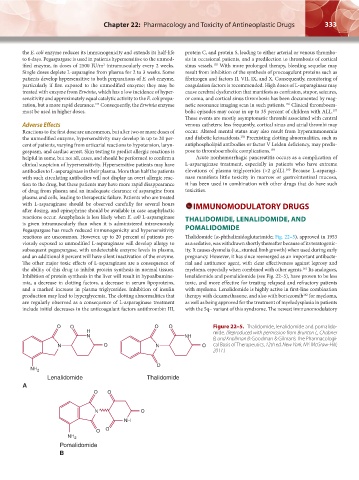
                  reactions are uncommon. However, up to 20 percent of patients pre-  Thalidomide (α-phthalimidoglutarimide; Fig. 22–5), approved in 1953
                  viously exposed to unmodified L-asparaginase will develop allergy to   as a sedative, was withdrawn shortly thereafter because of its teratogenic-
                  subsequent pegaspargase, with undetectable enzyme levels in plasma,   ity. It causes dysmelia (i.e., stunted limb growth) when used during early
                  and an additional 8 percent will have silent inactivation of the enzyme.   pregnancy. However, it has since reemerged as an important antibacte-
                  The other major toxic effects of L-asparaginase are a consequence of   rial and antitumor agent, with clear effectiveness against leprosy and
                  the ability of this drug to inhibit protein synthesis in normal tissues.   myeloma, especially when combined with other agents.  Its analogues,
                                                                                                                161
                  Inhibition of protein synthesis in the liver will result in hypoalbumine-  lenalidomide and pomalidomide (see Fig. 22–5), have proven to be less
                  mia, a decrease in clotting factors, a decrease in serum lipoproteins,   toxic, and more effective for treating relapsed and refractory patients
                  and a marked increase in plasma triglycerides. Inhibition of insulin   with myeloma. Lenalidomide is highly active in first-line combination
                  production may lead to hyperglycemia. The clotting abnormalities that   therapy with dexamethasone, and also with bortezomib  for myeloma,
                                                                                                                162
                  are regularly observed as a consequence of L-asparaginase treatment   as well as being approved for the treatment of myelodysplasia in patients
                  include initial decreases in the anticoagulant factors antithrombin III,   with the 5q– variant of this syndrome. The newest immunomodulatory

                             O    O                           O    O              Figure 22–5.  Thalidomide, lenalidomide and pomalido-
                                       H                                          mide. (Reproduced with permission from Brunton L, Chabner
                                       N                                NH        B, and Knollman B: Goodman & Gilman’s The Pharmacologi-
                              N              O                 N              O   cal Basis of Therapeutics, 12th ed. New York, NY: McGraw-Hill;
                                                                                  2011.)

                                                               O
                    NH 2
                          Lenalidomide                      Thalidomide
                  A
                                          O   O


                                          N               O
                                                    NH
                                           O  O
                                 NH 2
                              Pomalidomide
                              B


          Kaushansky_chapter 22_p0313-0352.indd   333                                                                   9/18/15   10:25 PM

