


Page 457 - Williams Hematology ( PDFDrive )
P. 457
432            Part V:  Therapeutic Principles                                                                                               Chapter 28:  Therapeutic Apheresis: Indications, Efficacy, and Complications          433


               in the management of acute multiorgan failure syndrome, preparation   useful when circumstances require isovolemic procedures.  The vol-
                                                                                                                 84
               for  general  anesthesia,  complications  of  pregnancy,  or  frequent  pain   ume of red cells to be removed (VR) during an automated erythrocy-
               episodes. 48,56                                        tapheresis procedure in order to achieve a desired hematocrit can be
                                                                               85
                                                                      calculated as :
               Red Cell Exchange in Protozoan Disease
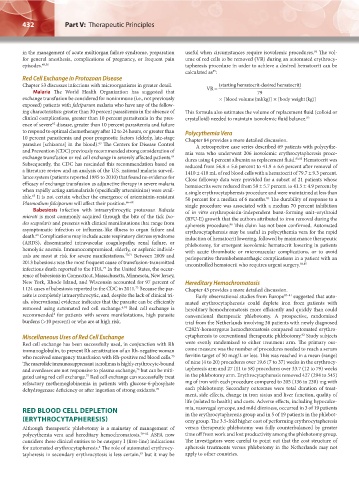
               Chapter 53 discusses infections with microorganisms in greater detail.  VR  =  (startinghematocrit-desiredhematocrit)
                   Malaria The World Health Organization has suggested that                   79
               exchange transfusion be considered for nonimmune (i.e., not previously   × [blood volume(ml/kg)]  × [bodyweight(kg)]
               exposed) patients with falciparum malaria who have any of the follow-
               ing characteristics: greater than 30 percent parasitemia in the absence of   This formula also estimates the volume of replacement fluid (colloid or
               clinical complications, greater than 10 percent parasitemia in the pres-  crystalloid) needed to maintain isovolemic fluid balance. 83
               ence of severe  disease, greater than 10 percent parasitemia and failure
                         62
               to respond to optimal chemotherapy after 12 to 24 hours, or greater than   Polycythemia Vera
               10 percent parasitemia and poor prognostic factors (elderly, late-stage   Chapter 84 provides a more detailed discussion.
               parasites [schizonts] in the blood).  The Centers for Disease Control   A retrospective case series described 69 patients with polycythe-
                                         63
               and Prevention (CDC) previously recommended strong consideration of   mia vera who underwent 206 isovolemic erythrocytapheresis proce-
               exchange transfusion or red cell exchange in severely affected patients.    dures using 4 percent albumin as replacement fluid. 83,85  Hematocrit was
                                                                 64
               Subsequently, the CDC has rescinded this recommendation based on   reduced from 56.8 ± 5.6 percent to 41.9 ± 6.6 percent after removal of
               a literature review and an analysis of the U.S. national malaria surveil-  1410 ± 418 mL of red blood cells with a hematocrit of 79.7 ± 9.3 percent.
               lance system (patients reported 1985 to 2010) that found no evidence for   Close followup data were provided for a subset of 21 patients whose
               efficacy of exchange transfusion as adjunctive therapy in severe malaria   hematocrits were reduced from 58 ± 5.7 percent to 41.5 ± 4.9 percent by
               when rapidly acting antimalarials (specifically artemisinins) were avail-  a single erythrocytapheresis procedure and were maintained at less than
               able.  It is not certain whether the emergence of artemisinin-resistant   50 percent for a median of 6 months.  The durability of response to a
                   65
                                                                                                 85
               Plasmodium falciparum will affect their position. 66–68  single procedure was associated with a median 70 percent inhibition
                   Babesiosis  Infection with intraerythrocytic protozoan  Babesia   of  in vitro erythropoietin-independent burst-forming unit–erythroid
               microti is most commonly acquired through the bite of the tick Ixo-  (BFU-E) growth that the authors attributed to iron removal during the
               des scapularis and presents with clinical manifestations that range from   apheresis procedure.  This claim has not been confirmed. Automated
                                                                                     86
               asymptomatic infection or influenza-like illness to organ failure and   erythrocytapheresis may be useful in polycythemia vera for the rapid
               death.  Complications may include acute respiratory distress syndrome   induction of hematocrit lowering, followed by maintenance therapeutic
                    69
               (ARDS), disseminated intravascular coagulopathy, renal failure, or   phlebotomy, for emergent isovolemic hematocrit lowering in patients
               hemolytic anemia. Immunocompromised, elderly, or asplenic individ-  with acute thrombotic or microvascular complications, or to avoid
               uals are most at risk for severe manifestations. 70,71  Between 2009 and   perioperative thrombohemorrhagic complications in a patient with an
               2013 babesiosis was the most frequent cause of transfusion-transmitted   uncontrolled hematocrit who requires urgent surgery. 56,85
                                          72
               infectious death reported to the FDA.  In the United States, the occur-
               rence of babesiosis in Connecticut, Massachusetts, Minnesota, New Jersey,
               New York, Rhode Island, and Wisconsin accounted for 97 percent of   Hereditary Hemochromatosis
                                                     73
               1124 cases of babesiosis reported to the CDC in 2011.  Because the par-  Chapter 43 provides a more detailed discussion.
               asite is completely intraerythrocytic, and, despite the lack of clinical tri-  Early observational studies from Europe 87–91  suggested that auto-
               als, observational evidence indicates that the parasite can be efficiently   mated erythrocytapheresis could  deplete  iron from patients  with
               removed  using  automated  red  cell  exchange.   Red  cell  exchange  is   hereditary hemochromatosis more efficiently and quickly than could
                                                 4,74
               recommended  for patients with severe manifestations, high parasite   conventional therapeutic phlebotomy. A prospective, randomized
                          4
               burdens (>10 percent) or who are at high risk.         trial from the Netherlands involving 38 patients with newly diagnosed
                                                                      C282Y-homozygous hemochromatosis compared automated erythro-
                                                                                                             92
               Miscellaneous Uses of Red Cell Exchange                cytapheresis to conventional therapeutic phlebotomy.  Study subjects
               Red cell exchange has been successfully used, in conjunction with Rh   were evenly randomized to either treatment arm. The primary out-
               immunoglobulin, to prevent Rh sensitization of an Rh-negative woman   come measure was the number of procedures needed to reach a serum
                                                                 75
               who received emergency transfusion with Rh-positive red blood cells.    ferritin target of 50 mcg/L or less. This was reached in a mean (range)
               The macrolide immunosuppressant tacrolimus is highly erythrocyte-bound   of nine (4 to 20) procedures over 19.6 (7 to 37) weeks in the erythrocy-
                                                      76
               and overdoses are not responsive to plasma exchange,  but can be miti-  tapheresis arm and 27 (11 to 58) procedures over 33.7 (12 to 79) weeks
                                     77
               gated using red cell exchange.  Red cell exchange can successfully treat   in the phlebotomy arm. Erythrocytapheresis removed 427 (294 to 545)
               refractory methemoglobinemia in patients with glucose-6-phosphate   mg of iron with each procedure compared to 205 (136 to 230) mg with
               dehydrogenase deficiency or after ingestion of strong oxidants. 78  each phlebotomy. Secondary outcomes were total duration of treat-
                                                                      ment, side effects, change in iron status and liver function, quality of
                                                                      life (related to health) and costs. Adverse effects, including hypocalce-
               RED BLOOD CELL DEPLETION                               mia, vasovagal syncope, and mild dizziness, occurred in 3 of 19 patients
                                                                      in the erythrocytapheresis group and in 5 of 19 patients in the phlebot-
               (ERYTHROCYTAPHERESIS)                                  omy group. The 3.5-fold higher cost of performing erythrocytapheresis
               Although  therapeutic  phlebotomy  is  a  mainstay  of  management  of   versus therapeutic phlebotomy was fully counterbalanced by greater
               polycythemia vera and hereditary hemochromatosis, 79–82  ASFA now   time off from work and lost productivity among the phlebotomy group.
               considers these clinical entities to be category I (first-line) indications   The investigators were careful to point out that the cost structure of
               for automated erythrocytapheresis.  The role of automated erythrocy-  apheresis treatments versus phlebotomy in the Netherlands may not
                                         4
               tapheresis in secondary erythrocytosis is less certain,  but it may be   apply to other countries.
                                                       83


          Kaushansky_chapter 28_p0427-0436.indd   432                                                                   9/17/15   6:05 PM

