


Page 507 - Williams Hematology ( PDFDrive )
P. 507
482            Part VI:  The Erythrocyte                                                                                                                                                     Chapter 32:  Erythropoiesis           483


                             A                         B                          C


                                                              ∗          L L
                                                    L L


                                               D                    E

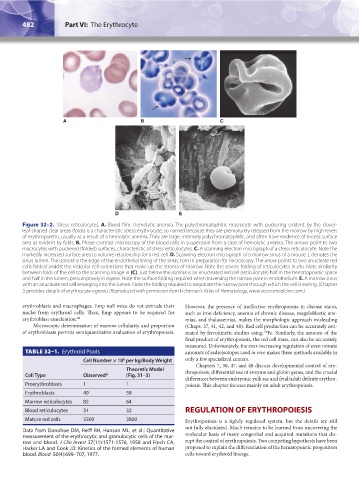
               Figure 32–2.  Stress reticulocytes. A. Blood film. Hemolytic anemia. The polychromatophilic macrocyte with puckering evident by the clover-
               leaf-shaped clear areas (folds) is a characteristic stress erythrocyte, so named because they are prematurely released from the marrow by high levels
               of erythropoietin, usually as a result of a hemolytic anemia. They are large, intensely polychromatophilic, and often have evidence of excess surface
               area as evident by folds. B. Phase-contrast microscopy of the blood cells in suspension from a case of hemolytic anemia. The arrows point to two
               macrocytes with puckered (folded) surfaces, characteristic of stress reticulocytes. C. A scanning electron micrograph of a stress reticulocyte. Note the
               markedly increased surface area to volume relationship for a red cell. D. Scanning electron micrograph of a marrow sinus of a mouse. L denotes the
               sinus lumen. The asterisk is the edge of the endothelial lining of the sinus, torn in preparation for microscopy. The arrow points to two anucleate red
               cells folded amidst the reticular cell extensions that make up the stroma of marrow. Note the severe folding of reticulocytes in situ. Note similarity
               between folds of the cell to the scanning image in (C). Just below the asterisk is an enucleated red cell (reticulocyte) half in the hematopoietic space
               and half in the lumen, presumptively in egress. Note the surface folding required when traversing the narrow pore in endothelium. E. A marrow sinus
               with an anucleate red cell emerging into the lumen. Note the folding required to negotiate the narrow pore through which the cell is exiting. (Chapter
               3 provides details of erythrocyte egress.) (Reproduced with permission from Lichtman’s Atlas of Hematology, www.accessmedicine.com.)


               erythroblasts and macrophages. Emp null mice do not extrude their   However, the presence of ineffective erythropoiesis  in disease states,
               nuclei from  erythroid cells. Thus, Emp  appears to be required for     such as iron deficiency, anemia of chronic disease, megaloblastic ane-
               erythroblast enucleation. 48                           mias, and thalassemias, makes the morphologic approach misleading
                   Microscopic determination of marrow cellularity and proportion   (Chaps. 37, 41, 42, and 48). Red cell production can be accurately esti-
               of erythroblasts permits semiquantitative evaluation of erythropoiesis.   mated by ferrokinetic studies using  Fe. Similarly, the amount of the
                                                                                                 59
                                                                      final product of erythropoiesis, the red cell mass, can also be accurately
                                                                      measured. Unfortunately, the ever-increasing regulation of even minute
                TABLE 32–1.  Erythroid Pools                          amounts of radioisotopes used in vivo makes these methods available in
                                    Cell Number × 10  per kg/Body Weight  only a few specialized centers.
                                                 8
                                                                          Chapters 7, 30, 47, and 48 discuss developmental control of ery-
                                                  Theoretic Model
                Cell Type           Observed*     (Fig. 31–3)         thropoiesis, differential use of enzyme and globin genes, and the crucial
                                                                      differences between embryonic yolk sac and fetal/adult definite erythro-
                Proerythroblasts    1             1                   poiesis. This chapter focuses mainly on adult erythropoiesis.
                Erythroblasts       49            58
                Marrow reticulocytes  82          64
                Blood reticulocytes  31           32                  REGULATION OF ERYTHROPOIESIS
                Mature red cells    3300          3800                Erythropoiesis is a tightly regulated system, but the details are still
                                                                      not fully elucidated. Much remains to be learned from uncovering the
               Data from Donohue DM, Reiff RH, Hanson ML, et al.: Quantitative
               measurement of the erythrocytic and granulocytic cells of the mar-  molecular basis of many congenital and acquired mutations that dis-
               row and blood. J Clin Invest 37(11):1571-1576, 1958 and Finch CA,   rupt the control of erythropoiesis. Two competing hypothesis have been
               Harker LA and Cook JD: Kinetics of the formed elements of human   proposed to explain the differentiation of the hematopoietic progenitors
               blood. Blood  50(4):699–707, 1977.                     cells toward erythroid lineage.


          Kaushansky_chapter 32_p0479-0494.indd   482                                                                   9/17/15   6:10 PM

