


Page 510 - Williams Hematology ( PDFDrive )
P. 510
484  Part VI:  The Erythrocyte                                                   Chapter 32:  Erythropoiesis          485


                                                                    Runx1
                                                             LT-HSC  Scl/tal1  Stem cell class
                    Pluripotent  stem cells              Self-       Bmi-1  Required for production,
                                                                     Lmo2
                                                                      MII
                                                                          survival, or self-renewal
                                                         renewal
                                                                       Tel
                                                                          of HSCs
                                                                     Gfi-1
                                                                    GATA-2
                                                         ST-HSC

                                                          CMP                                           CLP
                    Multipotent  progenitors  MEP                 GMP                                     Ikaros


                                                                                                           PU.1
                                                                                                                  Notch
                                                                       PU.1                        E2A            TCF-1
                                   GATA-1                                                          EBF
                                   GATA-2                             C/EBPα                       Pax5           GATA-3
                                    FOG1             GATA-2   GATA-1                              Bcl11a
                                                                                                  (Evi9)

                    Committed  precursors  GATA-1  GATA-1                Gfi-1

                           FOG1
                           Gfi-1b
                            EKLF    Gfi-1b            GATA-1          C/EBPc                      XBP-1


                     Mature cells  RBC  Megakaryocyte   Mast cell  Eosinophil  Neutrophil  Macrophage  B lymphocyte  T lymphocyte
                                                                                   Monocyte/
                                                                                                        LT-HSC: long term HSCs
                                     Fli-1
                                                                                                         ST HSC: short term HSCs
                                    Nf-E2
                                                                                                    CMP: Common myeloid progenitor
                                                                                                   CLP: common lymphoid progenitor
                                                                                              MEP: megakaryocyte/erythroid progenitors
                                       Platelets                                              GMP: granulocyte/macrophage progenitors
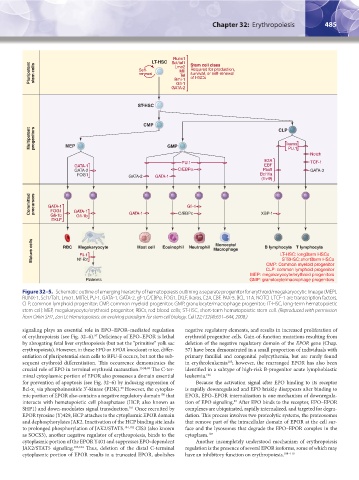
                  Figure 32–5.  Schematic outline of emerging hierarchy of hematopoiesis outlining a separate progenitor for erythroid/megakaryocytic lineage (MEP).
                  RUNX-1, Scl1/Tal1, Lmo1, MllTel, PU-1, GATA-1, GATA-2, gf-1,C/EBPα, FOG1, EKLF, Ikaros, E2A, EBF, PAX-5, BCL 11A, NOTCH, TCF-1 are transcription factors.
                  CLP, common lymphoid progenitor; CMP, common myeloid progenitor; GMP, granulocyte/macrophage progenitor; LT-HSC, long-term hematopoietic
                  stem cell; MEP, megakaryocyte/erythroid progenitor; RBCs, red blood cells; ST-HSC, short-term hematopoietic stem cell. (Reproduced with permission
                  from Orkin SH1, Zon LI: Hematopoiesis: an evolving paradigm for stem cell biology. Cell 22;132(4):631–644, 2008.)

                  signaling plays an essential role in EPO–EPOR–mediated regulation   negative regulatory elements, and results in increased proliferation of
                  of erythropoiesis (see Fig. 32–6).  Deficiency of EPO–EPOR is lethal   erythroid progenitor cells. Gain-of-function mutations resulting from
                                          97
                  by abrogating fetal liver erythropoiesis (but not the “primitive” yolk sac   deletion of the negative regulatory domain of the EPOR gene (Chap.
                  erythropoiesis). However, in these EPO or EPOR knockout mice, differ-  57) have been demonstrated in a small proportion of individuals with
                  entiation of pluripotential stem cells to BFU-E occurs, but not the sub-  primary familial and congenital polycythemia, but are rarely found
                  sequent erythroid differentiation. This occurrence demonstrates the   in erythroleukemia ; however, the rearranged EPOR has also been
                                                                                       105
                  crucial role of EPO in terminal erythroid maturation. 35,98,99  The C-ter-  identified in a subtype of high-risk B-progenitor acute lymphoblastic
                  minal cytoplasmic portion of EPOR also possesses a domain essential   leukemia. 106
                  for prevention of apoptosis (see Fig. 32–6) by inducing expression of   Because the activation signal after EPO binding to its receptor
                  Bcl-x  via phosphoinositide 3′-kinase (PI3K).  However, the cytoplas-  is rapidly downregulated and EPO briskly disappears after binding to
                                                   53
                      L
                  mic portion of EPOR also contains a negative regulatory domain  that   EPOR, EPO–EPOR internalization is one mechanism of downregula-
                                                                100
                  interacts with hematopoietic cell phosphatase (HCP, also known as   tion of EPO signaling.  After EPO binds to the receptor, EPO–EPOR
                                                                                         92
                  SHP1) and down-modulates signal transduction.  Once recruited by   complexes are ubiquinated, rapidly internalized, and targeted for degra-
                                                      101
                  EPOR tyrosine (Y)429, HCP attaches to the cytoplasmic EPOR domain   dation. This process involves two proteolytic systems, the proteosomes
                  and dephosphorylates JAK2. Inactivation of the HCP binding site leads   that remove part of the intracellular domain of EPOR at the cell sur-
                  to prolonged phosphorylation of JAK2/STAT5. 101,102  CIS3 (also known   face and the lysosomes that degrade the EPO–EPOR complex in the
                  as SOCS3), another negative regulator of erythropoiesis, binds to the   cytoplasm. 107
                  cytoplasmic portion of the EPOR Y401 and suppresses EPO-dependent   Another incompletely understood mechanism of erythropoiesis
                  JAK2/STAT5 signaling. 103,104  Thus, deletion of the distal C-terminal   regulation is the presence of several EPOR isoforms, some of which may
                  cytoplasmic portion of EPOR results in a truncated EPOR, abolishes   have an inhibitory function on erythropoiesis. 108–110


          Kaushansky_chapter 32_p0479-0494.indd   485                                                                   9/17/15   6:10 PM

