


Page 505 - Williams Hematology ( PDFDrive )
P. 505
480            Part VI:  The Erythrocyte                                                                                                                                                     Chapter 32:  Erythropoiesis           481


               more advanced phylum Annelida. However, the evolutionary advantage   ceases, and erythropoiesis moves to the marrow (Chaps. 7 and 48 pro-
               derived from enucleation appears to be slight. Nucleated red cells are   vide details of developmental switching of embryonic, fetal, and adult
               observed in more advanced animals, such as reptiles and birds.  All   globin expression).
                                                               14
               mammalian erythrocytes are nonnucleated and in most species are disc   During the neonatal period, the volume of available marrow
                                          15
               shaped, but are oval in some species.  Enucleation decreases the work-  space is almost the same as the total volume of hematopoietic cells and
                                                                                     28
               load of heart as it reduces one third of the cell weight.  marrow vasculature.  This process continues for a few years until the
                   In nonmammalian species, the spleen is the fundamental erythro-  growth of bones and bone cavities exceeds the growth of hematopoi-
               poietic organ. However, in some fish, the kidneys also are involved in   etic mass. However, whenever the demand on erythropoiesis increases
               red cell production. 16,17  In vertebrates, an evolutionary shift occurred   (blood loss, hypoxia, ineffective erythropoiesis, or hemolysis), the lack
                                                                 18
               from the spleen to the liver and from the liver to the bones cavities.    of reserve space in neonates and small children reactivates extramedul-
                                                                                                    29
               The homeostatic regulation of blood or hemoglobin production has   lary erythropoiesis in the liver and spleen.  In adults, expansion of mar-
                                  8
               been studied in Daphnia,  where a balance exists between oxygen need   row space continues, and the amount of fatty tissue gradually increases
               and hemoglobin production. In higher animals, this relationship is   in all bone cavities. Because of the abundant marrow space, compen-
               maintained by adjusting red cell production. Studies of birds,  fish,    satory reactivation of extramedullary sites rarely occurs in later life.
                                                             19
                                                                 20
                          21
               and mammals  indicate that red cell production is controlled by EPO,   Extramedullary hematopoiesis during adult years indicates pathologic
               which is capable of adjusting red cell production to the demands for   rather than compensatory blood formation, such as seen in primary
               oxygen in the tissues. EPO of mammals has considerable biologic simi-  myelofibrosis (Chap. 86) wherein the stem cells have abnormal inter-
                                                                                                30
               larity and genetic homology. 22                        action with the extracellular matrix.  During fetal life, EPO production
                                                                                     31
                                                                      is primarily hepatic.  At birth, a gradual switch to renal production of
                                                                      EPO occurs. In the adult, the kidney is responsible for approximately
                  ONTOGENY OF RED CELL PRODUCTION                     85 percent of total production. 32,33
               EMBRYONIC AND FETAL ERYTHROPOIESIS                          CELLULAR COMPONENTS OF
               The environment within the bone apparently is optimal for cellular
               proliferation and maturation. However, bone cavities do not develop   ERYTHROPOIESIS
               until the fifth fetal month. Other, presumably less favorable, sites are
               responsible for red cell production during early embryonic life (Chap.   PROGENITOR CELLS
               7). In the human, large nucleated blood cells are first formed in the yolk   Our ability to evaluate early erythropoiesis rests on functional assays
               sac,  and some enucleate.  They cluster in blood islands that become   of hematopoietic progenitors. The developmentally earliest progenitor
                  23
                                  24
               enveloped by endothelial cells forming the vascular plexus of the yolk   committed to the erythroid lineage is the burst-forming unit–erythroid
               sac.  This is referred to as primitive erythropoiesis, and is contrasted   (BFU-E). It was initially termed a burst because it contains cells still
                  25
               with definitive erythropoiesis, which occurs in the fetal liver and in the   capable of migration. These cells form smaller clusters around a larger
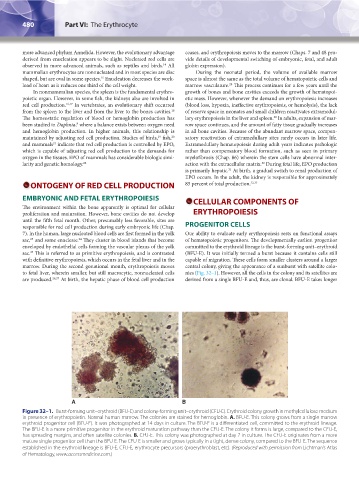
               marrow. During the second gestational month, erythropoiesis moves   central colony, giving the appearance of a sunburst with satellite colo-
               to fetal liver, wherein smaller, but still macrocytic, nonnucleated cells   nies (Fig. 32–1). However, all the cells in the colony and its satellites are
               are produced. 26,27  At birth, the hepatic phase of blood cell production   derived from a single BFU-E and, thus, are clonal. BFU-E takes longer


                                A                                    B
               Figure 32–1.  Burst-forming unit–erythroid (BFU-E) and colony-forming unit–erythroid (CFU-E). Erythroid colony growth in methylcellulose medium
               in presence of erythropoietin. Normal human marrow. The colonies are stained for hemoglobin. A. BFU-E. This colony grows from a single marrow
               erythroid progenitor cell (BFU-E). It was photographed at 14 days in culture. The BFU-E is a differentiated cell, committed to the erythroid lineage.
               The BFU-E is a more primitive progenitor in the erythroid maturation pathway than the CFU-E. The colony it forms is large, compared to the CFU-E,
               has spreading margins, and often satellite colonies. B. CFU-E. This colony was photographed at day 7 in culture. The CFU-E originates from a more
               mature single progenitor cell than the BFU-E. The CFU-E is smaller and grows typically in a tight, dense colony, compared to the BFU-E. The sequence
               established in the erythroid lineage is BFU-E, CFU-E, erythrocyte precursors (proerythroblast, etc). (Reproduced with permission from Lichtman’s Atlas
               of Hematology, www.accessmedicine.com.)


          Kaushansky_chapter 32_p0479-0494.indd   480                                                                   9/17/15   6:10 PM

