


Page 508 - Williams Hematology ( PDFDrive )
P. 508
482  Part VI:  The Erythrocyte                                                   Chapter 32:  Erythropoiesis          483


                                                    Erythron                                 Erythropoiesis
                     Stem   Progenitor cells  Precursor cells  Mature                          Stem cell
                     cells  BFU-E   CFU-E  Erythroblasts        cells
                                                                            SCF, IL3
                                                                                              CFU-GEMM
                                                                                                            Redundant role for
                                                                                                              EPO/EPOR
                                                                           EPO, G-CSF,          BFU–E
                                                                              TPO
                                                                                                CFU–E        Obligatory role for
                                                                                                               EPO/EPOR
                                                                                              Erythroblast
                                                                                              Reticulocyte
                                                                           A                  Erythrocyte

                                                                                Regulation of erythropoiesis by hypoxia
                                                                                   Oxygen homeostasis
                                                                               in local tissue oxygen tension

                                                                                                      Anaerobic metabolism
                  Receptors                                                         HIF-1 level       Angiogenesis
                    EPO
                                                                                                      Erythropoiesis
                   GM-CSF
                     IL-3                                                         Glycolytic enzyme genes
                  Transferrin
                                                                                  VEGF
                  Fibronectin                                                     EPO       Kidney (liver)
                                                                              B             erythroid progenitors
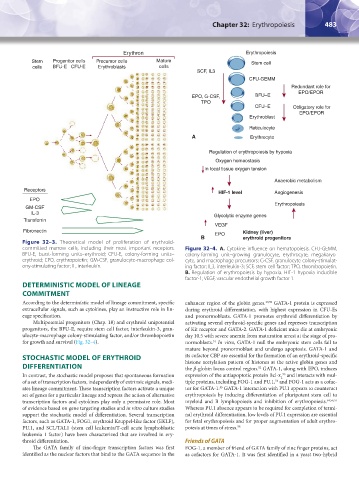
                  Figure 32–3.  Theoretical model of proliferation of erythroid-
                  committed marrow cells, including their most important receptors.   Figure 32–4.  A.  Cytokine  influence  on  hematopoiesis.  CFU-GEMM,
                  BFU-E, burst-forming units–erythroid; CFU-E, colony-forming units–  colony-forming unit–growing granulocyte, erythrocyte, megakaryo-
                  erythroid; EPO, erythropoietin; GM-CSF, granulocyte-macrophage col-  cyte, and macrophage precursors; G-CSF, granulocyte colony-stimulat-
                  ony-stimulating factor; IL, interleukin.              ing factor; IL3, interleukin-3; SCF, stem cell factor; TPO, thrombopoietin.
                                                                        B. Regulation of erythropoiesis by hypoxia. HIF-1 hypoxia inducible
                                                                        factor-1; VEGF, vascular endothelial growth factor 1.
                  DETERMINISTIC MODEL OF LINEAGE
                  COMMITMENT
                  According to the deterministic model of lineage commitment, specific   enhancer region of the globin genes. 49,50  GATA-1 protein is expressed
                  extracellular signals, such as cytokines, play an instructive role in lin-  during erythroid differentiation, with highest expression in CFU-Es
                  eage specification.                                   and pronormoblasts.  GATA-1 promotes erythroid differentiation by
                     Multipotential progenitors (Chap. 18) and erythroid unipotential   activating several erythroid-specific genes and represses transcription
                  progenitors, the BFU-E, require stem cell factor, interleukin-3, gran-  of Kit receptor and GATA-2. GATA-1 deficient mice die at embryonic
                  ulocyte-macrophage colony-stimulating factor, and/or thrombopoietin   day 10.5 with severe anemia from maturation arrest at the stage of pro-
                  for growth and survival (Fig. 32–4).                  normoblasts.  In vitro, GATA-1 null the embryonic stem cells fail to
                                                                                  51
                                                                        mature beyond pronormoblast and undergo apoptosis. GATA-1 and
                  STOCHASTIC MODEL OF ERYTHROID                         its cofactor CBP are essential for the formation of an erythroid-specific
                                                                        histone acetylation pattern of histones at the active globin genes and
                  DIFFERENTIATION                                       the β-globin locus control region.  GATA-1, along with EPO, induces
                                                                                                 52
                                                                                                         53
                  In contrast, the stochastic model proposes that spontaneous formation   expression of the antiapoptotic protein Bcl-x  and interacts with mul-
                                                                                                        L
                  of a set of transcription factors, independently of extrinsic signals, medi-  tiple proteins, including FOG-1 and PU.1,  and FOG-1 acts as a cofac-
                                                                                                       54
                                                                                    55
                  ates lineage commitment. These transcription factors activate a unique   tor for GATA-1.  GATA-1 interaction with PU.1 appears to counteract
                  set of genes for a particular lineage and repress the action of alternative   erythropoiesis  by  inducing  differentiation  of  pluripotent  stem  cell  to
                  transcription factors and cytokines play only a permissive role. Most   myeloid and B lymphopoiesis and inhibition of erythropoiesis. 54,56,57
                  of evidence based on gene targeting studies and in vitro culture studies   Whereas PU.1 absence appears to be required for completion of termi-
                  support  the  stochastic  model of  differentiation.  Several transcription   nal erythroid differentiation, low levels of PU.1 expression are essential
                  factors, such as GATA-1, FOG1, erythroid Kruppel-like factor (EKLF),   for fetal erythropoiesis and for proper augmentation of adult erythro-
                  PU.1, and SCL/TAL1 (stem cell leukemia/T-cell acute lymphoblastic   poiesis at times of stress. 58
                  leukemia 1 factor) have been characterized that are involved in ery-
                  throid differentiation.                               Friends of GATA
                     The  GATA  family  of  zinc-finger  transcription  factors  was  first   FOG-1, a member of friend of GATA family of zinc finger proteins, act
                  identified as the nuclear factors that bind to the GATA sequence in the   as cofactors for GATA-1. It was first identified in a yeast two-hybrid


          Kaushansky_chapter 32_p0479-0494.indd   483                                                                   9/17/15   6:10 PM

