


Page 52 - Williams Hematology ( PDFDrive )
P. 52
28             Part I:  Clinical Evaluation of the Patient                                                                                                                       Chapter 3:  Examination of the Marrow              29


                    MARROW ASPIRATION TECHNIQUE

               At birth, all bones contain hematopoietic marrow. Fat cells begin to
               replace hemopoietic marrow in the extremities in the fifth to seventh
               year. By adulthood, the hemopoietic marrow is limited to the axial         1
               skeleton and the proximal portions of the extremities (Chaps. 5 and 9).    2
               Fatty  marrow  appears  yellow,  whereas  hematopoietic  marrow  is  red.   3
               Red marrow contains fat, however, and fat droplets are visible grossly
               in aspirated marrow specimens. Histologically, yellow marrow consists
               almost entirely of fat cells and supporting connective tissue. Red mar-
               row contains an abundance of hematopoietic cells, fat cells, and con-
               nective tissue. The marrow fills the spaces between the trabeculae of
               bone in the marrow cavity. Marrow is soft and friable and can be readily
               aspirated or biopsied with a needle.
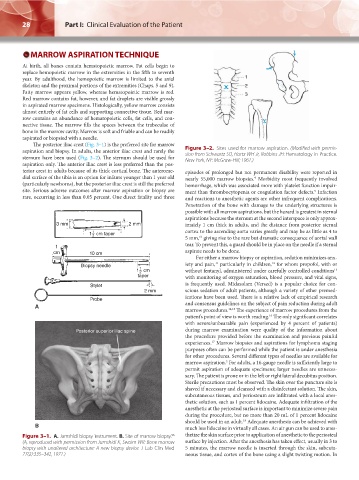
                   The posterior iliac crest (Fig. 3–1) is the preferred site for marrow
               aspiration and biopsy. In adults, the anterior iliac crest and rarely the   Figure 3–2.  Sites used for marrow aspiration. (Modified with permis-
               sternum have been used (Fig. 3–2). The sternum should be used for   sion from Schwartz SO, Hartz WH Jr, Robbins JH: Hematology in Practice.
                                                                      New York, NY: McGraw-Hill; 1961.)
               aspiration only. The anterior iliac crest is less preferred than the pos-
               terior crest in adults because of its thick cortical bone. The anterome-  episodes of prolonged but not permanent disability were reported in
               dial surface of the tibia is an option for infants younger than 1 year old   nearly 55,000 marrow biopsies.  Morbidity most frequently involved
                                                                                             9
               (particularly newborns), but the posterior iliac crest is still the preferred   hemorrhage, which was associated more with platelet function impair-
               site. Serious adverse outcomes after marrow aspiration or biopsy are   ment than thrombocytopenia or coagulation factor defects.  Infection
                                                                                                                 9
               rare, occurring in less than 0.05 percent. One direct fatality and three   and reactions to anesthetic agents are other infrequent complications.
                                                                      Penetration of the bone with damage to the underlying structures is
                                                                      possible with all marrow aspirations, but the hazard is greatest in sternal
                                                                      aspirations because the sternum at the second interspace is only approx-
                           3 mm                    2 mm               imately 1 cm thick in adults, and the distance from posterior sternal
                                       1
                                      1 cm taper                      cortex to the ascending aorta varies greatly and may be as little as 4 to
                                       2
                                                                      5 mm,  giving rise to the rare but dramatic consequence of aortal wall
                                                                           10
                          1                                           tear. To prevent this, a guard should be in place on the needle if a sternal
                          cm          10 cm                           aspirate needs to be done.
                                                                          For either a marrow biopsy or aspiration, sedation minimizes anx-
                                                                                                   12
                                                                                11
                                   Biopsy needle                      iety and pain,  particularly in children,  for whom propofol, with or
                                                       1
                                                      1cm             without fentanyl, administered under carefully controlled conditions
                                                                                                                        13
                                                       2
                                                      taper           with monitoring of oxygen saturation, blood pressure, and vital signs,
                                      Stylet                          is frequently used. Midazolam (Versed) is a popular choice for con-
                                                        2 mm          scious sedation of adult patients, although a variety of other premed-
                                                                      ications have been used. There is a relative lack of empirical research
                                      Probe
                    A                                                 and consensus guidelines on the subject of pain reduction during adult
                                                                      marrow procedures. 14,15  The experience of marrow procedures from the
                                                                      patient’s point of view is worth reading.  The only significant correlates
                                                                                                  16
                                                                      with severe/unbearable pain (experienced by 4 percent of patients)
                                 Posterior superior iliac spine       during marrow examination were quality of the information about
                                                                      the procedure provided before the examination and previous painful
                                                                               17
                                                                      experiences.  Marrow biopsies and aspirations for lymphoma staging
                                                                      purposes often can be performed while the patient is under anesthesia
                                                                      for other procedures. Several different types of needles are available for
                                                                      marrow aspiration.  For adults, a 16-gauge needle is sufficiently large to
                                                                                    3
                                                                      permit aspiration of adequate specimens; larger needles are unneces-
                                                                      sary. The patient is prone or in the left or right lateral decubitus position.
                                                                      Sterile precautions must be observed. The skin over the puncture site is
                                                                      shaved if necessary and cleansed with a disinfectant solution. The skin,
                                                                      subcutaneous tissues, and periosteum are infiltrated with a local anes-
                                                                      thetic solution, such as 1 percent lidocaine. Adequate infiltration of the
                                                                      anesthetic at the periosteal surface is important to minimize severe pain
                                                                      during the procedure, but no more than 20 mL of 1 percent lidocaine
                                                                                         18
                                                                      should be used in an adult.  Adequate anesthesia can be achieved with
                    B                                                 much less lidocaine in virtually all cases. An air gun can be used to anes-
               Figure 3–1.  A. Jamshidi biopsy instrument. B. Site of marrow biopsy.      thetize the skin surface prior to application of anesthetic to the periosteal
                                                                 96
               (A, reproduced with permission from Jamshidi K, Swaim WR: Bone marrow   surface by injection. After the anesthesia has taken effect, usually in 3 to
               biopsy with unaltered architecture: A new biopsy device. J Lab Clin Med     5 minutes, the marrow needle is inserted through the skin, subcuta-
               77(2):335–342, 1971.)                                  neous tissue, and cortex of the bone using a slight twisting motion. In


          Kaushansky_chapter 03_p0027-0040.indd   28                                                                    17/09/15   5:36 pm

