


Page 56 - Williams Hematology ( PDFDrive )
P. 56
32             Part I:  Clinical Evaluation of the Patient                                                                                                                       Chapter 3:  Examination of the Marrow              33


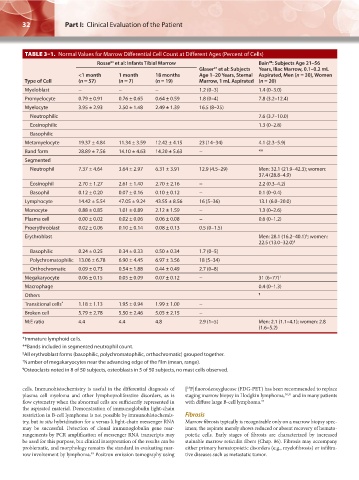
                TABLE 3–1.  Normal Values for Marrow Differential Cell Count at Different Ages (Percent of Cells)
                                        Rosse  et al: Infants Tibial Marrow                    Bain : Subjects Age 21–56
                                                                                                  98
                                             64
                                                                                97
                                                                           Glaser  et al: Subjects   Years, Iliac Marrow, 0.1–0.2 mL
                                  <1 month      1 month     18 months      Age 1–20 Years, Sternal  Aspirated, Men (n = 30), Women
                Type of Cell      (n = 57)      (n = 7)     (n = 19)       Marrow, 1 mL Aspirated (n = 20)
                Myeloblast        −             −           −              1.2 (0–3)           1.4 (0–3.0)
                Promyelocyte      0.79 ± 0.91   0.76 ± 0.65  0.64 ± 0.59   1.8 (0–4)           7.8 (3.2–12.4)
                Myelocyte         3.95 ± 2.93   2.50 ± 1.48  2.49 ± 1.39   16.5 (8–25)
                  Neutrophilic                                                                 7.6 (3.7–10.0)
                  Eosinophilic                                                                 1.3 (0–2.8)
                  Basophilic
                Metamyelocyte     19.37 ± 4.84  11.34 ± 3.59  12.42 ± 4.15  23 (14–34)         4.1 (2.3–5.9)
                Band form         28.89 ± 7.56  14.10 ± 4.63  14.20 ± 5.63  −                  **
                Segmented
                  Neutrophil      7.37 ± 4.64   3.64 ± 2.97  6.31 ± 3.91   12.9 (4.5–29)       Men: 32.1 (21.9–42.3); women:
                                                                                               37.4 (28.8–4.9)
                  Eosinophil      2.70 ± 1.27   2.61 ± 1.40  2.70 ± 2.16   −                   2.2 (0.3–4.2)
                  Basophil        0.12 ± 0.20   0.07 ± 0.16  0.10 ± 0.12   −                   0.1 (0–0.4)
                Lymphocyte        14.42 ± 5.54  47.05 ± 9.24  43.55 ± 8.56  16 (5–36)          13.1 (6.0–20.0)
                Monocyte          0.88 ± 0.85   1.01 ± 0.89  2.12 ± 1.59   −                   1.3 (0–2.6)
                Plasma cell       0.00 ± 0.02   0.02 ± 0.06  0.06 ± 0.08   −                   0.6 (0–1.2)
                Proerythroblast   0.02 ± 0.06   0.10 ± 0.14  0.08 ± 0.13   0.5 (0–1.5)
                                                                                                              §
                Erythroblast                                                                   Men: 28.1 (16.2–40.1) ; women:
                                                                                               22.5 (13.0–32.0) §
                  Basophilic      0.24 ± 0.25   0.34 ± 0.33  0.50 ± 0.34   1.7 (0–5)
                   Polychromatophilic 13.06 ± 6.78  6.90 ± 4.45  6.97 ± 3.56  18 (5–34)
                  Orthochromatic  0.09 ± 0.73   0.54 ± 1.88  0.44 ± 0.49   2.7 (0–8)
                Megakaryocyte     0.06 ± 0.15   0.05 ± 0.09  0.07 ± 0.12   −                   31 (6–77) †
                Macrophage                                                                     0.4 (0–1.3)
                Others                                                                         ¶
                Transitional cells *  1.18 ± 1.13  1.95 ± 0.94  1.99 ± 1.00  −
                Broken cell       5.79 ± 2.78   5.50 ± 2.46  5.05 ± 2.15   −
                M:E ratio         4.4           4.4         4.8            2.9 (1–5)           Men: 2.1 (1.1–4.1); women: 2.8
                                                                                               (1.6–5.2)
               *Immature lymphoid cells.
               **Bands included in segmented neutrophil count.
               § All erythroblast forms (basophilic, polychromatophilic, orthochromatic) grouped together.
               † Number of megakaryocytes near the advancing edge of the film (mean, range).
               ¶ Osteoclasts noted in 8 of 50 subjects, osteoblasts in 5 of 50 subjects, no mast cells observed.


                                                                       18
               cells. Immunohistochemistry is useful in the differential diagnosis of   [ F]fluorodeoxyglucose (FDG-PET) has been recommended to replace
               plasma cell myeloma and other lymphoproliferative disorders, as is   staging marrow biopsy in Hodgkin lymphoma, 50,51  and in many patients
               flow cytometry when the abnormal cells are sufficiently represented in   with diffuse large B-cell lymphoma. 52
               the aspirated material. Demonstration of immunoglobulin light-chain
               restriction in B-cell lymphoma is not possible by immunohistochemis-  Fibrosis
               try, but in situ hybridization for κ versus λ light-chain messenger RNA   Marrow fibrosis typically is recognizable only on a marrow biopsy spec-
               may be successful. Detection of clonal immunoglobulin gene rear-  imen; the aspirate merely shows reduced or absent recovery of hemato-
               rangements by PCR amplification of messenger RNA transcripts may   poietic cells. Early stages of fibrosis are characterized by increased
               be used for this purpose, but clinical interpretation of the results can be   stainable marrow reticulin fibers (Chap. 86). Fibrosis may accompany
               problematic, and morphology remains the standard in evaluating mar-  either primary hematopoietic disorders (e.g., myelofibrosis) or infiltra-
               row involvement by lymphoma.  Positron emission tomography using    tive diseases such as metastatic tumor.
                                      49


          Kaushansky_chapter 03_p0027-0040.indd   32                                                                    17/09/15   5:37 pm

