


Page 57 - Williams Hematology ( PDFDrive )
P. 57
32  Part I:  Clinical Evaluation of the Patient                      Chapter 3:  Examination of the Marrow              33


                  Storage Diseases                                      only on biopsy specimens, necessitates examination by special stains
                  Storage disorders, such as Gaucher and Niemann-Pick diseases (Chap.   for fungal and mycobacterial organisms, but the differential diagnosis
                  72), are characterized by abnormal macrophages containing stored   is extensive. 53,61
                  material in various forms seen in aspirate or biopsy.  Reactive cells,
                                                         53
                  such as the histiocytes with “sea-blue” inclusion granules (Chap. 72) or
                  pseudo-Gaucher cells associated with chronic myelogenous leukemia   NECROSIS AND GELATINOUS
                  (CML) (Chap. 89),  can resemble the cells seen in storage disorders.  TRANSFORMATION
                               53
                                                                        Marrow necrosis may occur in a variety of disorders, particularly sickle
                  Amyloidosis                                           cell disease and neoplastic processes involving the marrow.  Aspirates
                                                                                                                   62
                  Amyloid refers to extracellular proteins that become insoluble as a result   of necrotic marrow stained with polychrome stains contain cells with
                  of alteration in secondary structure to form beta pleated sheets. Amy-  indistinct margins and smudged basophilic nuclei surrounded by aci-
                  loid light-chain amyloidosis may result from a plasma cell neoplasm,   dophilic material. Marrow sections stained with hematoxylin and eosin
                  and is associated with nephrotic syndrome, restrictive cardiomyopa-  show loss of normal marrow architecture, indistinct cellular margins,
                  thy, neuropathy and other tissue involvement. Amyloid deposits can be   and a background of amorphous eosinophilic material. Patients with
                  identified in the marrow by characteristic birefringence or fluorescence   severe weight loss may develop gelatinous transformation of the mar-
                  of deposits when stained with Congo Red. 54           row, characterized by amorphous extracellular material (proteogly-
                                                                        cans), fat atrophy, and marrow hypoplasia. 63
                  INFECTIONS
                  Infectious organisms with an intracellular location, such as Leishma-    MORPHOLOGIC DIFFERENTIATION OF
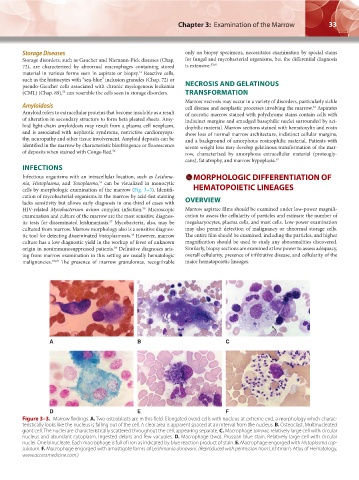
                  nia, Histoplasma, and  Toxoplasma,  can be visualized in monocytic
                                            55
                  cells by morphologic examination of the marrow (Fig. 3–3). Identifi-  HEMATOPOIETIC LINEAGES
                  cation of mycobacterial organisms in the marrow by acid-fast staining
                  lacks sensitivity but allows early diagnosis in one-third of cases with   OVERVIEW
                  HIV-related  Mycobacterium avium complex infection.  Microscopic   Marrow aspirate films should be examined under low-power magnifi-
                                                          56
                  examination and culture of the marrow are the most sensitive diagnos-  cation to assess the cellularity of particles and estimate the number of
                  tic tests for disseminated leishmaniasis.  Mycobacteria, also, may be   megakaryocytes, plasma cells, and mast cells. Low-power examination
                                               57
                  cultured from marrow. Marrow morphology also is a sensitive diagnos-  may  also  permit  detection  of malignancy  or  abnormal  storage  cells.
                  tic tool for detecting disseminated histoplasmosis.  However, marrow   The entire film should be examined, including the particles, and higher
                                                      58
                  culture has a low diagnostic yield in the workup of fever of unknown   magnification should be used to study any abnormalities discovered.
                  origin in nonimmunosuppressed patients.  Definitive diagnoses aris-  Similarly, biopsy sections are examined at low power to assess adequacy,
                                                 59
                  ing from marrow examination in this setting are usually hematologic   overall cellularity, presence of infiltrative disease, and cellularity of the
                  malignancies. 59,60  The presence of marrow granulomas, recognizable   major hematopoietic lineages.


                           A                            B                             C


                           D                            E                             F
                  Figure 3–3.  Marrow findings. A. Two osteoblasts are in this field. Elongated ovoid cells with nucleus at extreme end, a morphology which charac-
                  teristically looks like the nucleus is falling out of the cell. A clear area is apparent spaced at an interval from the nucleus. B. Osteoclast. Multinucleated
                  giant cell. The nuclei are characteristically scattered throughout the cell, appearing separate. C. Macrophage (arrow), relatively large cell with circular
                  nucleus and abundant cytoplasm. Ingested debris and few vacuoles. D. Macrophage (two). Prussian blue stain. Relatively large cell with circular
                  nuclei. One binucleate. Each macrophage is full of iron as indicated by blue reaction product of stain. E. Macrophage engorged with Histoplasma cap-
                  sulatum. F. Macrophage engorged with amastigote forms of Leishmania donovani. (Reproduced with permission from Lichtman’s Atlas of Hematology,
                  www.accessmedicine.com.)


          Kaushansky_chapter 03_p0027-0040.indd   33                                                                    17/09/15   5:38 pm

