


Page 556 - Williams Hematology ( PDFDrive )
P. 556
530  Part VI:  The Erythrocyte                         Chapter 35:  Aplastic Anemia: Acquired and Inherited           531


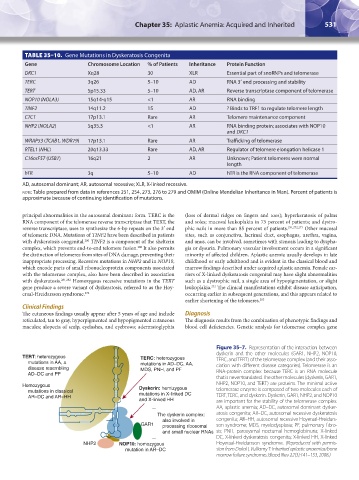
                   TABLE 35–10.  Gene Mutations in Dyskeratosis Congenita
                   Gene                 Chromosome Location  % of Patients  Inheritance  Protein Function
                   DKC1                 Xq28                30            XLR         Essential part of snoRNPs and telomerase
                   TERC                 3q26                5–10          AD          RNA 3′ end processing and stability
                   TERT                 5p15.33             5–10          AD, AR      Reverse transcriptase component of telomerase
                   NOP10 (NOLA3)        15q14-q15           <1            AR          RNA binding
                   TINF2                14q11.2             15            AD          ? Binds to TRF1 to regulate telomere length
                   CTC1                 17p13.1             Rare          AR          Telomere maintenance component
                   NHP2 (NOLA2)         5q35.3              <1            AR          RNA binding protein; associates with NOP10
                                                                                      and DKC1
                   WRAP53 (TCAB1, WDR79)  17p13.1           Rare          AR          Trafficking of telomerase
                   RTEL1 (NHL)          20q13.33            Rare          AD, AR      Regulator of telomere elongation helicase 1
                   C16orF57 (USB1)      16q21               2             AR          Unknown; Patient telomeres were normal
                                                                                      length
                   hTR                  3q                  5–10          AD          hTR is the RNA component of telomerase
                  AD, autosomal dominant; AR, autosomal recessive; XLR, X-linked recessive.
                  note: Table prepared from data in references 251, 254, 273, 276 to 279 and OMIM (Online Mendelian Inheritance in Man). Percent of patients is
                  approximate because of continuing identification of mutations.


                  principal abnormalities in the autosomal dominant form. TERC is the   (loss of dermal ridges on fingers and toes); hyperkeratosis of palms
                  RNA component of the telomerase reverse transcriptase that TERT, the   and soles; mucosal leukoplakia in 75 percent of patients; and dystro-
                  reverse transcriptase, uses to synthesize the 6-bp repeats on the 3′ end   phic nails in more than 85 percent of patients. 251,272,273  Other mucosal
                  of telomeric DNA. Mutations of TINF2 have been described in patients   sites, such as conjunctiva, lacrimal duct, esophagus,  urethra, vagina,
                  with dyskeratosis congenital.  TINF2 is a component of the shelterin   and anus, can be involved, sometimes with stenosis leading to dyspha-
                                       280
                  complex, which prevents end-to-end telomere fusion.  It also permits   gia or dysuria. Pulmonary vascular involvement occurs in a significant
                                                        280
                  the distinction of telomeres from sites of DNA damage, preventing their   minority of affected children. Aplastic anemia usually develops in late
                  inappropriate processing. Recessive mutations in NHP2 and in NOP10,   childhood or early adulthood and is evident in the classical blood and
                  which encode parts of small ribonucleoprotein components associated   marrow findings described under acquired aplastic anemia. Female car-
                  with the telomerase complex, also have been described in association   riers of X-linked dyskeratosis congenital may have slight abnormalities
                  with dyskeratosis. 281,282  Homozygous recessive mutations in the TERT   such as a dystrophic nail, a single area of hypopigmentation, or slight
                                                                                 272
                  gene produce a severe variant of dyskeratosis, referred to as the Hoy-  leukoplakia.  The clinical manifestations exhibit disease anticipation,
                  eraal-Hreidarsson syndrome. 272                       occurring earlier in subsequent generations, and this appears related to
                                                                        earlier shortening of the telomeres. 283
                  Clinical Findings
                  The cutaneous findings usually appear after 5 years of age and include   Diagnosis
                  reticulated, tan to gray, hyperpigmented and hypopigmented cutaneous   The diagnosis results from the combination of phenotypic findings and
                  macules; alopecia of scalp, eyelashes, and eyebrows; adermatoglyphia   blood cell deficiencies. Genetic analysis for telomerase complex gene


                                                                                   Figure 35–7.  Representation of the interaction between
                                                                                   dyskerin and the other molecules (GAR1, NHP2, NOP10,
                  TERT: heterozygous                     TERC: heterozygous        TERC, and TERT) of the telomerase complex (and their asso-
                    mutations in AA, a                   mutations in AD–DC, AA,   ciation with different disease categories). Telomerase is an
                    disease resembling                   MDS, PNH, and PF          RNA-protein complex because TERC is an RNA molecule
                    AD–DC and PF
                                                                                   that is never translated. The other molecules (dyskerin, GAR1,
                  Homozygous                             Dyskerin: hemizygous      NHP2, NOP10, and TERT) are proteins. The minimal active
                    mutations in classical               mutations in X-linked DC  telomerase enzyme is composed of two molecules each of
                    AR–DC and AR–HH                                                TERT, TERC, and dyskerin. Dyskerin, GAR1, NHP2, and NOP10
                                                         and X-linked HH           are important for the stability of the telomerase complex.
                                                                                   AA, aplastic anemia; AD–DC, autosomal dominant dysker-
                                                               The dyskerin complex:  atosis congenita; AR–DC, autosomal recessive dyskeratosis
                                                                 also involved in  congenita; AR–HH, autosomal recessive Hoyeraal-Hreidars-
                                                          GAR1    processing ribosomal  son syndrome; MDS, myelodysplasia; PF, pulmonary fibro-
                                                                 and small nuclear RNAs sis; PNH, paroxysmal nocturnal hemoglobinuria; X-linked
                                                                                   DC, X-linked dyskeratosis congenita; X-linked HH, X-linked
                                      NHP2        NOP10: homozygous                Hoyeraal-Hreidarsson syndrome.  (Reproduced with permis-
                                                     mutation in AR–DC             sion from Dokal I, Vulliamy T: Inherited aplastic anaemias/bone
                                                                                   marrow failure syndromes. Blood Rev 22(3):141–153, 2008.)


          Kaushansky_chapter 35_p0513-0538.indd   531                                                                   9/19/15   12:24 AM

