


Page 555 - Williams Hematology ( PDFDrive )
P. 555
530            Part VI:  The Erythrocyte                                                                                                                           Chapter 35:  Aplastic Anemia: Acquired and Inherited            531


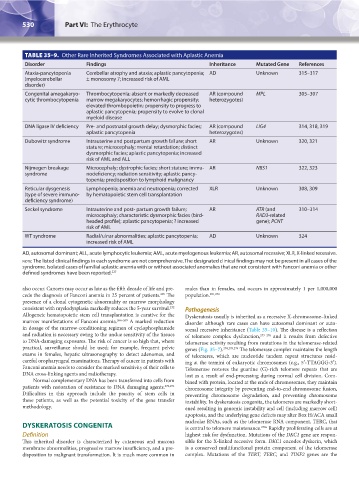
                TABLE 35–9.  Other Rare Inherited Syndromes Associated with Aplastic Anemia
                Disorder             Findings                                 Inheritance     Mutated Gene  References
                Ataxia-pancytopenia    Cerebellar atrophy and ataxia; aplastic pancytopenia;  AD  Unknown   315–317
                (myelocerebellar     ± monosomy 7; increased risk of AML
                disorder)
                Congenital amegakaryo-  Thrombocytopenia; absent or markedly decreased   AR (compound   MPL  305–307
                cytic thrombocytopenia  marrow megakaryocytes; hemorrhagic propensity;   heterozygotes)
                                     elevated thrombopoietin; propensity to progress to
                                     aplastic pancytopenia; propensity to evolve to clonal
                                     myeloid disease
                DNA ligase IV deficiency  Pre- and postnatal growth delay; dysmorphic facies;   AR (compound   LIG4  314, 318, 319
                                     aplastic pancytopenia                    heterozygotes)
                Dubowitz syndrome    Intrauterine and postpartum growth failure; short   AR   Unknown       320, 321
                                     stature; microcephaly; mental retardation; distinct
                                     dysmorphic facies; aplastic pancytopenia; increased
                                     risk of AML and ALL
                Nijmegen breakage    Microcephaly; dystrophic facies; short stature; immu- AR  NBS1         322, 323
                syndrome             nodeficiency; radiation sensitivity; aplastic pancy-
                                     topenia; predisposition to lymphoid malignancy
                Reticular dysgenesis   Lymphopenia; anemia and neutropenia; corrected   XLR   Unknown       308, 309
                (type of severe immuno-  by hematopoietic stem cell transplantation
                deficiency syndrome)
                Seckel syndrome      Intrauterine and post- partum growth failure;   AR       ATR (and      310–314
                                     microcephaly; characteristic dysmorphic facies (bird-    RAD3-related
                                     headed profile); aplastic pancytopenia; ? increased      gene); PCNT
                                     risk of AML
                WT syndrome          Radial/ulnar abnormalities; aplastic pancytopenia;   AD  Unknown       324
                                     increased risk of AML
               AD, autosomal dominant; ALL, acute lymphocytic leukemia; AML, acute myelogenous leukemia; AR, autosomal recessive; XLR, X-linked recessive.
               note: The listed clinical findings in each syndrome are not comprehensive. The designated clinical findings may not be present in all cases of the
               syndrome. Isolated cases of familial aplastic anemia with or without associated anomalies that are not consistent with Fanconi anemia or other
               defined syndromes have been reported. 227

               also occur. Cancers may occur as late as the fifth decade of life and pre-  males  than in females, and  occurs  in approximately  1 per  1,000,000
                                                              265
               cede the diagnosis of Fanconi anemia in 25 percent of patients.  The   population. 251,272
               presence of a clonal cytogenetic abnormality or marrow morphology
               consistent with myelodysplasia markedly reduces the 5-year survival.    Pathogenesis
                                                                 232
               Allogeneic hematopoietic stem cell transplantation is curative for the   Dyskeratosis usually is inherited as a recessive X-chromosome–linked
               marrow manifestations of Fanconi anemia. 266–269  A marked reduction   disorder although rare cases can have autosomal dominant or auto-
               in dosage of the marrow-conditioning regimen of cyclophosphamide   somal recessive inheritance (Table 35–10). The disease is a reflection
               and radiation is necessary owing to the undue sensitivity of the tissues   of  telomere  complex  dysfunction, 273–276   and  it  results  from  defective
               to DNA-damaging exposures. The risk of cancer is so high that, where   telomerase activity resulting from mutations in the telomerase-related
               practical, surveillance should be used; for example, frequent pelvic   genes (Fig. 35–7). 274,278,279  The telomerase complex maintains the length
               exams in females, hepatic ultrasonography to detect adenomas, and   of telomeres, which are nucleotide tandem repeat structures resid-
               careful oropharyngeal examinations. Therapy of cancer in patients with   ing at the termini of eukaryotic chromosomes (e.g., 5′-TTAGGG-3′).
               Fanconi anemia needs to consider the marked sensitivity of their cells to   Telomerase restores the guanine (G)-rich telomere repeats that are
               DNA cross-linking agents and radiotherapy.             lost as a result of end-processing during normal cell division. Com-
                   Normal complementary DNA has been transferred into cells from   bined with protein, located at the ends of chromosomes, they maintain
               patients with restoration of resistance to DNA damaging agents. 270,271    chromosome integrity by preventing end-to-end chromosome fusion,
               Difficulties in this approach include the paucity of stem cells in   preventing chromosome  degradation,  and  preventing  chromosome
               these patients, as well as the potential toxicity of the gene transfer   instability. In dyskeratosis congenita, the telomeres are markedly short-
               methodology.                                           ened resulting in genomic instability and cell (including marrow cell)
                                                                      apoptosis, and the underlying gene defects may alter Box H/ACA small
               DYSKERATOSIS CONGENITA                                 nucleolar RNAs, such as the telomerase RNA component, TERC, that
                                                                      is central to telomere maintenance.
                                                                                                  Rapidly proliferating cells are at
                                                                                               279a
               Definition                                             highest risk for dysfunction. Mutations of the DKC1 gene are respon-
               This  inherited  disorder  is  characterized  by  cutaneous  and  mucous   sible for the X-linked recessive form. DKC1 encodes dyskerin, which
               membrane abnormalities, progressive marrow insufficiency, and a pre-  is a conserved multifunctional protein component of the telomerase
               disposition to malignant transformation. It is much more common in   complex. Mutations of the  TERT, TERC, and  TINF2 genes are the


          Kaushansky_chapter 35_p0513-0538.indd   530                                                                   9/19/15   12:24 AM

