


Page 554 - Williams Hematology ( PDFDrive )
P. 554
528  Part VI:  The Erythrocyte                         Chapter 35:  Aplastic Anemia: Acquired and Inherited           529


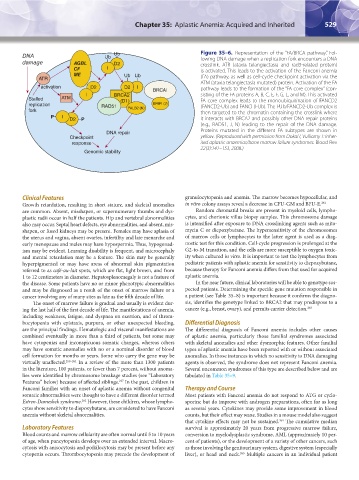
                  DNA                        Ub  Ub                           Figure 35–6.  Representation of the “FA/BRCA pathway.” Fol-
                                                                              lowing DNA damage when a replication fork encounters a DNA
                  damage           AGBL          D2                           crosslink, ATR (ataxia telangiectasia and rad3-related protein)
                                   CF         I                               is activated. This leads to the activation of the Fanconi anemia
                                   ME               Ub Ub                     (FA) pathway, as well as cell-cycle checkpoint activation via the
                       ATR
                                                                              ATM (ataxia telangiectasia mutated) protein. Activation of the FA
                        activation       D2         D2  I     BRCAI           pathway leads to the formation of the “FA core complex” (con-
                                       I         BRCA2                        sisting of the FA proteins A, B, C, E, F, G, L, and M). This activated
                    Stalled    ATM                 (D1)                       FA core complex leads to the monoubiquitination of FANCD2
                    replication             RAD51             BRIPI (J)       (FANCD2-Ub) and FANCI (I-Ub). The I-Ub/FANCD2-Ub complex is
                    fork                             PALB2 (N)                then targeted to the chromatin containing the crosslink where
                           P   I                                              it interacts with BRCA2 and possibly other DNA repair proteins
                                  D2  P
                                                                              (e.g., RAD51, J, N) leading to the repair of the DNA damage.
                                              DNA repair                      Proteins mutated in the different FA subtypes are shown in
                                  Checkpoint                                  yellow. (Reproduced with permission from Dokal I, Vulliamy T: Inher-
                                  response                                    ited aplastic anaemias/bone marrow failure syndromes. Blood Rev
                                                                              22(3):141–153, 2008.)
                                       Genomic stability


                  Clinical Features                                     granulocytopenia and anemia. The marrow becomes hypocellular, and
                  Growth retardation, resulting in short stature, and skeletal anomalies   in vitro colony assays reveal a decrease in CFU-GM and BFU-E. 261
                  are common. Absent, misshapen, or supernumerary thumbs and dys-  Random chromatid breaks are present in myeloid cells, lympho-
                  plastic radii occur in half the patients. Hip and vertebral abnormalities   cytes, and chorionic villus biopsy samples. This chromosome damage
                  also may occur. Septal heart defects, eye abnormalities, and absent, mis-  is intensified after exposure to DNA crosslinking agents such as mito-
                  shapen, or fused kidneys may be present. Females may have aplasia of   mycin C or diepoxybutane. The hypersensitivity of the chromosomes
                  the uterus and vagina, absent ovaries, infertility and late menarche and   of marrow cells or lymphocytes to the latter agent is used as a diag-
                  early menopause and males may have hypospermia. Thus, hypogonad-  nostic test for this condition. Cell-cycle progression is prolonged at the
                  ism may be evident. Learning disability is frequent, and microcephaly   G2-to-M transition, and the cells are more susceptible to oxygen toxic-
                  and mental retardation may be a feature. The skin may be generally   ity when cultured in vitro. It is important to test the lymphocytes from
                  hyperpigmented or may have areas of abnormal skin pigmentation   pediatric patients with aplastic anemia for sensitivity to diepoxybutane,
                  referred to as café-au-lait spots, which are flat, light brown, and from   because therapy for Fanconi anemia differs from that used for acquired
                  1 to 12 centimeters in diameter. Hepatosplenomegaly is not a feature of   aplastic anemia.
                  the disease. Some patients have no or minor phenotypic abnormalities   In the near future, clinical laboratories will be able to genotype sus-
                  and may be diagnosed as a result of the onset of marrow failure or a   pected patients. Determining the specific gene mutation responsible in
                  cancer involving any of many sites as late as the fifth decade of life.  a patient (see Table  35–8) is important because it confirms the diagno-
                     The onset of marrow failure is gradual and usually is evident dur-  sis, identifies the genotype linked to BRCA2 that may predispose to a
                  ing the last half of the first decade of life. The manifestations of anemia,   cancer (e.g., breast, ovary), and permits carrier detection. 263
                  including weakness, fatigue, and dyspnea on exertion, and of throm-
                  bocytopenia with epistaxis, purpura, or other unexpected bleeding,   Differential Diagnosis
                  are the principal findings. Hematologic and visceral manifestations are   The differential diagnosis of Fanconi anemia includes other causes
                  combined eventually in more than a third of patients, but some may   of aplastic anemia, particularly those familial syndromes associated
                  have cytopenias and inconspicuous somatic changes, whereas others   with skeletal anomalies and other dysmorphic features. Other familial
                  may have somatic anomalies with no or a nominal disorder of blood   types of aplastic anemia have been reported with or without associated
                  cell formation for months or years. Some who carry the gene may be   anomalies. In those instances in which no sensitivity to DNA damaging
                  virtually unaffected. 259–261  In a review of the more than 1300 patients   agents is observed, the syndrome does not represent Fanconi anemia.
                  in the literature, 100 patients, or fewer than 7 percent, without anoma-  Several uncommon syndromes of this type are described below and are
                  lies were identified by chromosome breakage studies (see “Laboratory   tabulated in Table 35–9.
                  Features” below) because of affected siblings.  In the past, children in
                                                  227
                  Fanconi families with an onset of aplastic anemia without congenital   Therapy and Course
                  somatic abnormalities were thought to have a different disorder termed   Most patients with Fanconi anemia do not respond to ATG or cyclo-
                  Estren-Dameshek syndrome.  However, these children, whose lympho-  sporine but do improve with androgen preparations, often for as long
                                      262
                  cytes show sensitivity to diepoxybutane, are considered to have Fanconi   as several years. Cytokines may provide some improvement in blood
                  anemia without skeletal abnormalities.                counts, but their effect may wane. Studies in a mouse model also suggest
                                                                        that cytokine effects may not be sustained.  The cumulative median
                                                                                                        264
                  Laboratory Features                                   survival is approximately 20 years  from progressive marrow failure,
                  Blood counts and marrow cellularity are often normal until 5 to 10 years   conversion to myelodysplastic syndrome, AML (approximately 10 per-
                  of age, when pancytopenia develops over an extended interval. Macro-  cent of patients), or the development of a variety of other cancers, such
                  cytosis with anisocytosis and poikilocytosis may be present before any   as those involving the genitourinary system, digestive system (especially
                  cytopenia occurs. Thrombocytopenia may precede the development of   liver), or head and neck.  Multiple cancers in an individual patient
                                                                                           265


          Kaushansky_chapter 35_p0513-0538.indd   529                                                                   9/19/15   12:24 AM

