


Page 553 - Williams Hematology ( PDFDrive )
P. 553
528            Part VI:  The Erythrocyte                                                                                                                           Chapter 35:  Aplastic Anemia: Acquired and Inherited            529


                TABLE 35–8.  Gene Mutations Found in Fanconi Anemia
                Gene                 Chromosome Location  % of Patients  Inheritance  Protein Function
                FANCA                16q24.3              ~65*          AR           FA core complex
                FANCB                Xp22.31              rare          XLR          FA core complex
                FANCC                9q22.3               ~10           AR           FA core complex
                FANCDI (BRCA2)       13q12.3              rare          AR           RAD51 recruitment
                FANCD2               3p25.3               rare          AR           Monoubiquitinated protein
                FANCE                6p21.3               ~10           AR           FA core complex
                FANCF                11p15                rare          AR           FA core complex
                FANCG (XRCC9)        9p13                 ~10           AR           FA core complex
                FANCI (KIAA1794)     15q25–26             rare          AR           Monoubiquitination of FANCD2
                FANCJ (BACH1/BRIP1)  17q22.3              rare          AR           5′ to 3′ DNA helicase/ATPase
                FANCL (PHF9/POG)     2q16.1               rare          AR           FA core complex, E3 ubiquitin ligase
                FANCM (Hef)          14q21.3              rare          AR           FA core complex, ATPase/translocase, DNA
                                                                                     helicase motifs
                FANCN (PALB2)        16q12.1              rare          AR           Regulation of BRCA2 localization
                FANCO(RAD51C/RAD51L2)  17q25.1            Rare          AR           Homologous combination In DNA repair
                FANCP (SLX4/BTBD12/  16p13.3              Rare          AR           SLX4 endonuclease subunit
                KIAA)
                FANCQ (XPF/ERCC4)    16p13.12             Rare          AR           DNA-repair endonuclease XPF
               AR, autosomal recessive; ATPase, adenosine triphosphatase; FA, Fanconi anemia; XLR, X-linked recessive.
               *There are more than 100 mutant FANCA alleles, approximately 40 percent of which are large intragenic deletions. This table was made using
               material from references 251 to 256.

               aldehydes produced by normal cellular metabolism. 255–257  In addition to   The generation of reactive oxygen radicals and aldehydes, the
               the genetic defects leading to DNA instability and an inability to repair   defective mechanisms of DNA repair, the hypersensitivity to cytokines
               DNA, TNF-α and -γ are overexpressed in the marrow of Fanconi ane-  such as TNF-α, and the age-related shortening of DNA-protective telo-
               mia patients.  The excess TNF-α may play a role in the suppression of   meres produce a marked predisposition to clonal evolution and neopla-
                         258
               erythropoiesis in these patients.                      sia in Fanconi anemia patients (see “Therapy and Course” below).

                 FA DNA repair pathway                                                    Other functions in DNA repair
                 FANCA      FA core complex.                                              FANCG/XRCC9  Homologous recombination.
                 FANCB      Monoubiqutinates                                              FANCD2     They form a complex with
                 FANCC      FANCD2 and FANCI                                              FANCD1/BRCA2 XRCC3.
                 FANCE      in response to DNA
                 FANCF      damage                                                        FANCM      Interacts with BLM
                 FANCG/XRCC9                                                              FANCP/SLX4  Interacts with MUS81/EME1 and
                 FANCL/POG                                                                           SLX1. Holliday junction resolvase
                 FANCM                                FANCA      FANCD1  FANCN                       Telomere maintenance
                                                      FANCB      FANCD2  FANCO
                 FANCD2     FA core complex substrates.  FANCE   FANCJ    FANCP           FANCQ/XPF  NER and some HR transactions.
                 FANCI      Monoubiqutinated FANCD2   FANCF      FANCM   FANCQ
                            is required for incisions,                                    FANCD1/BRCA2  DBS repair.
                            TLS and HR                FANCI                               FANCJ/BRIP1
                                                                                          FANCN/PALB2
                 FANCP/SLX4  Nuclease complex.                                            FANCO/RAD51C
                 FANCQ/XPF  Required for incision(s) at the           FANCG
                            site of crosslinked DNA                   FANCC               FANCJ/BRIP1  G quadruplet resolution.
                 FANCD1/BRCA2  Homolgous recombination.               FANCL               Other functions
                 FANCJ/BRIP1  BRCA/RAD51-mediated
                 FANCN/PALB2  repair.                                                     FANCC      Modulates PKR, STAT1, Hsp70
                 FANCO/RAD51C
                                                                                          FANCC      Interact with REDOX factors
                                                                                          FANCG
                                                                                          FANCL      Polyubiquitinates β–catenin
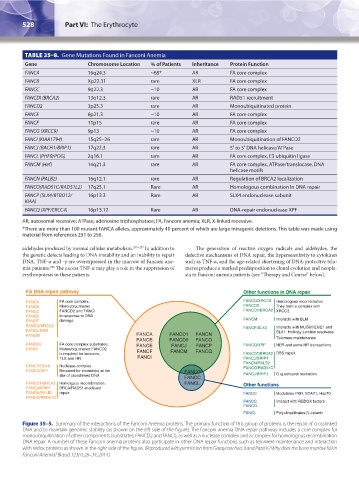
               Figure 35–5.  Summary of the interactions of the Fanconi Anemia proteins. The primary function of this group of proteins is the repair of crosslinked
               DNA and to maintain genomic stability (as shown on the left side of the figure). The Fanconi anemia DNA repair pathway includes a core complex for
               monoubiquitination of other components (substrates, FANCD2 and FANCI), as well as a nuclease complex and a complex for homologous recombination
               DNA repair. A number of these Fanconi anemia proteins also participate in other DNA repair functions such as telomere maintenance and interaction
               with redox proteins as shown in the right side of the figure. (Reproduced with permission from Garaycoechea JI and Patel KJ Why does the bone marrow fail in
               Fanconi Anemia? Blood 123(1):26–34, 2014.)


          Kaushansky_chapter 35_p0513-0538.indd   528                                                                   9/19/15   12:24 AM

