


Page 60 - Williams Hematology ( PDFDrive )
P. 60
36             Part I:  Clinical Evaluation of the Patient                                                                                                                       Chapter 3:  Examination of the Marrow              37


               with more simultaneous colors places greater demand on resources for
               development, maintenance and ongoing quality assurance. Most clini-
               cally important phenotypic markers are analyzed as cell surface proteins
               by directly adding conjugated antibodies to cell suspension, followed
               by washing and lysis of red cells.  Assessment of intracytoplasmic and
                                       73
               nuclear-associated proteins is accomplished after staining for surface
               makers by then fixing cells in suspension and adding the relevant anti-
               bodies in conjunction with a membrane-permeabilizing agent. Some
               lineage-specific markers (CD3 in precursor T cells; CD79a and CD22
               in B cells; myeloperoxidase in granulocyte lineage; cyclin D1 in mantle
               cell lymphoma) are expressed only in the cytoplasm at certain stages of
               development. Fluorescence and light scatter data are stored electron-  A
               ically as list mode data files that can be archived and later reanalyzed
               using appropriate software. As the number of parameters collected on
               individual cells  increases,  standard  ways  of  looking  at  multiple  two-
               parameter histograms of gated cell populations become more difficult.
               Data analysis techniques and automation appropriate to discovery and
               interpretation of multidimensional data sets such as those generated by
               various “-omics” analyses may become part of the multiparameter flow
               cytometry workflow. 74,75  Computational methods for identifying cell
               populations in highly multidimensional data sets have been shown to
               be more effective in reliable and consistent identification of clinically
               relevant cell populations in multicolor flow cytometry than manual gat-
                           76
               ing and analysis,  particularly in the context of a consensus approach
               using an ensemble of algorithms, as is commonly done today in weather
               forecasting.
                                                                      B
               GATING STRATEGIES
               In heterogeneous specimens such as marrow, in which the relevant clin-
               ical population (such as blasts) may be a minor population overall, a
               strategy for specifically identifying the population(s) of interest is neces-
               sary. As discussed in Chap. 2, this is accomplished for blood cells by very
               complex cluster analysis using multiple physical parameters. Because
               the flow cytometer has a much more sophisticated analytical capability
               at the back end with the fluorescent markers, the front-end selection of
               cells is not intended to be definitive, but should include the cells of inter-
               est and exclude nonrelevant cells, particularly those that may create an
               interpretive problem if included in the analysis. This process, referred to
               as gating, is typically accomplished by a combination of CD45 (common
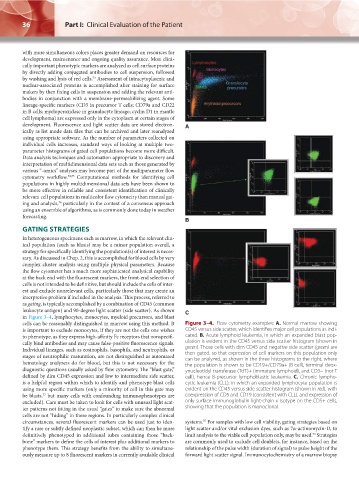
               leukocyte antigen) and 90-degree light scatter (side scatter). As shown   C
               in Figure 3–4, lymphocytes, monocytes, myeloid precursors, and blast
               cells can be reasonably distinguished in marrow using this method. It   Figure 3–4.  Flow cytometry examples: A. Normal marrow showing
               is important to exclude monocytes, if they are not the cells one wishes   CD45 versus side scatter, which identifies major cell populations as indi-
               to phenotype, as they express high-affinity Fc receptors that nonspecifi-  cated. B. Acute lymphoid leukemia, in which an expanded blast pop-
               cally bind antibodies and may cause false-positive fluorescence signals.   ulation is evident in the CD45 versus side scatter histogram (shown in
               Individual lineages, such as eosinophils, basophils, and neutrophils, or   green). Those cells with dim CD45 and negative side scatter (green) are
               stages of neutrophilic maturation, are not distinguished as automated   then gated, so that expression of cell markers on this population only
                                                                      can be analyzed, as shown in the three histograms to the right, where
               hematology analyzers do for blood, but this is not necessary for the   the population is shown to be CD19+/CD79a+ (B cell), terminal deox-
               diagnostic questions usually asked by flow cytometry. The “blast gate,”   ynucleotidyl transferase (TdT)+ (immature lymphoid), and CD3− (not T
               defined by dim CD45 expression and low to intermediate side scatter,   cell),  hence  B-precursor  lymphoblastic  leukemia.  C.  Chronic lympho-
               is a helpful region within which to identify and phenotype blast cells   cytic leukemia (CLL), in which an expanded lymphocyte population is
               using more specific markers (only a minority of cell in this gate may   evident on the CD45 versus side scatter histogram (shown in red), with
               be blasts,  but many cells with confounding immunophenotypes are   coexpression of CD5 and CD19 (consistent with CLL), and expression of
                      77
               excluded). Care must be taken to look for cells with unusual light scat-  only surface immunoglobulin light-chain κ isotype on the CD5+ cells,
               ter patterns not fitting in the usual “gates” to make sure the abnormal   showing that the population is monoclonal.
               cells are not “hiding” in these regions. In particularly complex clinical
               circumstances, several fluorescent markers can be used just to iden-  systems.  For samples with low cell viability, gating strategies based on
                                                                            75
               tify a rare or subtly defined neoplastic subset, which can then be more   light scatter and/or vital exclusion dyes, such as 7α-actinomycin-D, to
               definitively phenotyped in additional tubes containing those “back-  limit analysis to the viable cell population only, may be used.  Strategies
                                                                                                                 73
               bone” markers to define the cells of interest plus additional markers to   are commonly used to exclude cell doublets, for instance, based on the
               phenotype them. This strategy benefits from the ability to simultane-  relationship of the pulse width (duration of signal) to pulse height of the
               ously measure up to 8 fluorescent markers in currently available clinical    forward light scatter signal. Immunocytochemistry of a marrow biopsy


          Kaushansky_chapter 03_p0027-0040.indd   36                                                                    17/09/15   5:38 pm

